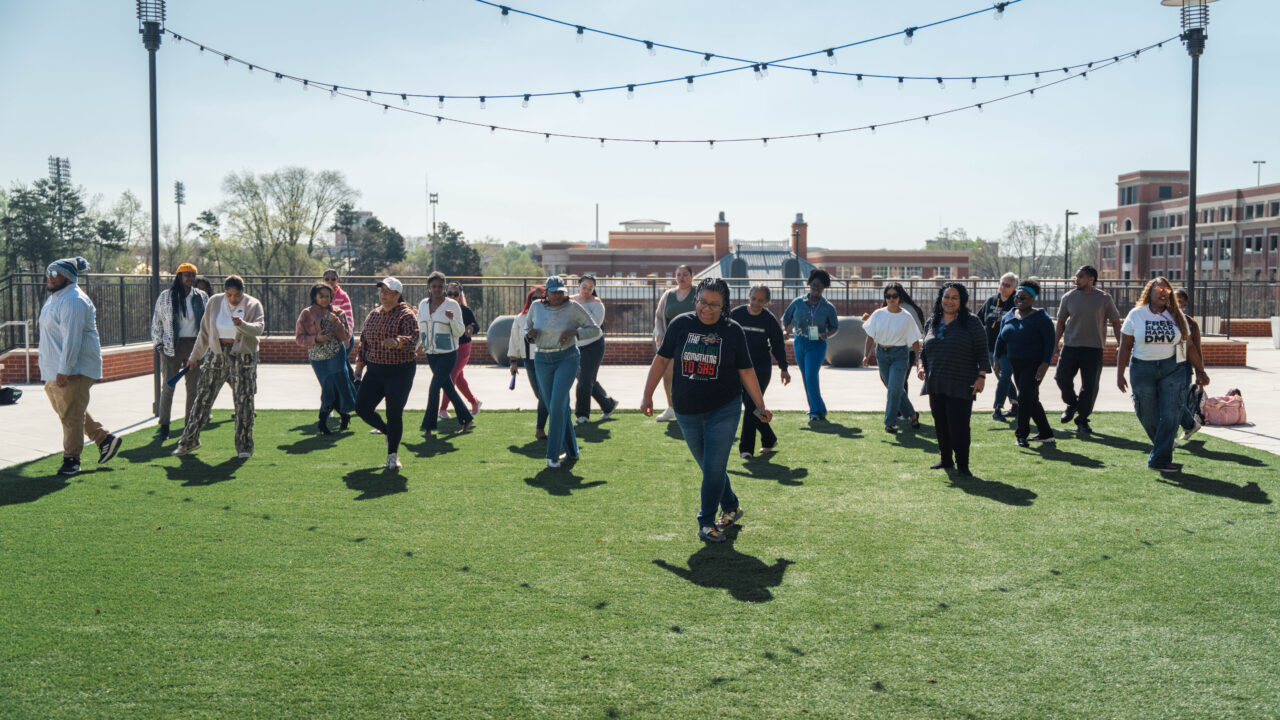
A protest can spark momentum, but only infrastructure sustains it. If we want a multiracial democracy that lasts, we have to fund the organizers, trainers, and educators building it every day.
Philanthropy says it wants to stop authoritarianism. But right now, it is shifting funding from the very resistance meant to stop it.
Across the country, movement organizations are laying off staff. Comprehensive training programs are being dismantled. Political education and leadership development programs—especially for Black, brown, Indigenous, trans, queer, and disabled organizers—are being deprioritized or cut altogether. The very infrastructure that sustains movements is being gutted at the precise moment it is most needed.
What we need now is not retreat. It is a reframe.
This is a “yes, and” moment. Yes, we must resist. And, we must also build the democracy we have never fully realized but still believe is possible. That means investing in vision, not just defense. Community-rooted leadership, healing-centered organizing, and long-term strategies must be part of how we meet this moment. This is how we move from panic to possibility.

If we focus only on fighting back, we lose sight of what we are fighting for. We must invest in the future we want, not just delay the collapse of what no longer serves us.
Philanthropy continues to operate from a scarcity mindset, treating short-term resistance and long-term strategy as if they cannot coexist. As if we must abandon what we have built to respond to what is coming.
There is enough money, people, and imagination to resist authoritarianism and build something better. We do not need to scale back. We need to double down on infrastructure, imagination, and the organizers who are holding the line and showing us the way forward.
Philanthropy’s role in this moment is clear: fund the BIPOC grassroots organizers leading the fight against authoritarianism. There is no path to a liberated, multiracial democracy without deep, ongoing investment in the people and organizations building it.
Today, many funders are turning to political science research that describes this moment as a tipping point when civic institutions, democratic norms, and public trust begin to unravel. A widely used metaphor in this research is the “U-turn”: a sharp, accelerating shift away from democracy and toward autocracy. Scholars emphasize that collective action is essential to confronting this backslide. But collective action alone is not enough. We need a both/and approach: direct action and deep training, rapid response and long-term strategy, mass mobilization and the infrastructure that makes it all possible.
History shows us that once a country completes the authoritarian “U-turn,” the path back is long and never guaranteed. When democratic institutions collapse, rebuilding them often requires massive reconstruction across political, social, and cultural spheres. In many parts of the world, that process has taken decades and depended on sustained organizing and societal reckoning. The lesson is clear: once democracy breaks, it can take generations to restore.
Make no mistake: in the United States, we are mid-turn. The evidence is everywhere. January 6th. Escalating attacks on bodily autonomy. Book bans, voter suppression, political violence. But stopping this authoritarian U-turn will take more than direct action and mass mobilizations. It will also require durable movement infrastructure: training, organizing, leadership development, and political education. A protest can spark momentum, but only infrastructure sustains the movement.
Think of it like highway construction: Departments of Transportation across the U.S. use “design-build” models to accelerate progress—starting construction while still refining the plan. Movements must do the same. The fight against unchecked power requires us to resist and build simultaneously, to construct while we confront. Waiting for the perfect blueprint means delay, and we do not have that kind of time.
However, to philanthropy, long-haul funding rarely feels urgent or exciting. It is a tale as old as time: every election cycle or national crisis sparks a flurry of activity. New funds are created. Rapid response emails go out. Organizers are flooded with expectations and one-year grants. Then the spotlight shifts. The money dries up. And the very people who delivered the wins are left overworked, underpaid, and forgotten.
This isn’t a funding gap. It’s a pattern of neglect rooted in a scarcity mindset. Philanthropy keeps saying, “There’s only enough to fight this fire,” when in fact, there’s enough to fight and to rebuild. What’s missing is imagination.
Black, brown, and Indigenous organizers—especially women, queer, and trans leaders—are being treated as shock troops for democracy, deployed in moments of crisis and discarded afterward. Consultants get more contracts. Institutions get credit. And the people doing the hardest, most relational, most imaginative work are pushed to the margins of strategy conversations, if they’re included at all.
This is not how we build power. This is how we burn it out.
Resisting the U-turn requires a long-view strategy grounded in trust, practice, and imagination. That’s what liberatory organizing makes possible.

Liberatory organizing is a pro-Black, people-centered approach to power-building that prioritizes care, relationship, and community-led governance. It moves us from reaction to regeneration. From transactional politics to transformational change. It prepares organizers not just to protest, but to govern. Not just to resist anti-democratic forces, but to lead with love and clarity in its wake.
At re:power, this is the heart of our work. We train organizers, technologists, civic leaders, and elected officials across the country to step into leadership in ways that are sustainable, not sacrificial. We partner with them to build strategy, digital tools, healing practices, and policy agendas that reflect the complexity of our communities.
And it works.
This year, we partnered with Data+Soul to speak with more than 40 alumni nationwide who had completed re:power trainings. From electoral strategists to movement technologists to governance practitioners, we heard a clear theme: liberatory organizing is not a theory. It’s a practice. And it’s how we survive what’s coming next.
Michelle Pappas, a grassroots organizer in Spokane, shared how she shifted the culture of her coalition by centering healing:
“I’m the founder and lead facilitator of the Housing Coalition, Shaping Spokane Together. At the end of our meetings, we take five minutes to do community breathing because we wanted to provide some healing, recognizing that in these policy meetings, emotions do and should run high.
They all came back the next month saying, ‘I felt more calm and centered going into my following meetings than I had walking out of any other meeting.’ We started with four organizations and are now over 20 strong, and I really do credit that to no one sacrificing any mental health and also feeling like their mental health is maybe boosted by coming to these meetings.”
Cedric Craig, one of our Grassroots Organizing alums, shared how he’s building decentralized voter engagement through trusted networks:
“We began planning and strategizing for our phase three how we are going to actively go about activating our vote for the election. We now have something called our ‘vote power squad’—member leaders use their personal networks to hold house meetings and get another 15 folks ready to vote. We’re already having a larger impact, bringing more folks in. Fifteen signed up for the next meeting, which is higher than the goal of five that we had.”
This is what liberatory organizing looks like. Not just turnout, but transformation. Not just resistance, but resilience. These stories remind us: the work of democracy is not one-size-fits-all. It takes a collective. And it takes trust in the people doing the work every day to bring others along.
And re:power isn’t alone. Many movement organizations are doing vital capacity-building work across the country, training local leaders, organizing communities, and defending democracy not just at the ballot box but in everyday life. These groups are not operating at the margins of the movement. They are frontline infrastructure in the fight for freedom.
Power is built through both local organizing and national infrastructure. Movements thrive when resources flow across the entire ecosystem of organizers, trainers, educators, and builders. This is not the time for false choices or consolidation. It’s time to invest in the full architecture of movement power.
If philanthropy is serious about ensuring democracy’s future, it must fund the conditions that make it possible. Not because it’s nice, but because it works. When movement organizations are resourced, they help organizers recommit to the fight and sharpen their strategy.
The money exists. The political will doesn’t. And that’s a choice.
Now is not the time to pull funding from the very people safeguarding our democracy. It’s time to fund what we’ve built and imagine what comes next. Grassroots organizers cannot fight authoritarianism if they are running on empty. This is the moment to double down on care, on capacity, and on the leaders building the democracy we all deserve. We don’t have to choose between defending democracy and creating something better. We can do both. And we must.