Listen to the interview here.
This interview has been edited for length and clarity.
OPENING
KATHERINE DÍAZ
Hello, welcome. I’m Kathy Diaz, the senior grassroots engagement manager with Liberation in a Generation, which is a national movement support organization building the power of people of color to totally transform the economy, who controls it, how it works, and most importantly, for whom. We at LibGen are beyond excited to partner once again with the team at The Forge to guest edit this special edition.
For this edition, we have curated a group of experts to explore and connect on issues that intersect with corporate power. Joining me for this conversation today is Sofia Lopez with the Texas Organizing Project and Corinne Hendrickson with Corinne’s Little Explorers and Wisconsin Early Childhood Action Needed (WECAN).
Together, we’ll discuss how corporate consolidation has invisible and visible ways of harming the communities they serve and explore how long-term divestment and policy choices prioritize profit over people and have empowered corporate beasts.
COMING INTO MOVEMENT
KATHERINE DÍAZ
I came into organizing in 2016 because I couldn’t stand on the sidelines anymore. A lot of my organizing experience is rooted around demonstrating that, with or without papers, we have political power and the capacity to change the conditions we’re living in by organizing our people.
In 2018, with a team that was 99% undocumented, we ended up quadrupling the Latinx turnout in the primaries of the Georgia governor’s race in which Stacey Abrams ran against Brian Kemp. At the time, I did not realize that normal everyday people with a full-time job and kids, and who didn’t have experience doing this sort of work, could make such a big difference. And I honestly became super addicted to organizing because I was able to see with my own eyes and through my own experience how we were making folks reconsider how they were treating us, how we were proving folks wrong who said that Latine folks just don’t care.
And through that, we demonstrated that our folks do care. However, the system wasn’t designed to be accessible for our folks, and we took it into our own hands to make it accessible by going to our people, talking to them in Spanish, explaining how the process of voting worked, so that they felt ready to vote, if they had papers. And if they didn’t have papers, they were able to see how other folks who couldn’t vote were out there getting others to go out and vote. And we invited them to join us. I was one of the only people on the team that had papers, which demonstrates how much political power we actually do have with or without papers.
And so, as we get started with this conversation, I would love to ask both of you if you could start by telling us what brought you into this work. Can we start with Sofia?
SOFIA LOPEZ
Yeah, of course. What brought me into this work? I grew up in Austin, Texas, with parents who worked really, really, really hard all the time. I was just very aware of that my whole life. But, I happened to go to a school — I think my classmates’ parents also worked really hard — but I just saw that it was much harder for my parents to get ahead. I had a dad who worked nights my whole life as a nurse, just because it would pay a little extra to help bring in more money to put food on the table.
And I remember as a little kid waiting for my dad to come pick me up from school, and sometimes he would sleep through when he was supposed to get there. So, I have all these memories of sitting on the sidewalk waiting for him to get there, but he was sleeping because that was his nighttime, his time to rest. I just remember having this deep burning feeling in my gut that something weird is happening here. As I got older, I became more and more aware of my parents and the ways in which they talked about struggling to get ahead.
I think the thing that radicalized me the most was this lifetime of seeing my parents struggle, but also I got a job working here at the City of San Antonio, and I remember I was working on some zoning case related to a thing that I was assigned. And I remember my boss telling me, “Do you know who owns this piece of property? We give this person whatever they want. ” And I remember thinking, “That’s really weird. Who is this person?” I needed to know. I’m very nosy, very metiche as we say in Spanish. So I had to go look it up and figure out, who’s the person? And it turns out this was someone who was on the board of regents for the University of Texas, someone who had a close relationship with the governor. And I remember thinking, this is some real bullshit. This is who things work for.
They don’t work for my dad, who, for forty years of my life, worked nights every single night. They don’t work for my relatives who live along the border. They work for people who are close friends of the governor, who already have all the money in the world, who can buy land, like prime real estate. I had done a little bit of organizing before, but I feel like that was the kernel that really ignited in me the need to understand how power operates, who has it, who doesn’t, and what we can do to try and take it back for our people.
KATHERINE DÍAZ
Thank you so much. Also, something that you said about the nosiness, I feel like that’s a key trait of good organizers, is that curiosity takes you so far.
Corinne, would you tell us a little bit about how you got into the work?
CORRINE HENDRICKSON
I’m a former family childcare provider for eighteen years. About 13 years ago, I had a child in my family childcare who had some significant special needs, and I tried finding resources and support because our public school system has ways of supporting kids with special needs. Why wouldn’t our childcare system, right? Well, speaking of nosy curiosity and pushing back, our governor at the time was a Republican. I was told by his people below him just to expel this child, and that was not okay with me.
And knowing what I do know about child development, social interaction is so important. That’s really what lit the fire in my belly and got me involved. I had never, ever done anything political. I was taught politics is icky, politics is gross, politics is for those people with power and privilege, because we’re taught to put people on a pedestal. So, I went to a town hall with a colleague of mine and a co-founder of WECAN, Wisconsin Early Childhood Action Needed.
We both said, “What do we even do with this? ” And I said, “I don’t know. Let’s find out. ” The worst that can happen is we go, and it doesn’t work. So we went, we listened to what they had to say. When they asked if anybody there had any questions or stories or needed help, I stood up. I barely got the words out. But I powered through because I cared about this little girl, and I cared about her and our community and her potential. She was three months old. So, it really helped me share that story. Then our Senator John Urbanbach, at the time, came over and he talked to us. He had his assistant talk with us, and we found ourselves at the Capitol within two weeks in a meeting with the powers that be.
The powers that be told us that we could charge the parents more money to hire someone. And I said, “That’s illegal, that’s called discrimination, and it’s against the ADA.” And my friend, Brooke, she goes, “So when we get sued, are you going to go show up in court and get our lawyers covered for us? Because I’m not comfortable doing that, because first off, it’s not right, but second, it’s illegal.” And she backed off really quickly. And then we’re like, “What do you have for supports?” And she said, “Oh, there’s lots of them.” And we said, “Okay, what are they?” “Well, that was a long time ago, and I’m not sure.”
So, after she left, we looked at our senator, and he said, “Well, that got us nowhere, so let’s write legislation.” We never got the legislation that we wanted passed, but because of the work we did with him, they did make some changes to the children’s long-term support system. So, then there was more access to the little tiny support that there was. That’s really what got me started.
And then the two of us started doing “No Small Matter,” a documentary that you could take out on the road, basically. We were presenting in 2019 and 2018 about the lack of childcare. And in survey after survey of big businesses and small businesses, childcare was one of the top two barriers for employment for people and to get more people available to work. So, we pushed back on that. We started our advocacy that way and started building a network. COVID hit, and that’s when Wisconsin Early Childhood Action Needed was born. And we pivoted from, what do we need right now for COVID, to long-term — we need universal childcare — and what is causing people not understand or want to participate? As people who didn’t participate much in our democracy, we got it. We understood it. So, we really just started helping demystify the process and also take people off their pedestal.
I think we’re around 2,500 members now. We keep adding all the time across the state, mostly rural. And it’s because the people in the rural areas feel the most isolated. We’ve had people come to the Capitol that are three, four hours away and speak in hearings. And that’s what we’ve done with WECAN is really help people understand they have the power. This is how this system works. We can break the system. We don’t have to follow these rules because it was created to keep us out. And as long as you’re doing it with this as your goal, you’re being reasonably polite, but you can be honest; that’s helped. And also helping people understand it does not have to be this way. Why do we do it this way? And helps sort of question that because in our culture, we very much don’t like to question the power and the structure, or think that it’s impossible to change. So yeah, that’s my origin.
KATHERINE DÍAZ
Thank you so much for sharing that. I think one more thing that I want to pull out is that both of you were just regular people, and this whole demystifying that we have to be a very special kind of person to get involved, I think that’s one of the narratives that really holds our movement back. Because it honestly just takes being a regular person who is kind of sick of the shit like, “Yeah, I’m tired. I need to go do something because this is fucked up and I don’t want to keep participating.”
IN/VISIBLE IMPACTS OF CORPORATE POWER IN OUR LIVES
I want to get into the nitty-gritty of how corporate consolidation is manifesting in your communities. Corinne, as a long-term childcare operator, provider, and community organizer, can you share about the invisible and visible ways that corporate power has shown up in your work and life?
CORRINE HENDRICKSON
The first and most basic is the cost of things. Because, as we have corporate concentration, your costs for everything go up because there’s no competition. So, insurance is a big one. As more companies are getting out of childcare, fewer and fewer are offering to cover childcare programs. The costs have gone up double for a lot of places, or we’re getting dropped from insurance completely. And when you get dropped completely, as a family childcare provider, a lot of times you can’t find new insurance that will cover you as a business if you don’t also go through them for your home and your other personal items. You must have insurance because kids get hurt, and you’re not going to risk your entire home for a child getting hurt because, again, you can do everything possible, but kids get hurt, right? Things happen.
So what I was finding is we were calling and calling all these different people. We found out that one insurance company only covers up to six children. Well, in Wisconsin, you’re licensed for up to eight children. Then, another company that had been one of the most stellar ones is no longer covering family childcare at all. So one of the people I spoke to kept calling and she finally was able to find a company that would take her, but she had to move all of her other personal insurance over to that company and it was costing her $6,000 more a year, which is $500 more a month and, being in a really rural area, she can’t pass that cost off all onto her parents. So, she’s taking a pay cut to stay open. And she is now working a second job.
Another level is that our group childcare centers are getting letters constantly from private equity firms offering to buy them out. But before they will even talk to you, they make you sign a non-disclosure agreement. And then a lot of private equity firms won’t change the name of the childcare group center they’ve purchased, and they actually keep the owner on as the director for a while. So it appears that there has been no change, but that director then loses all autonomy.
The other thing we found out is that during the Biden administration, the private equity corporations for childcare were outwardly saying yes to investment, but it appears that they convinced Joe Manchin to vote no, along with the Republicans, to kill it, and he received donations from those private equity firms.
Our theory is that the big companies and private equity know that there’s going to be a tipping point where the government is going to have to meaningfully invest in childcare. In the meantime, they’re going to come in and buy us out, and then the money from future large-scale government investments will come in, and they will be able to profit after taking all of us out.
KATHERINE DÍAZ
I think it goes to show how sneaky the corporations are in keeping the heat off themselves and putting the burden of raising the costs on care providers. What you shared makes it really apparent that childcare providers are getting hit from multiple sides, and are being constrained in a way that kind of puts them between la espada y la pared, in a corner, between a rock and a hard place. Thank you for sharing that, Corinne.
CORRINE HENDRICKSON
Yeah, corporations just know that we’ll do it for the kids, and that’s what they’re relying on. And it’s so predatory, and it’s just gross. It, again, goes back to having that spine-stiffening rage and speaking out against it. But so many people don’t want to because they’re afraid that their families won’t approve of them speaking out against things.
KATHERINE DÍAZ
Yeah. But I think that one of the most exciting things about this series is that we get to put a light on the places that most people don’t know about, and that shouldn’t be divisive across any party line because we’re not talking about Republicans or Democrats right now. We’re talking about kids, the people who care for the kids, and the parents. And that shouldn’t be such a politicized thing, especially because who isn’t a worker? I don’t know anyone that’s not a worker, and we all have to go to work. So that means that if you decide to have a family, you also need some support with taking care of your kids.
Okay, Sofia, as an organizer and an organization that is working with people on the ground, how have these issues manifested specifically for your community in Texas?
SOFIA LOPEZ
So, my background is in doing housing organizing, and so, I think of a group of folks that I work with here in San Antonio. There’s some renters who live on the east side of the city. They actually live in what used to be a public housing development, but in the early 2000s, was totally torn down and turned into a public-private partnership. So, we have this senior complex that is operated through a low-income housing tax credit project. For folks who don’t know, it’s a convoluted structure that was created in the 80s as a way to fund affordable housing, but it created these financial entities where now these residents have been living without adequate heating or air conditioning for going on, I think, three years at this point.
I think everyone who lives there is over the age of sixty, if I’m not mistaken. And there were stories last winter of them sleeping with the oven on and the door open, like curled up to try and stay warm during a cold snap that we had. And when these residents are organizing, when they go, and they point the finger at who’s responsible, what I appreciate so deeply is they’re very clear. There is a corporation that is keeping them from living with the dignity they deserve, having worked their whole lives, now living out their golden years, their corporate landlord continues to tell them, “It’s too expensive. We can’t get this air conditioning system fixed. It’s too complicated.”
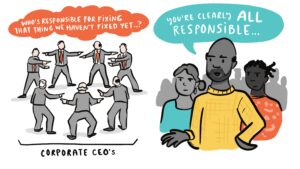
But because there is this complex tax credit structure, it’s like that Spider-Man meme, like everyone is pointing the finger at everybody else, and no one wants to take any accountability for it. All of this just keeps us running around in circles, trying to distract us from the fact that there’s a corporation that makes billions of dollars every year. They have the ability to give these seniors in this complex working heat and air conditioning if they wanted to, but it’s a matter of corporate greed.
There are too many examples to name. I think in Houston in 2024, there was a hurricane that hit, Hurricane Beryl. Over two million people lost power. Like it’s a natural disaster, okay, fine. Maybe people are going to lose power in a large hurricane. But we had members of our organization who were without power, again, seniors, for two weeks. People died because it didn’t get fixed. And the company that maintains the lines that same year had over a billion dollars in profits.
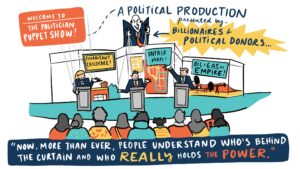
We also know the way that politics exist in this state; we don’t have campaign contribution limits. And so, who are the people who donate the most, who are the ones who get to dictate what this state actually looks like and continue to push it further and further to the right? By and large, it’s oil and gas billionaires who are not accountable to anybody. And I feel like it’s been pretty well documented. We are living in their vision of what Texas should be. Not the vision of our members. Not the vision of ordinary working-class folks.
We’ve got all the money that we need in this country. We’ve got all the money we need in this state, frankly, but it’s completely in the wrong hands. It’s not serving our vision. So what do we have to do? We have to organize to take the power that we deserve and win the state and the country that’s going to serve our people’s interests.
KATHERINE DÍAZ
I have so many feelings. And I think that what’s so beautiful about organizing is that it’s a bunch of people coming together to say, “I think it’s time for us to create our vision of what this can be, and together we can do it.” And I think that you both have pointed out how corporations are turning our lives upside down and folks at the top of these corporations are getting rich while sucking us dry at the same time and that it is legal and that there’s so little protection for small businesses and the everyday person and that there’s no accountability for these massive corporations and the violence that they inflict on us every day.
INFLUENCE OF OUR POLITICAL LANDSCAPES OVER CORPORATE POWER
I want to talk more about what you both began to talk about, about how your political landscape has influenced these matters, and in what ways have policies in Texas and Wisconsin exacerbated corporate greed, and/or how are they contributing to diminishing corporate greed?
So, Sofia, in Texas, it’s home to ultra-conservative billionaires. How have they influenced the political landscape, and whether corporations are held accountable?
SOFIA LOPEZ
I think one of the most frustrating parts about living in a state like Texas is that we have so much going for us. It’s a beautiful state. I’m a proud Texan. We’ve got a huge population. We’re the size of some countries. We’re booming with Texas pride.
I think as an organizer, I stay very rooted in the fact that there are more of us. There are more people who want the state to work for us than there are people who want a state that is the vision of ultra-right-wing, often Christian nationalists. And, as organizers at the Texas Organizing Project, we’ve notched some pretty important wins along the way. But I think one of the things that can be incredibly frustrating is that we’re a state that has preemption. And so when we do that good local organizing work, oftentimes the kinds of wins that we notch can be seen as a threat. I remember recently in Houston, there was a pilot in Harris County to give people a universal basic income. And maybe it wasn’t quite universal, but there was a small pilot program to get cash to folks. And we know there’s so much research that shows when you give cash directly to folks, it improves their life outcomes.
Well, I think our attorney general decided he didn’t like that program, and so basically got it shut down. So we’ve got this cycle that happens all the time, where cities and counties want to try things that are going to make people’s lives better. Oftentimes, in response to people actually demanding it or naming the things that are going to improve their living conditions. And then we’ve got these three folks who decide — and when I say three, I mean our governor, our lieutenant governor, and our attorney general — who decide that this doesn’t reflect the Texas that they want. And so, they work to kill it. And who are they doing that on behalf of? It’s not on behalf of their constituents. It’s not on behalf of regular ordinary people. It’s in the service of their political donors.
So we’ve got a pretty broken system here that keeps our folks in pain, and there’s no way for us to fix it but organizing and building exactly that large enough base. And I’m really, I’m inspired by what Corrine’s describing, this focus on organizing across the state, because it’s going to take more than just little pockets here and there. It takes all of us.
KATHERINE DÍAZ
Corrine, would you like to jump in? Thank you, Sofia, for that answer.
CORRINE HENDRICKSON
Sofia, it’s almost like they see that it’s working and they are threatened by it, and so they have to shut it down. In Wisconsin, when the Tea Party came through, and the more right-wing conservatives were able to get the trifecta here in our state, they immediately changed maps after the census. So it was impossible for the Democrats to take back over. And they also campaigned on local control, but as soon as they got enough power, they actually took that levy ability away and the sales taxability away from the local communities. So, it’s impossible in Wisconsin to even try things like that in certain counties or communities, or even raise the minimum wage. They changed the rules to keep the people in power.
We also have some very rich people who keep our state elected representatives in power by writing out large checks. We have decent campaign contribution limits on our state campaigns, but the money coming in from the outside or the money that gets funneled through the Democratic and the Republican campaign committees, they can write a check out to them, and then they write checks out to the candidates, and there’s no limit on that.
Sofia, like you were saying about things that divide people and make people angry, and give somebody to blame instead of the people in power that are doing the things to us. It’s very divide and conquer. Our state budget, the last three times, so six years, has taken money away from our public schools. This year, they got a $0 per student increase, but the private voucher schools got $680 more per kid. So every school district’s going to a referendum, and it’s increasing property taxes.
And then the same thing with childcare. They refused to invest anything, replace any of the federal dollars coming in with state dollars, even though we proved that it worked. We proved that investing in the programs meant that teachers could get paid better and stay, more programs would open, and it’s now going exactly the opposite way as we all screamed it would because they didn’t invest. And actually, I closed my business last August because of the budget. It was going to be an extra $40 a week for me to raise my rates for my families or I was going to have to take the pay cut. And as much as I’ve been basically screaming it into the void that we have to stop martyring ourselves, we have to stop allowing this to happen to us.
But I think across the country, we’re all running into the same things. It’s the corporate power. It’s the money. And it’s the lack of people in power who have the guts to say to the party, “No.” Because I’ve had that too, multiple Republicans say, “Well, I get it. It’s a problem. It’s costing me a lot of money, but my leadership won’t let me vote for this.” And I’m like, “Who? What?” But it comes down to the leadership that can make sure that they keep their seat because the leadership can then use money to oust them or to keep them. And so it’s like, really, I think at the core, Citizens United is really what took us down this rabbit hole and has allowed a lot of this to happen.
SOFIA LOPEZ
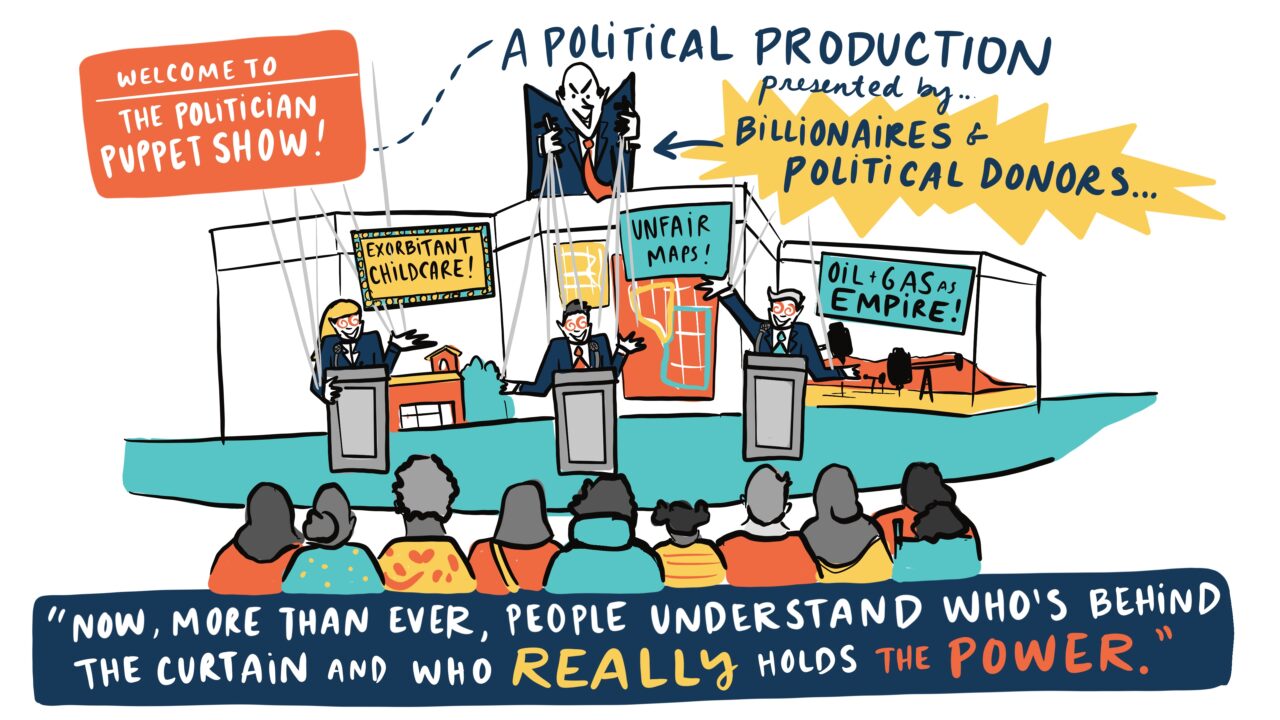
It seems like now more than ever also people understand who’s behind the curtain and who really holds the power. I was telling someone recently that when I was having organizing conversations, and I would talk about billionaires, people would say, “Well, should I blame them that they were successful in their business?” Yes. You should absolutely blame them for exploiting workers, for exploiting renters, for exploiting family, all of us, right? But that was a much harder conversation to have with people than it has been within the last year. And so, just to your point, I think people now are more intuitively understanding what’s driving up their cost of living, making it more difficult to live in this country, all the ways in which things are breaking down. And it’s because of a bunch of billionaires scratching each other’s backs and enriching themselves off of our suffering.
NAVIGATING THE CONTRADICTIONS OF OUR CURRENT ECONOMY
KATHERINE DÍAZ
Because corporate power is so expansive and it’s so ingrained in our economy, we often find ourselves interacting with the very corporations that we’re fighting against. So, given this, how do you personally navigate the contradictions of the world that we are forced to live in, where we may have to do business with these awful corporations while we are also fighting them?
CORRINE HENDRICKSON
It comes down to doing the best that you can. So as much as I can, I try to make sure that I go to the smaller businesses, the independent people, the people that I know share my values, but there are times when you don’t have another option, right? So, giving yourself grace and understanding that you’re doing the best that you can with what you have, and also still fighting in the ways that I can to cut down on corporate concentration and monopolies, and fighting for fair taxation.
I think corporations need to have parameters on them. Capitalism isn’t necessarily bad, but in our version right now, capitalism relies on exploitation. Exploitation of people and exploitation of resources. Our government is supposed to protect the people and protect the resources. It can protect by putting parameters around the corporations, holding them accountable, making sure they follow what they’re supposed to follow, and fine them appropriately when they don’t, along with that taxation, and not be so afraid that if they put parameters on a corporation, they’ll leave. Because if they leave, there’s a lot of small businesses that will bubble up and take their place to fill that need.
I think that so much of our economy and so much of our government runs on fear. We’re afraid of change. We’re afraid of things not existing, and that it will make our lives harder. But I think we’re at that inflection point, again, where I don’t know how much harder it can get. And so, this is our opportunity to say, “Look, you rich people, you billionaires, trying to become the first trillionaire. It’s at the point where your business is going to implode here pretty darn soon because nobody is going to be able to buy things.”
SOFIA LOPEZ
Yeah, I think my take on this question is that, in this country, we spend so much time talking about individuals as the problem and not systems. I think on a personal level, I do what I can. There are places that I don’t shop at. Actually, I feel like I’m one of the few people I know who doesn’t have an Amazon account. There’s a whole system that exists to meet the needs of someone who needs something immediately.
Now, I’m not here to judge people who do, right? That’s not a way that we build a movement. I think the way that we build a movement is by doing things like deep political education to help more people understand systemic and structural problems, and then creating plans together to try and make the sort of change we need. I feel like people in the climate change segment of the movement are way ahead of the curve on this because I think that those folks understand, yeah, individual choices are important, but what matters a whole lot more are the ones that we can make collectively, and also the actions that people who have all the power are taking.
KATHERINE DÍAZ
Yeah. That was something that I saw so often when I was on the ground was people blaming each other. And I’ll give a quick story. I took my kid to urgent care, and now I have insurance through my job, but I was a server for ten years, and then I didn’t have insurance. So, I only went to the doctor when it was like, “I think I’m going to die.” I’m so lucky that with my kid I have insurance. I go, and there’s one person in front of me; we’re the first two people. As soon as the doors get unlocked, she had a child who probably was like ten years old. I heard the woman say to the front desk person, “I don’t have it. I get paid tomorrow.” And then the lady said back to her, “We can’t let you in if you don’t pay.” And then she was like, “Please, I can pay tomorrow.”
And I was wearing my LibGen bag that said, “Fix systems, not people.” And she walks out, I go outside, and I’m trying to get her attention. I finally get her to turn around, and she’s bawling. The last question she asked inside was, “What am I supposed to do with my son?” And the lady shrugged her shoulders, “I don’t know.” She’s bawling, and I’m like, “How much do you owe? How much do you have to pay?” And she said, “$36.” And for $36, they weren’t going to take care of her child.
The fact that somebody owns this and is making so much money and never has to worry about $36 to take care of their kid, and you are sitting here blaming yourself. I was like, “Put the anger and the shame on them. Shame on you, that we are letting ten-year-olds who are having heart palpitations go home because of $36.” And then we figured out a solution, and she just kept saying, “I’m sorry. I’m sorry.” And I grabbed her arms, and I said, “You don’t have to be sorry. I would love for you to be mad with me, because this is bullshit.”
The fact that somebody owns this and is making so much money and never has to worry about $36 to take care of their kid, and you are sitting here blaming yourself. I was like, “The best way for you to thank me is that you don’t blame yourself. Put the anger and the shame on them. Shame on you, that we are letting ten-year-olds who are having heart palpitations that are irregular go home because of $36.”
CORRINE HENDRICKSON
Yeah. Getting rid of that guilt and shame, as if it’s on you. It’s not. It’s on the systems.
WHAT IT WILL TAKE TO WIN
KATHERINE DÍAZ
I think, leaning into folks that are building power together, would y’all share what are some transformative policy alternatives that you are either helping push forward or keeping a pulse on? And how are your communities and relationships with them?
CORRINE HENDRICKSON
So we’re really working on centering anything that’s going to strengthen families and children here in Wisconsin, because I think if we can get childcare and we can get public schools invested, that takes a huge burden off of our families. It takes a big burden off of our communities, and it takes a big burden off of even our small business owners being able to recruit and retain, or even start a business themselves.
SOFIA LOPEZ
That’s great. And I think for us here, in Texas, we’ve just ended a process where we have done a year of deep listening. We’ve been running multiple campaigns, challenging corporate power, challenging mass incarceration. Meanwhile, we have been doing deep listening with our folks to understand, okay, “So if there’s one thing that is going to make your life better for you and your family, what is that one thing?” And another way we talk about it is, “What’s the thing that’s going to motivate you? What do you care so deeply about that you’re going to get out of bed at six in the morning on a Saturday and go to the Capitol?” What is that thing that is just burning deep in your heart?
All told, we talked to about 1,500 people. In the first round of conversations, we heard that people are fed up with the cost of living. They just need more money in their pocket and lower costs. And they specifically named housing as an issue. They named healthcare. They named childcare. But they also pointed to the fact that they just don’t make enough money. We don’t make enough money to begin with. And so, we workshopped potential campaign ideas. And the things that people told us they really wanted to fight on were a massive investment in affordable housing, affordable healthcare for everybody, taxing the rich—which I didn’t expect, like particularly large billionaires, making them pay their fair share. And the last one was increasing the minimum wage because down here in Texas. We’re still stuck at $7.25. So we’re doing more deep listening to understand, okay, what are we going to fight for first? What are we going to go to bat for? What’s the thing that people are going to wake up at six o’clock in the morning on a Saturday to go fight for?
I learned very early that the most beautiful policy in the world doesn’t mean a thing. It’s not worth more than the paper it’s on if real, actual people aren’t the ones making it happen, right? If they’re not the ones who are going to go to bat for it. So make no mistake, we’ve got to listen to our folks to get the direction for what the policies are that we’re going to win.
ENGAGING IN THIS WORK
KATHERINE DÍAZ
For folks who may be listening who have not been involved and are eagerly asking, “What do I do?” What is one call to action that y’all have for them in this work to remove corporate power and elite wealth from our housing, our neighborhoods, our healthcare, our childcare, and our communities?
CORRINE HENDRICKSON
I would say just start and pick the one thing that you’re most passionate about. Find people that you know who are connected to things and ask them, and they will get you connected to the appropriate group. The biggest thing is that so many of us feel passionate about so many things that we get lost in all of it. Like Sofia said, “What’s one thing that would change your life the most?” Find the resources that are connected to that. That’s what you can then focus on, and that will get you started.
SOFIA LOPEZ
Absolutely. I think the thing I keep saying is talk to your neighbors. I was having a long conversation with someone yesterday. A lot of us are isolated, and much of that is by design. We’ve got a lot of things competing for our attention, and we’re increasingly actually disconnected from one another. And I think we’ve got to be building together. We’ve got to create relationships that are rooted in shared and common interests, and to also constantly be asking the question, “What’s going to fix this?” And don’t be satisfied with the first answer that you come up with. We’ve got to push one another. We’ve got to embrace tension and healthy conflict because that’s how we get to shared values and a shared vision for things that we can fight for together.
CLOSING
KATHERINE DÍAZ
Beautiful. Thank you both so much, Sofia and Corinne, for taking this time out of your super busy lives and organizing your communities. And thank you for allowing the listeners to get a peek into your beautifully resistant, creative, and strong community and letting us know how corporate greed is impacting them and how you guys are fighting back.
For more conversations like this one, visit forgeorganizing.org. And for more about Liberation and a Generation, check out liberationinageneration.org or email us at partnerships@liberationinageneration.org. Thank you to Nino Fernandez for audio post-production and editing.