Listen to the interview here.
This interview has been edited for length and clarity.
OPENING
JEREMIE GREER
Hello, welcome. I’m Jeremie Greer, co-founder and co-executive director of Liberation in a Generation. LibGen is a national movement support organization that builds the power of people of color to transform the economy, who controls it, how it works, and most importantly, for whom. We are beyond excited to partner once again with the team at The Forge to guest edit this special edition on corporate power. For this edition, building on previous efforts to bridge between anti-monopoly researchers, policy advocates, and grassroots leaders of color, we’ve curated a group of experts to explore and connect on issues that intersect with corporate power.
The discussion today is going to be about how we — us in the movement — engage and connect with folks most close to the impacts of corporate power. We’ll be talking about how to engage communities, how to empower communities to fight against corporate power, and we’ll be talking about some of the political and policy solutions to push back against corporate power and how we as a movement can really think strategically about how to do this work.
I’ll be joined in the conversation today by Dania Rajendra and Andrea Dehlendorf. Thank you both for joining.
Dania was the founding director of Athena, a broad coalition of local and national organizers representing working people, small business people, people of color, immigrants, and neighbors. She’s a poet and essayist, a born-and-bred New Yorker, a frequent speaker on racism, antisemitism, economic justice and injustice, and the political right. Dania has served as a board member of the International Labor Communications Association, Political Research Associates, and Jews for Racial and Economic Justice. She was also a longtime member of the advisory board of In These Times and now sits on the international advisory committee or board for the Diaspora Alliance.
Andrea has worked as a labor organizer and campaigner at SEIU, Unite Here, and the UFCW, contributing to major victories with people working in the most unstable and precarious low-wage service jobs, from janitors to hotel workers. She co-founded and led United for Respect, a national organization that builds power for people working in low-wage jobs. She was part of the team that launched Athena, a multi-issue coalition that brings together workers and impacted communities to challenge Amazon’s concentrated power.
WHY JOIN THE FIGHT TO CURB CORPORATE POWER?
Welcome both. Thanks for joining us.
So we’re going to have a lot of conversations about how you engage communities, communities of color, communities that are impacted by corporate power, but what engaged you? Why did you join this fight to curb corporate power? Andrea, I wonder if we could start with you.
ANDREA DEHLENDORF
Thank you so much for hosting this critical conversation. So I’m going to start early. I am not from an elite, super-wealthy family, but my parents sent me to an elite private school where, frankly, the ruling class was being reproduced in my city. And so I saw firsthand, very young, the kind of entitlement that came from the top echelon of elites in our society. And to give some flavor to it, when our football team played the urban, mostly people of color, football teams, they would chant in the stadium. “It’s all right. It’s okay. You’ll all work for us one day.”
So even though my parents sent me to the school, they gave me good values, and I emerged from that, not wanting to join them, but rather build power to contest and redistribute from them, and I was a bit confused about where I fit in that. I didn’t see myself as a leader of low-wage worker movements and discovered this thing called organizing, where I could be in solidarity and support the leadership of the most impacted communities by the unequal economic structures of our society under racial capitalism, and have been doing that work now for thirty years.
JEREMIE GREER
Yeah, oof, I’m glad I wasn’t at that football game. Good God. Dania, so how about you?
DANIA RAJENDRA
Well, the short answer is I was kind of born into it. My mom was a red diaper baby, so I am the inheritor of the American communist Jewish left tradition. And my dad was an immigrant from India. He was born a colonial subject. His uncles were active in the Quit India Movement and the struggle for independence. The other reason I’m in it is because when I was a young person, things were, I guess, better than they are now for the most part. But they still sucked. And I think we can do better. And I still think that. And that’s a lot of work, so that’s why I organize.
JEREMIE GREER
On this issue of corporate power, for me, I was working at a national think tank, and our board was just a corporate board. And it was 2016, and I never thought anything of that because they were kind of not present in the work. And we kind of did what we thought was right, and we didn’t hear from them. And then when Donald Trump nominated Steve Mnuchin to be the Treasury Secretary, we wrote this statement against it. And in the statement we used a quote that somebody else had coined, calling him the foreclosure in chief.
The board lost its mind and basically read us the riot act and lectured us on why that was something that we shouldn’t do. And I remember vividly, because I was in a taxi going from JFK to Midtown Manhattan at the time, and the call was that entire length of that ride, like forty-five minutes to an hour from JFK, and they just read us — read me in particular — the riot act the whole way. And it was this awakening for me that, like, “Oh, that’s who I work for here.” And it was like this vivid illustration for me about, like, “Oh, this is what they mean by corporate power.” I had never really thought about it.
And it was a moment for me that it’s like, “Oh, well, you can’t use the resources if they are at the root of the problem that we’re trying to solve.” And that was what I quickly moved to get out of. So that’s my story in a nutshell. And thank you both for sharing yours.
WHAT AGENCY OR IMPACT DO EVERYDAY PEOPLE HAVE IN THE FIGHT AGAINST CORPORATE POWER?
As we get into the discussion, I want to hone in on kind of where we are today. It feels to me like there’s a real consolidation of power happening right now. Like you see it kind of in ways that used to be underneath the surface, that is just happening in the mainstream right in front of us, whether it’s an oligarch joining the government to shut down all the agencies that regulate him, in the case of Elon Musk. And then there’s two mega billion-dollar corporations in Netflix and Paramount fighting over another mega billion-dollar corporation in Warner Bros.
And it seems that, from an outsider’s perspective, I can understand why someone would look at all that and feel like kind of one of the subjects in the Game of Thrones. There’s this battle happening in the castle, and I’m not a part of it, and I’m not in it. So what’s it got to do with me? And kind of shrug your shoulders. So I said all that to say, in this moment of consolidation, why should people feel like they have any agency or can impact these issues or these fights around corporate power?
ANDREA DEHLENDORF
Yeah, I’ll jump in with an experience that I had early in my career that convinced me both of the necessity and the appetite that people actually have to fight back around this. So, starting in 1998, I worked with the movement called Justice for Janitors, which was organizing at a time when much of the labor movement was not invested in organizing immigrant workers. The real estate industry had gone from employing direct in-house janitors who were mostly Black and subcontracting that work and hiring immigrants that were fleeing from the wars in Central America and coming from largely Mexico. And so they just abdicated responsibility for that as a strategy to break the union and keep more of their capital.
The strategy that the architects of that campaign and Stephen Lerner, Rocío Sáenz, Jono Shaffer and others had a theory that we were not going to win on the level of fighting the contractors, but that the fight was going to be by taking the fight to the highest upstream source of the resources and capital who were really pulling the strings and making the decisions. And I was hired, I’d been an organizer, but I did a stint as a researcher, and my first project was to spend a year with a committee of members of janitors on an analysis of the corporate structure and financing structure of the real estate industry and what a strategy would be to contest for that.
I was part of a second wave of this organizing. And in this wave, we did a citywide strike of about 10,000 janitors that included the most extraordinary protest I’ve ever been a part of, which was 10,000 people marching from downtown to Century City, for those who know LA. The strike started with a smaller group of janitors, but people literally were coming out of office buildings. We took the march on a detour through Beverly Hills, which was incredible. So we had landscapers, maids, we had construction workers standing on the roof, cheering us on. And by the time we made it to Century City, they evacuated it. They were so freaked out that they sent everybody home at the middle of the day from Century City, and we just had a great big picnic on the lawn. It was incredible.
And what was extraordinary was that because we had done this process, people who maybe started out thinking, “My fight is with the janitorial subcontractor,” realized, “Oh no, there’s five major corporations that own this market. We’re going to bring everybody to those five places.” And by the end of that, the building owners themselves came to the table, organized by the Republican mayor, Richard Riordan, I believe, to make a deal to raise standards and give health insurance for janitors. And it really showed me both why, if you want to win, you have to go at the money if you’re serious about redistribution of resources and power. You can change the political climate by having those fights and redistribute and raise standards for people, and transform the orientation of even conservative Republicans.
I think it made me realize that, on the one hand, I agree with you that the problems are so overwhelming that there is a frozenness that happens. But when we are very intentional — and I think ACRE (the Action Center on Race and the Economy) Bargaining for Common Good, and Athena are masterful at really building these conversations from the bottom up — when we take the time to do that, and we give people something to focus on that isn’t just a policy win but centers corporate power, people will activate. And how do we, as people who are positioned to provide leadership within the progressive movement, do more of that is really the question to me.
JEREMIE GREER
Yeah, when you’re talking about targeting these five actors, it sounds like there’s a real critical lesson that made that more bite-sized than this big thing. I wonder, is that the experience in that?
ANDREA DEHLENDORF
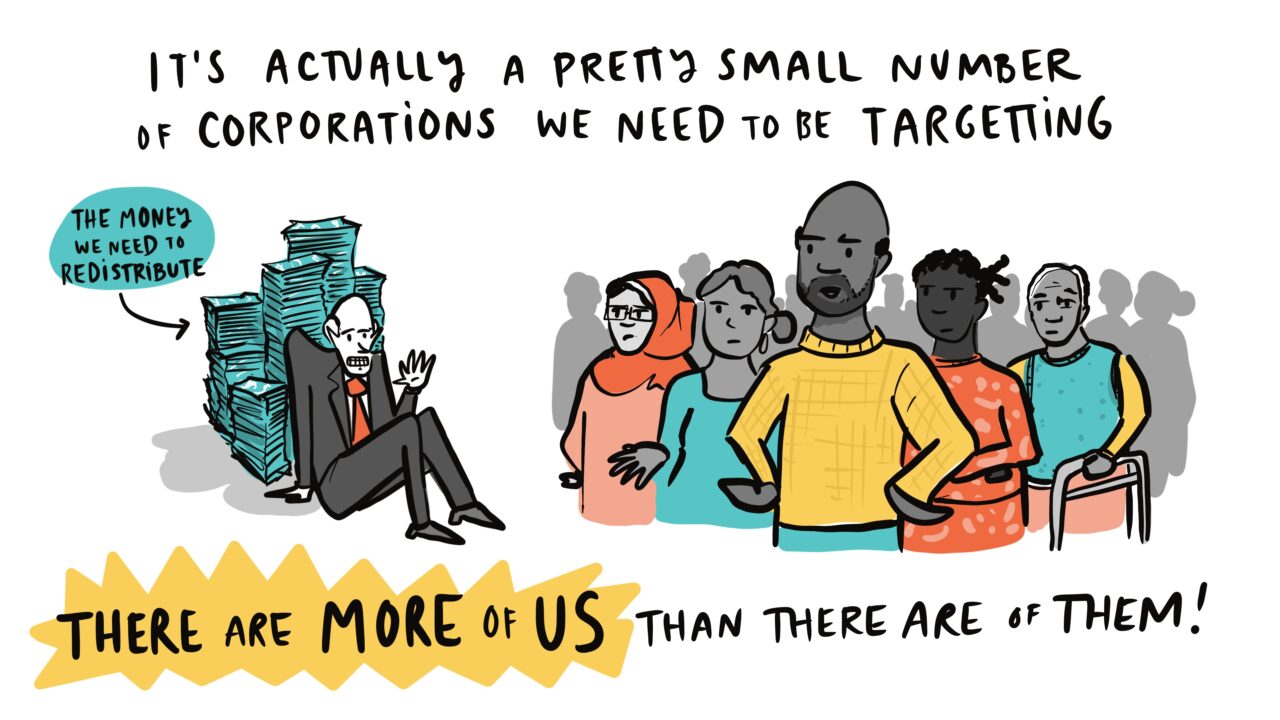
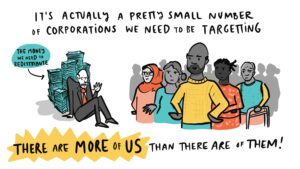
Absolutely. I think your point around the consolidation that’s happening with corporate power in this era is that it is a relatively small number of people. We’ve all watched the tech capture — it’s seven companies ultimately that decide and control everything that happens. Amazon is one of them, and it’s not that big of a group if we are able to really, really focus our energy and our campaign capacity to take them on.
JEREMIE GREER
Dania, what are your thoughts on that?
DANIA RAJENDRA
Yeah, I mean, one of the things that Andrea said that I want to pick up on is, we were talking earlier about the responsibility piece, and in my experience working and organizing and hanging out with people across the class spectrum, there’s a very strong sense that we are responsible for ourselves and each other in this work. That is not my experience, as I didn’t grow up in the upper echelons of society the way Andrea got to, but I did grow up in the 80s and 90s in the suburbs of New York City, so that’s probably pretty close. And I remain struck at how little responsibility people feel like they have to take for what’s around them. And I think that was really a stark contrast in the New York City mayoral race between Zohran Mamdani and Andrew Cuomo. So part of my answer is that people want to be responsible to each other, and it is the job of movements to make that possible.
I think the other thing is that, like I said earlier, this sucks. And “this sucks” is kind of a flat way to be like, we’re in a poly crisis. The earth itself is changing. We will have massive numbers of people displaced. AI is draining every possible body of water across North America as fast as it possibly can. It’s tremendous what we’re up against and it is possible that we won’t have the agency to fix it. But it is definitively true that if we do not try, bad things are definitely going to happen, and so we should try.
BREAKING THROUGH & EMPOWERING PEOPLE IN FIGHT TO CURB CORPORATE POWER
JEREMIE GREER
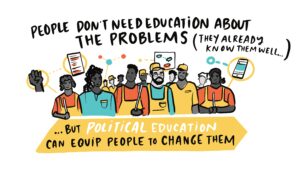
There’s a thread between the story you told, Andrea, and your provocation, Dania, that feels like an organizing problem. People kind of start from a place of having to explain these problems to people, and my gut tells me that people kind of already know the problems exist; they don’t really need the explanation. So what we do is we bring these academic conversations to them in order to kind of teach them about why corporate power is an issue. And to me, it just feels like it undermines the effort when we do that. Maybe I’m off. Maybe I’m wrong. But I feel like people know that these things are messed up and that something has to be done.
DANIA RAJENDRA
Well, I think that it’s hard not to feel like, when we say consolidation of power in the capital markets and in the consumer markets and in the labor markets, what that means is everything just gets more messed up, and no one can fix it. So the airlines consolidate and your flight gets canceled and you call the customer service people and they can’t really help you. They recognize that it’s a mess. You’re stuck in this conversation. No one can do anything about solving this problem. And I think that people do experience all of the ways in which we have that incursion into what should be pretty easy, and actually could be pretty friendly as corporate power.
And I think, at least as I recall our experience as Athena, we did better in bringing people into the weeds of antitrust policy at the FTC (Federal Trade Commission) by starting with people talking about how they experienced this concentration of power themselves and then following through, like, “Well, how did it get to be like this?” Because the part that most people don’t know, because most people don’t spend time thinking about the history of antitrust, is that it wasn’t always like this. In fact, it wasn’t like this not that long ago. People made this happen, and we can make something else. The “how people made this happen, it seems so normal,” part is a place where I feel like political education has a place.
ANDREA DEHLENDORF
I also think, Jeremie, you’re getting at a question of what kind of political education is needed and how it is delivered. And I want to be clear, when we did this process with janitors in 1998 and 1999, it was not me in front of the room teaching people about corporate power. It was me facilitating a process that was drawing from the lived experience and analysis that people had developed on their own around all of this. And I really believe that working-class and middle-class bases of people are far more clear around the way corporations are shaping their lives, which I think Dania just said brilliantly, and it’s not reflected necessarily in the quote-unquote institutions and leaders of the movement.
We have a Democratic party dominated by centrists. When we were organizing people at Walmart, they loved Bernie but you couldn’t sell them Hillary Clinton, who’d been on the board of Walmart, who refused to disavow or criticize Walmart. And so we have, I think, a problem of not building enough containers, campaigns, and movements to channel what people know and understand to be true. I am paying, right now, particular attention to how this is playing out in tech. We have a consolidation of the tech industry, where part of it is a business model that’s based on capturing the media and using that to control what discourse is out there. The other is that there’s no return on investment right now on AI, so their whole strategy is to replace and degrade jobs, build and monetize an internal domestic surveillance state, and increase international military action. It’s about taking over public service administration and benefits administration, to eliminate those jobs and gut the public sector, and replace it with AI, Big Tech.
And then they’re all moving this through, building these data centers, which are just wreaking havoc on communities. And I was talking to somebody who runs a network around rural organizing, who said it is the number one issue that is coming from rural communities. And you know what? Funders aren’t funding that organizing. The national coalition connecting local fights is coordinated by Athena and AI Now, who have been first movers on these strategies for quite a while, and there is no resourcing to do it. And you’ve got this weird faction of MAGA who is out there talking to people about tech power, but you do not have very many Democrats who are at all. And so I think we have a real disconnect between the issues that animate the base.
And another example: Bezos, Zuckerberg, and Musk have the highest unfavorability of practically anybody right now, and we could be making so much energy and movement around that anger and frustration. Polling in California showed that people don’t love AI. What they say is that they do not trust the elite corporate actors who are controlling AI. That is the foundation of a movement. And really, the only comprehensive effort linking all of this together, and galvanizing and organizing base groups, is Athena, which has been doing this for a decade. And I think this was really missing from the corporate consolidation movement. It was very DC-focused, but we didn’t build a movement to undergird it. And so it was very easy to have this backlash with Biden because there was no power behind it, and there was no accountability.
And so the industry could very easily sort of turn to the right, and I think that there is so much we could be doing right now. I think Tesla Takedown is a good, comprehensive effort on Musk. Purge Palantir, which is getting off the ground, is another example, but we really need more of these movements and more leadership from both the Democrats on both the center and the more economic populist end, and from progressive movement leaders.
RE/BUILDING THE MUSCLES TO TAKE ON CORPORATE POWER IN THIS MOMENT

DANIA RAJENDRA
I think that there is something to say that links these efforts, and that I think people also are legitimately experiencing, which is that capitalism is broken. I mean, capitalism does run to monopoly and concentration of power when left to its own devices, and that is not broken. That is the system working as it is constructed. And I do think that there is room in our movements to expand the questions about why? Why are Zuckerberg and Bezos and Musk and Thiel and Andreessen pivoting so hard, right? Like, what are they pivoting towards? How does that connect to other questions? Because I do think that yes, of course, they’re greedy jerks, and that’s part of it. But I actually think we’re in a really interesting and complicated moment in world economic history that almost none of us understand very well. And we need the people who are working on the front lines to help inform and complete the analysis, because something significant is happening, and in order to make good strategy, we need good analysis.
I think one of the things that you were pointing to in your question, Jeremie, and that Andrea was talking about regarding the disconnect between DC-focused policy change and the grassroots, is that it’s not just that we can’t power policy change in DC or at a state house without real grassroots. That’s also true, but it’s that we can’t really understand what’s happening and provide an alternative or create a vision for what should be without the people who are directly experiencing it and also have dreams of their own that are different from what I was trained in my organizing education to focus on.
ANDREA DEHLENDORF
Yeah, building on what you just said, and I put myself in this basket, right? I have been doing comprehensive campaigning to extract concessions from capital to make people’s lives a little bit better and not insignificantly. But, we have not been in a situation with this level of fusion of capital and the state and corporate power and the state. And I don’t think we have a playbook for taking them on that isn’t about an incremental concession and costing them enough to make it more expensive for them to fight than to give in. And I think we need to really be looking at movements in Brazil and their campaigns to defeat authoritarianism. We need to look at South Korea. I think there are more international examples where movements have really gone at the structure fundamentally of the economy and of the corporate state fusion that we don’t necessarily have the muscle for. And I think that’s the biggest, most important project for us to do.
DANIA RAJENDRA
I would definitely add Mexico, because the nature of the political threat is different, but the way in which our version of authoritarianism is sort of a mafia state model is definitively related to places where organized crime plays such a big role in the political economy. And the way that Mexico has been able to raise living standards and thus contest for that space is super interesting and way off from the way that we talk about policy change and the necessity of policy change, like Andrea said. We have to do those things. It’s very important that you win short-term gains. And also, when I was coming up as an organizer, we did not have the space to campaign holistically in the way that it now is. And I’m curious, Jeremie, in your work and in your trajectory, how that space feels as it potentially opens up?
JEREMIE GREER
Yeah, I share the analysis that you all have, and one thing it has constrained is our ability. The incrementalism, the kind of small concessions out of capital, and with that being the only thing in our toolkit, we’ve lost the ability to make big economy-wide change. Like, really shake the thing up to the place where oppressive institutions fall, in which you can build from the ground up. I feel like we’ve lost that muscle. I think we have the tool in organizing, but because of how we’ve gotten into a practice of deploying it, we have lost the ability to have that kind of impact. And that’s kind of the thing that I’m searching out for.
And I’ll say one thing that caught my eye, Dania, was an article you wrote about strategy that I really enjoyed reading, and I think others should know about it because it connected two of my loves, strategy and football, together. I feel like it laid out a provocation to the movement to think differently about how we devise and construct strategy, and about how we think about the various people and the skills they bring in our movement.
So Dania, if you could, just for a quick second, give us a summary of that and why you wrote it and what you hoped that it’d provoked in kind of movement spaces.
DANIA RAJENDRA
Yeah, well, so I wrote an essay titled “Go Short!” for the magazine Dilettante Army, which I think probably doesn’t have as much circulation among Forge readers and listeners. Do not sleep on Dilettante Army. It’s full of such good stuff, including such weird and arty stuff that isn’t the format that we think about politics. Anyway, their Spring theme was rebuilding year.
So first of all, I just want to say, I love American football. I love it. I know how problematic it is. I get into all of the things in the piece
JEREMIE GREER
I’m with you.
DANIA RAJENDRA
It is an incredibly fun game. And it is also one of the biggest shapers of American culture. It’s the most popular sport in the United States. And I do think that as progressives, we overlook pop culture. I mean, we do talk a lot about narrative change, but we don’t take pop culture on its own terms, like really engage with what it does. And so, because I love American football, I was over the moon to be asked to think about politics and sports. And I knew immediately I wanted to talk about this shift.
So there are two main styles of gameplay in professional football. You can hold it in your arms and run, or you can pass it. And by pass it, I don’t mean like those beautiful tens of yards. The ball is spiraling. The crowd is cheering. That’s not what I mean. I mean, you literally toss it for a few yards, and you basically bite off little bits of the field until you get to that end. There are many reasons, including pertaining to the stuff that’s problematic about football, that the passing game is better.
But what was interesting to me about this is, why did it take a hundred years for the passing game to be the dominant mode of play when it’s so obviously vastly superior, including for the health and safety of the athletes? It’s also more fun, it’s more democratic. And so that’s what my essay looks at, like what were the factors that meant that the gatekeepers of the NFL, the professional football league, could keep out a superior method of play, and then what changed so that they were no longer able to keep it out? I got to read so many books about football strategy and history, which is really a way to think about American history and world history.
But going back to the part we were talking about about the playbook, I find it very difficult to let go of the certainties that I developed as a young organizer about how we make change. I find that painful and challenging. And so I thought, okay, if I look at it in football, then I’m not as attached to it, and it can help shake loose those certainties and give me some space to think differently about what we’re up against. And I hope it does that for other folks too, even if they’re not football fans.
JEREMIE GREER
Yeah, and what I loved about the article is how you talked about the fact that in the history of football when this shift happened from a running game to a passing game, that the architects of that shift were ridiculed and kind of laughed at. And the reason they did it was out of necessity. It was a small college team that didn’t have the big, talented athletes, couldn’t get the big, talented athletes. So they were like, “We need to figure out a way to win with what we got.”
And that’s what we see today, right? When Mamdani came out originally, it was like, “Who the hell is this guy promising free bus rides?” Or when Bernie first got like, “Who is this guy?” The ridicule happens and then what happens often on the left is then we retrench. And what I loved about it was that it feels like a lesson here is that there has to be some persistence by those kind of radical idealists that want to do things differently to kind of push through the ridicule, which I found really, really powerful in your essay.
DANIA RAJENDRA
Yeah, I draw three lessons for progressives after a long and detailed look at the history of football, which was started by elite white college men — students who were really very sad that they had missed out on fighting in the Civil War and were in the midst of a culture-wide gender panic. And also football, like politics, is war by other means. And one thing we know from the anti-colonial struggles of the 20th century is that there are many ways to wage a freedom fight and not all of them involve running directly at your opponent.
So the first is that it takes the persistence you were talking about, Jeremie, it takes a lot of play. It requires a lot of joy. It requires a lot of experimentation, and it requires being prepared to lose. And one of the real strengths of the Mamdani campaign, I think, is that they were in it to win it, but they knew they might lose. And that’s a very different cost-benefit analysis than our centrist frenemies at the Democratic Party make, but I think it’s very instructive.
So the other piece of this experimentation is that you can’t Eff around and find out if you’re under the Klieg lights and there’s hundreds of thousands of spectators. You do that in practice or in scrimmage because that’s where the fun is, and that’s where you can talk about it, and you can run the play over and over again. So that’s the first thing, which is you‘ve got to play and you‘ve got to play outside of the spotlight. So, for our world, that means like grant reports and like the pressure to make a model that can be replicated immediately in lots of other places, or stepping right into the highest-profile fight.
The second lesson was that you need to study the tape. So a feature of football and the NFL is that they just tape everything. There’s unending amounts of footage of your team and the other side’s team. And it is a very serious part of everybody’s job to watch that tape and to think about what’s happening, to comment on it, to have meetings about it. That means two things. It means you have to have the footage, and you have to have the time to watch and talk about the footage.
And in the press of campaigning, and I think Andrea, this will feel very familiar to you, I certainly felt that way when I was the director of Athena — which is a long time ago now and I just want to say how amazing the coalition is doing — is that the more we were doing campaigning, the less time I had to think about what is Amazon doing in relation to the overall political economy, and what is shifting in the politics, and how do we think about the trends, and how they converge and what opportunities that might connect for us because I was just in the day to day. And so the way we have set up our organizations does not provide enough of this other cadence of work. It’s more time. It requires turning off all the Slack notifications and reading an actual book and then thinking about it and talking about it with people, and that is a lot to ask, given how much we need to do every day, and also the intensity of the pressure that our communities are under.
JEREMIE GREER
Yeah.
DANIA RAJENDRA
Nonetheless, it is a necessity. And as Andrea said in her discussion of the janitors, that’s a job for everyone. It’s not just a job for the coaches, the players, not just the quarterback, all the players study the tape, all the players and the coaches together make the strategy.
And then the third one is that it’s not enough to win. It’s kind of bananas to say. I wrote this before Mandani’s campaign really took off, but I think this piece is the part that’s most relevant. The political commentators and the Democratic Party operatives are desperate to come up with any lesson other than if you organize people into a participatory fight against big business and billionaires and for an optimistic future, we will do it. You can win. You can change not just the political weather, but the entire political calculus, and you can do all kinds of amazing things, and the process itself can be amazing.
And like, how many pieces were there about the camera angles of his social media videos? And I don’t know how you can do the affordability piece without the other piece, which is pro-trans, pro-immigrant, anti-racist, and pro-tenant, and anti-Zionist, and as if you could sever those pieces as if that makes any sense. And so I want to close with this, which is in thinking about what I was going to say today, I was thinking about this piece of it, and it made me think about the Black Panthers. I love to talk about the Black Panther breakfast program; a lot of people love to talk about the breakfast part.
Fewer people want to talk about the Panthers Armed Self-Defense program, and then even fewer people want to talk about how those two things came as a package and why they were a package. I’m not advocating armed self-defense, but I am saying we cannot take the lessons of the Panther Breakfast Program and then jettison the rest of it because everything happens in a context. All of politics is a context, and that, in some ways, is like the hardest lesson. That’s not how I learned to do issue cuts. That’s not how I learned to do this work. And so football and the Black Panthers will teach us how.
JEREMIE GREER
I second that.
APPLYING PAST LESSONS TO CURB CORPORATE POWER TO TODAY’S CORPORATE POWER THREATS
JEREMIE GREER
Andrea, I wonder if you could bring some of this home. I know that now you’re working on AI, but before you were working against Walmart and Amazon, what you would consider your kind of traditional corporate fights. What are the lessons from those fights at Walmart, from those fights with Wall Street that have been the traditional kind of leftist fights that connect to these new fights around AI, around tech, and around some of these other corporate structures?
ANDREA DEHLENDORF
Yeah, I love that question. And I think one thing is that we often talk about AI and the tech as the agent, and I think we all have to work on our language to be clear that it’s the big tech power that is using AI in order to do these harmful things that are impacting people. And there’s so much of a field of more sociotechnical interventions regulating around the edges. And I think if we believe that tech corporate consolidation and their turn to authoritarianism is the most existential challenge we face, which reasonable people can disagree on, but I really believe it is, then how are we taking them on with that analysis?
And I think that when I was trained to do campaigning, it was, who are you trying to move? What’s every lever point? What do you believe are the highest impact levers to pull? How do you, one, always make sure that one of your goals and strategies is about building institutionalized power to bear? And then the second is, what is the campaign arc of compressions, step backs, more intense compression, step back? And I think, to Dania’s point, you need to bake in an assessment of strategy in the planning. It is not a separate thing that you do. It is actually part of your planning and campaign arc to do those moments. And that is not instead of having scenarios of where you are going further.
I’ve been in campaigns before where you do a series of compressions, you get somewhere, and then everyone is exhausted, and you just do too much of a step back, and then the momentum dies, and you don’t build on it to make another win. And so, for example, with the janitor strike in Los Angeles, we queued up Orange County and went in and unionized and got better standards for 3000 people in nine months, which is an unprecedented timeline for unionizing that many people. And so I think it’s both and I think we need to build a series of compressions and be ready to build, build, build when we win, and I totally agree with Dania, we have to not be afraid to lose.
I think so much of our problem is that we contain ourselves to what’s achievable in our current imagination, versus creating the conditions for the bigger leaps forward and wins. We need to step back and allow for reflection, not as a side project, but as part of the problem. And we need to be thinking seriously about what kind of power do we need to make actual transformative change, and that that always has to be integrated in any campaign plan.
CLOSING
JEREMIE GREER
Wow. Well, thank you both for joining me in this conversation. Thank you for your amazing work and for all that you do. But before we all go, where can folks find you, and where can they find the work that you’re doing?
DANIA RAJENDRA
I am working on a new project with Rabbi Andy Kahn at The American Council for Judaism. Another place that monopolistic hold is getting shaken loose is in the American Jewish community, and we desperately need new institutions that reflect our values. Also, I know this is old school, but I’m old. I’m on Facebook, and you can be my Facebook friend. Otherwise, I write for In These Times, Convergence, and Dilettante Army.
ANDREA DEHLENDORF
And I have two major aspects of my work. One is I’m co-leading a new formation called Democracy Takes Work, which is raising and distributing resources and supporting both unionization and real, durable institutionalized worker power across a range of sectors. And part of the strategy there is really taking seriously what kind of organizing will take on and play what I believe is labor’s historic role in terms of challenging authoritarianism and the oligarchs that are constructing and enabling it.
And then I’m also advising the Global Fund for New Economy, and that is also really working on what are the transformations and the new economy that we need and the big bold ideas to make that happen. And then I’m so grateful to be a part of an ecosystem with organizations like Athena, Bargaining for Common Good, Action Center on Race and the Economy — Jeremie, I put you in there as well as an aligned organization — that are really building the movement muscle and supporting what frankly is largely bottom-up campaigns to really go after corporate power more directly. Oh, and you can find me on LinkedIn.
DANIA RAJENDRA
Yeah. Here, here, Jeremie, thank you and everyone at LibGen for everything you do.
JEREMIE GREER
Again, thank you for your work and thank you for listening. For more conversations like this one, visit forgeorganizing.org. For more information about Liberation In a generation, check out liberationinageneration.org or email us at partnerships@liberationinageneration.org. Thank you.