The trauma of climate disaster, and the lack of state response and care, makes us hyper-individualized within this shared moment—but we have to be nimble enough to respond with a bigger strategy and to organize our people.
Miski Noor: Kayla, thank you for agreeing to be a part of the Juneteenth issue with Movement for Black Lives! First things first, just ground us in you and who you are, your organizing experiences, both deep and wide, what brings you to this work?
Kayla Reed: I identify as a Black woman, a queer Black woman… an organizer, born and bred in St. Louis, Missouri. The people of St. Louis literally brought me into the work and sustained my passion for organizing. I grew up in North City, which is like many other ‘migration cities’, as I call them, where Black people left the South and settled post-emancipation. The north side of St. Louis…really suffered from political neglect, racist policies and systems that ultimately divested and abandoned us, and then sent in harmful systems to police and control our communities and limit our well-being. I grew up in that environment. I understood none of the politics as a child, but I knew that my family struggled, and I lived on a block where there were a lot of people struggling, it really shaped our understanding of the world. My mom was a bartender, my dad was a preacher, so I lived in these two very different spaces where Black people convened to find hope and to lay their burdens down.
And it shaped me in a way that I didn’t really understand until 2014, when Mike Brown was killed. I realized a value of mine was holding space for Black people…to find joy and peace and understand their collective power. Somebody told me that a person who thinks like that should be an organizer and I’ve been organizing ever since. It is an honor to stand on the soil that raised me and pour back into it.
That’s what this moment calls for. Bringing more people into this work. I co-founded an organization called Action St. Louis. That has been the vehicle for the majority of my organizing work. For many years, I have been a leader in the Movement for Black Lives, worked there for some time, but made the choice to stay home, and really be a part of what I think of as our generation’s requirement and mandate to build political homes for our people.
MN: I’d love for you to give us some grounding on Action St. Louis. Let us know a little bit about Action St. Louis, and then, from there, with the unrelenting attacks on Black communities by this current administration, how are you seeing Action St. Louis’ role in this movement, and what does your work look like?
KR: Action St. Louis comes out of the uprising [of 2014] and was originally called the St. Louis Action Council, which was really a grassroots, direct action planning space for the protesters during the uprising. I got pulled into leadership by other St. Louis organizers, [and] really got developed by incredible, legendary Black organizers in St. Louis, like Montague Simmons, Jamala Rogers.
And then Philando Castile and Alton Sterling got killed. Philando Castile was from St. Louis, and is buried here. The weekend of his funeral, I saw the funeral procession going into a cemetery off West Florissant, where Dred Scott is buried.
We held a meeting at St. John’s church [on] July 13th, 2016, and 300 folks showed up. We spent two years really being inside of protests and direct action, and we need to be inside of power in order to change things that are impacting us. And that really is the genesis–that meeting shaped what became Action St. Louis, because it’s still St. Louis Action Council.
Our strategy is threefold: invest, divest, and contest. In [our divest] work, we’ve done things like close a jail in St. Louis, fought for after budget changes, and reduced the scale and scope of harmful institutions. Our invest work really is reparation-centered, but focuses on housing, which has expanded a lot around the [May 2025] tornado. And then our contest work asks: how do you swing that pendulum? There has to be a force, that has looked like electoral justice, which I got to really hone in on and theorize about [as part of] M4BL and then actually practice it in St. Louis. We’ve been part of campaigns that have ushered progressives and leftists into office. We’ve made mistakes in that, and things that I feel very proud of, and that’s been a really challenging space because electoral justice is not the same thing as governance. You can elect someone, but that doesn’t mean they’re going to govern with the things that you have in mind. And what’s the relationship of a place like St. Louis, that has some progressive leanings and had real progressive leadership, inside of a very red, MAGA state like Missouri. That’s the petri dish experimentation spot for a lot of what we’re seeing happen nationally.
MN: Awesome. Thank you for that. Thank you for grounding us in the history of Action St. Louis. In May [of last year], there was a tornado that touched down in the greater St. Louis area. I would love for you to talk us through that: how it played out for your community, how you experienced it, how Action St. Louis responded, and some of the steps y’all took immediately.
KR: May 16th, around 4 p.m., I was actually an hour outside of St. Louis at a strategy meeting [when it started]. Alerts [were] coming in across this geographical landscape until somebody who lived in North City got a call that it had touched down in UCity. And that was stunning to me, because I lived a life where tornadoes happen in Missouri, [but] we grew up understanding that tornadoes didn’t happen in the city because the architecture of the city prevented the funneling, et cetera. We had wind damage sometimes, and it would rain really hard, but the core city of St. Louis hadn’t been hit with a tornado in half a century. And it got hit. It cuts through a sliver of a wealthy neighborhood in the central corridor of our city and heads north, and blows through neighborhoods in North City, where I grew up, where Black folks are concentrated. I said, “I’m gonna try to see what happened.”
So we traveled a little while, and as we crossed into these neighborhoods that I grew up in, like Fairground, O’Fallon, Super North, we start to see it. First, it’s just some branches down, then you start to see windows blown out, cars turned on their side, trees completely ripped out of the ground. I was stunned. I had the honor of serving as chair. of the Reparations Commission for the City of St. Louis just the year prior, and had written an entire report about the history of neglect in North City. These political decisions met a natural disaster, and that could only equal devastation.
So I called my team, and they had been working non-stop; we had just finished out the legislative session in the capital, and we had just finished elections in April. Locally, we lost massive representation, with the mayoral loss, and we were in a different political reality. I knew all of that, and I said, “We have to be present, because if we’re not present, they’re gonna forget these people. ” So we staged at the Y[MCA] the next day. I think the first day, a couple hundred people showed up to volunteer, and we very quickly sent some folks out to help clear debris out of streets and off the sidewalks. People started coming to drop off supplies and also get supplies.
We were up and running, not even 20 hours after the storm. And every day, that operation just grew. We called it the People’s Response and it was some of the most important work I’ve ever been a part of. In 50 days, we mobilized 10,000 volunteers. People were coming every day, using PTO, liquidating their savings… They would sit outside of Costco and Sam’s and wait for us to upload a list of things we needed and go in and shop. Folks were bringing their chainsaws and axes from home, and every day we got more sophisticated, smarter, and sharper about how the day would go. On our biggest volunteer day, we had 1,800 people show up to volunteer.
We had to hold that as a small organization, and we became a really trusted resource; a place where people felt like, “okay, if I go volunteer, then I’m gonna do something meaningful. I trust this organization, because I know that they care about these folks. They’ve been here before.”There was the hub, and there was everything that we were leveraging inside the hub for what we knew would be the organizing fight. So we built what we call the Resident Assessment Form, which was starting to take in the type of damage folks were having, what kind of resources they needed, to start to hold institutions in the city accountable to meeting the needs of the residents. If people could not come to us, we would dispatch folks to take the supplies to them.
We told that story inside of an impact report that really highlighted what we did at the Hub, because we were up against an administration who did not support us, and who we challenged just with our presence. The political infrastructure thought, because the previous mayor had lost, and Cori [Bush] had lost before that, that Action was out of power, right? That we had been defeated. I think we’re more powerful now than we have ever been because we put every skill that we knew on the table for the people. We were fundraising for the people. We were developing real-time systems, wellness checks, and everything else that we learned.
People from staff [of other organizations] were loaned out to us to help shepherd this amazing ecosystem and apparatus of recovery work. It’s something that we had never done before, but we were committed. The flood [in St. Louis] in 2022 really showed us, with the way it happened, that it really impacted a lot of low-income renters. I saw these national recovery organizations show up in that space, and turn a community-centered gymnasium into a jail, essentially, and call it a shelter. I watch people get questioned about needing $20 for gas after they drove miles to come to a center where there would be resources. They spent hours in line, and all they did was give all their information to someone at a table and walk out with nothing.
We were this small organization writing $500 checks then. That was how [the lessons from the flood] shaped us. We’re gonna do this and ground this in love and care with the dignity that our people deserve. And we’re gonna hold space for them. If they want to talk, we’re gonna talk. If they need to cry, they can cry. If they need $100, we’re gonna figure out how to get them $100. If their neighbor can’t make it up here and they need to take stuff for two households, we’re gonna let them. They want 5 plates of food? They can have it. We centered ourselves in care, and less in abundance, because we knew our resources had limitations, but we detached ourselves from any metric-based service. It was about meeting the need with real care and response, and I think that was encouraging to a lot of people, and that’s why they donated to us, and they kept showing up for us.
We ended up having the largest Relief Hub after the tornado and we kept it police-free. We anchored it in a sort of reparations lens: that the North City was owed reparations before the tornado, what do they deserve now, you know? That’s really how we shaped it. We set up this sort of phrase that North City is the North Star, which is sort of the tagline of the People’s Response. And really, what that means is, the city is not thriving, our communities writ large cannot thrive if North City is not whole. So now we’ve moved outside of that sort of hub infrastructure and into an organizing campaign. Our organization is nimble, and if an organization that is nimble, that has 15 employees, can hold an apparatus that big, then what the hell should the city and the state be doing, right? If we can do this, why can’t you do more? They could do what we were doing, right? Like, they couldn’t even do that, they couldn’t even bring us supplies.
MN: I think that’s what is making me so excited and hopeful around the example that y’all are setting. There are going to be more and more moments of climate crises when our communities have already been disenfranchised, overlooked and ignored for so long, and these are the ways in which movement needs to get creative and meet people exactly where they’re at, and show them that the shortcomings of the state are not because it’s impossible, it’s because they choose not to. Because of exactly what you said: how can a nimble organization of 15 people do this, but the entire state that takes everybody’s tax money can’t?
KR: What I’ll say is that Friday when we got out there, we really did think we would only need to be there for five days. It turned into 50 days. With [the people] asking, “Will you continue? Will you continue? Will continue?”
This was proof of concept that no one organization can hold what we held [alone]. We led it, but it was absolutely a coalitional effort of organizations like Our City Defenders and new partners like 4theVille and Best STL, with people leaning into their strengths. Lawyers being lawyers, but also lawyers directing traffic at the hub, and policy and data people doing those things, but also serving food. Our development manager was in charge of the lunch service and our field team was driving U-Hauls to other hubs to drop off supplies to them every day. It was what we have always tried to build into the DNA of this organization.
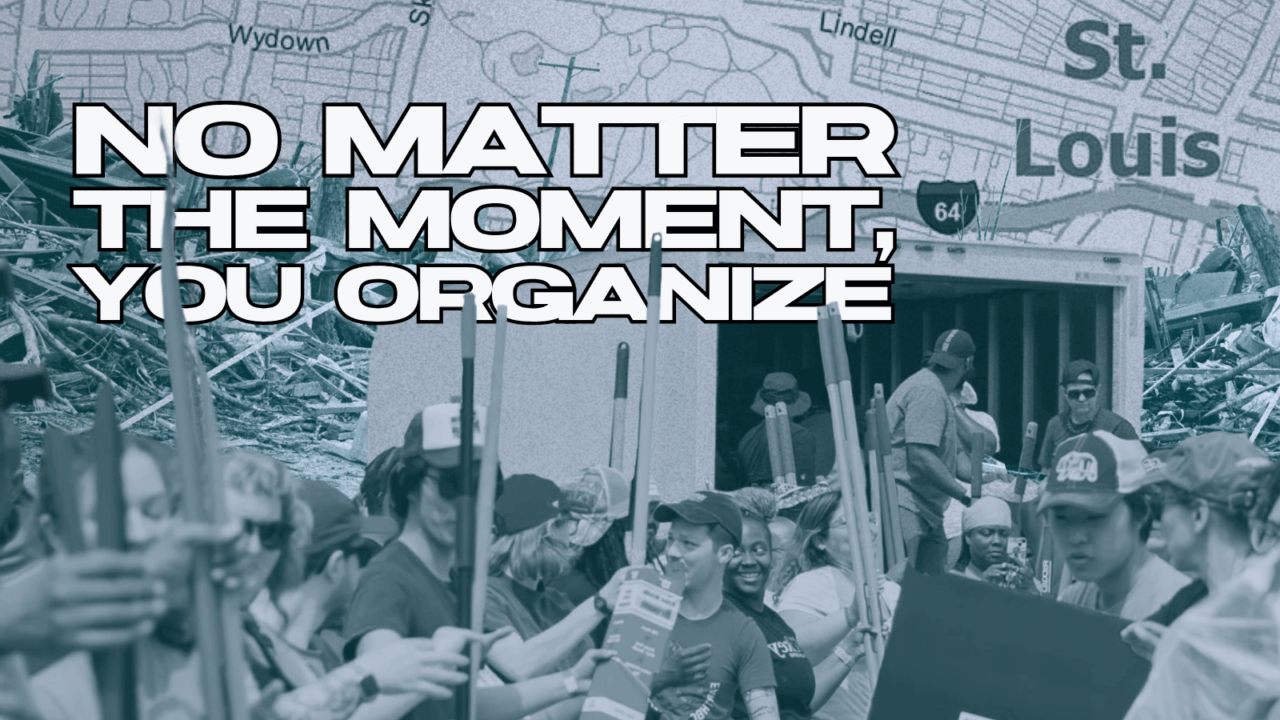
When you know how to organize, you know how to organize. If you know how to swim, you know how to swim. That’s the metaphor. You can swim in the pool, a pond, a lake, a river, an ocean. You just got to know how to swim and the elements are going to change. How fast you get there is going to be different. All of that changes. But if you can swim, you can swim. And that’s what I tried to build into my team: what we know is that it’s our responsibility to bring people into this work to develop their analysis. So we’re going to have political conversations up here. We’re going to call out the city. We’re not going to be in this kumbaya moment with people who should have millions of dollars already flowing into North City. We’re going to tell the story of their inadequacies, and we’re going to tell the story of how we stood in the gap of that. So much so that they’re trying to give us awards. And we’re like, “No. We don’t want that.” We did this for our people. We’ve been agitational, and we always knew that the goal was to have a public investment campaign to fight for resources for North City. Everything that we did there was shaped by our lens of history and our organizers. In every situation, you need to be organizing. If it’s a flood, if it’s a fire, if it’s a tornado, a police shooting, a food desert, a new data center being built in your neighborhood. No matter the water, you swim. No matter the moment, you organize.
MN: I love that. You already started to touch on this but many would say the work that you’re doing is actually the responsibility of local government. What was the role of local government or elected officials in this moment? Why was there a gap for your organization to fill to begin with? And what does Action St. Louis believe should be the response or the responsibility of elected officials in government in moments of extreme crises, environmental or otherwise?
KR: It wasn’t the responsibility of the local government alone; the state and federal governments should also show up. [When] Joplin had the tornado in Missouri under Obama, the national declaration of an emergency, which triggers FEMA, happened within hours of the tornado. It wasn’t even 24 hours by the time Obama was here and FEMA was on the ground in Joplin. It took three weeks for that same declaration to be given in St. Louis [after the May 2025 tornado]. And the city leadership should have known that it would take that long just because of the political reality that we are inside of. FEMA was late and under capacity because it’s been gutted tremendously. So folks who are going to navigate climate disasters need to be prepared for that new reality: that the FEMA of old is not the current FEMA. The other thing we know is that these are Black people in St. Louis. This is a democratic stronghold, and it’s the black people inside the Democratic stronghold. It’s Black people who are poor inside of a red state, inside of a red country. That means [federal and state government are] not going to show up at the full capacity that they need to. So the city failed because they had a doe-eyed analysis of what was going to happen. They thought, “We’re just waiting on the government.” Well, that’s 21 days. You know what could happen in 21 days? This was a new administration, Cara Spencer ran against the previous mayor, and she won. Her team was not assembled. She scapegoated the FEMA director and was more concerned about controlling the narrative than she was about actually responding to the needs of the people.
My advice to folks who are going to go through this, is that traditionally, relief work in the aftermath of a tornado is completely absent of organizing [and] political strategy. We have to build and demand at the same time, and people should assume that the gap [in relief support from the federal level] will exist, because that’s where we are now.
This administration, these states where Black people live, and majority-red states are not concerned about the well-being of our communities pre- or post-climate disaster. So we have to be. They should not be allowed to abandon their responsibility, but we should organize knowing that that’s the demand— we have to demand something of them that maybe felt like it would have just come before.
It was sort of ironic but also timely for us that all the Katrina documentaries and look-backs were happening while we were going through this. It made real to us what people were telling us that we were imagining. They were like, “You just have to give them time. You don’t know that they’re going to abandon these folks.” And it’s like, “No, there are just so many examples of this.” And people should feel empowered to say that.
Yeah, these are different cities and different types of disasters are happening, but the state has a singular arc of response, and it is to under-invest, over-criminalize, and then neglect to gentrify. We were trying to think about what could be our intervention at each stage of their strategy. How do we think about gentrification on day one? North City has the highest concentration of Black home ownership in the state of Missouri because these homes had been owned for generations. This was Big Mama’s house. You have people who have not had mortgages in years, but they also were denied the ability to have insurance on their homes. The tornado itself was not racist, but everything that the tornado touched and left behind had been so impacted by racism, and will continue to be impacted by these structural systems, that the only option will be for them to neglect.
We set up this program called the People’s Response Fellowship, which takes 20 North City residents through a fellowship program to lead organizing fights around what we call ‘just recovery’. One of the things we always have to be able to know, Ta-Nehisi Coates says this, which I’ve adopted: It’s the big lie. We’re watching this administration send the National Guard into all these particular cities because of the big lie that, “oh, these places are inherently violent”, “we need to take back control of these places”, et cetera. In climate, the same big lie, right? North City is this violent place, and people don’t care about their neighborhoods.” The big lie is always followed by the bigger scam, [such as] the complete gentrification of New Orleans. That is what they will set St. Louis up for. As organizers, we have to be inside the moment and be nimble enough to respond, but always aware of the big lie and the big scam that will come behind the lie, that [will be] justified by the lie, and be inside of a bigger strategy to organize our folks. Because what climate disaster does is bring us right back. It’s a collective moment of shared experience, which triggers a possibility to organize people around a shared collective interest and vision.
The trauma of it and the lack of state response and care makes us hyper-individualized inside of this collective shared moment. So I got to think about my roof. I got to think about my food, I got to think about my, my, my. What we’ve tried to do consistently is present the “our”, right? We do want you to have what you need and you’re not alone in this. Some of this is shared. It is so many of us impacted, it actually has to be our government that responds to our needs.
MN: That’s right. Thank you, Kayla. As you already started to name, as climate crises continue to increase, we know that the work of supporting folks in these moments is only going to become more necessary. What have you learned that you want to share with other organizers moving forward?
KR: Action St. Louis is a continuing resource. We did this oral history project called the People’s Response Archive to capture testimonies from the staff, leaders, volunteers, and residents who were on site there, in part because we need to be able to tell the story, because they’re going to lie and say we weren’t there or minimize it, and then also to, in real time, catalog what we were doing. Mutual aid absent organizing is a strategy-less tactic. And we can’t in this moment, not be strategic. in every season, we must organize and people are hungry for it. So don’t speak for the people. Don’t think that they’re so devastated and so harmed and so afraid that they’re not ready to fight because that’s not true. Leverage what is on the table for your people and be ruthless in pursuit of it. Tell the truth no matter the cost and call on others help. I’ve constantly thought about one of the most powerful things that happened to us as an organization. Another ED., Jeremy Alhaz, who runs Missouri Worker Center economic justice organization, was there volunteering and he asked, “How are you paying for all this?” I said, “We’re using our budget.” Then he called all of these partner organizations, labor unions, and said, “Hey, I’m giving $10,000 to Action. Will you match me?” So our first pool of resources came from other organizations giving us what they could.
That changed our capacity immediately. It freed us from having to go to foundations and write proposals. We have to, as an ecosystem of organizations on the left, be willing and ready to support each other. We have to be a network of safe houses toward this North Star, no matter where the disaster is. So long as our people need us, we must show up. And that’s the greatest lesson that I can tell folks. There is no Bible to this. Every situation in every place has its own history and context, and there are people who have a lot more experience in some of this than I do. You should take their help and also trust your gut; listen to the people and open yourself up to learning in real time. I think sometimes we try to perfectly plan a response, and we miss the moment. And climate work, resiliency work, recovery work requires us to be more committed to experimentation that is rooted in organizing.