We are living in fascist times, which means we must remember history to help us understand the possibilities of our futures. Do we want to subjugate ourselves to the tyranny of a dictatorial leader? Or do we want to struggle for the future that can encompass us all, free of the shackles of racism and colonialism, free from the unequal yoke of living in the heart of empire while our tax dollars fund genocides and conflicts around the world? We must strive for and demand justice, a democracy rooted in decolonization. And by this I mean a place where Indigenous sovereignty is true in a literal sense—where we live in harmony with human and non-human entities, where colonization and empire are both, in the words of Frantz Fanon, “banished from the earth.”
As a university professor, contrary to right-wing talking points, most of my job is not to
indoctrinate students but to prompt them by asking questions and to think critically about history
and our political reality, based on the best evidence available created through rigorous, peer-reviewed research. In my course on Afro-Indigenous History, one of the foundational lectures examines the meaning of democracy and its development in the United States. I explain to students how U.S.democracy started with two historical phenomena: the (incomplete) dispossession of Indigenous Peoples from their land and personhood, and the enslavement of African peoples and brutal violence that accompanied it. I also explain to them that the European-American founding fathers were deeply influenced by Haudenosaunee forms of governance and the fact that they worked to ensure that private property and conceptions of race were secured. Thomas Jefferson wrote that Native people were “merciless, Indian savages” in the Declaration of Independence. And they acted as if slavery didn’t matter to the nation, even though it was foundational to the development of American capitalism.
Given this history, at the end of the lecture, I say to students, “Based on the history of the
The United States’ democratic formation, is the United States a legitimate democracy, as a settler colonial society?” I pause and let them ponder the question. Students often look befuddled. I follow up with, “What, then, are the prospects of Black and Indigenous Peoples securing freedom within this nation-state?”
Some might be confused by this question. It might even seem nihilistic. But I’m an idealist, like
the radicals before me, such as Malcolm X, Beatriz Nascimento, Kwame Ture (Stokely
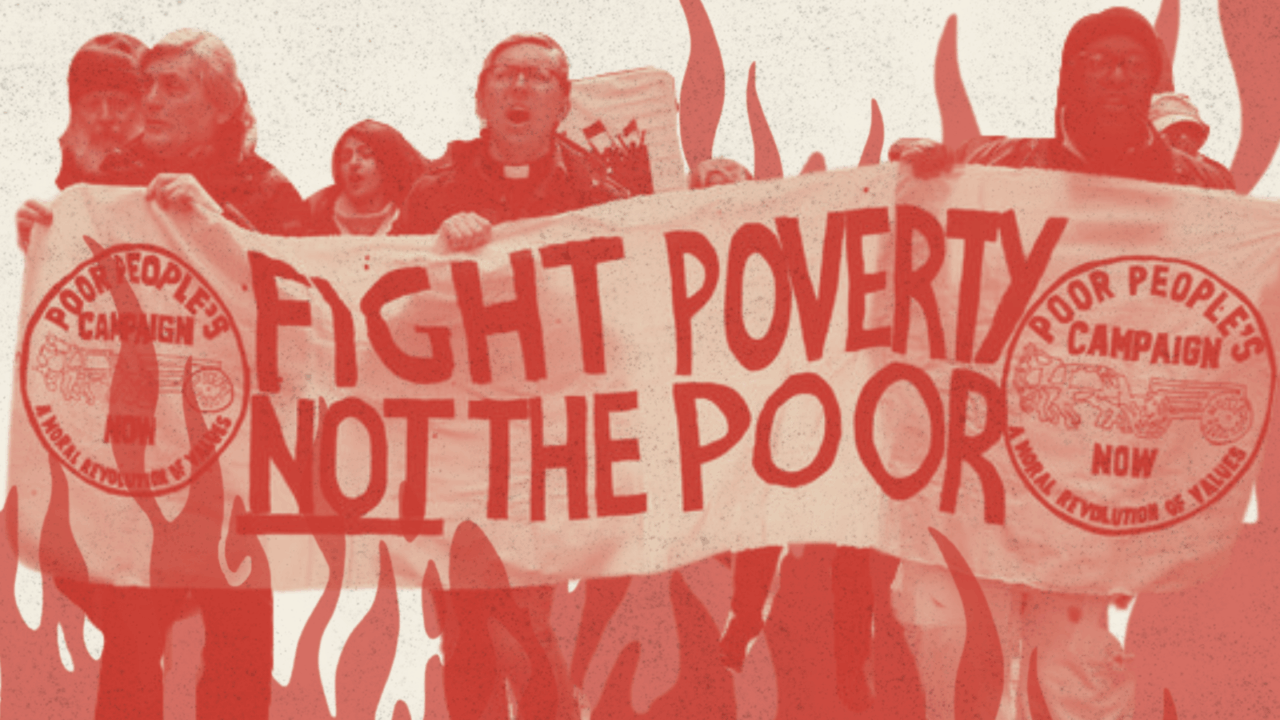
Carmichael), Hank Adams, and Mary Crow Dog. And like Leanne Betasamosake Simpson and Robin D.G. Kelley today, I believe justice will happen. With that context in mind, let’s turn to the period of 1967-1968 and briefly examine the Poor People’s Campaign, as it is a site of both meaning and possibility for the next 250 years.
The Poor People’s Campaign was one of the most significant moments in U.S. history that
brought together people seeking a radical change to the nature of a racial capitalist and settler
colonial society. It was a call to action to address and repair past harms, ensuring that vulnerable communities could thrive and secure the democratic rights the founders conceived.
What is often ignored within that history is that Indigenous people were key
figures within the movement. They fought alongside their Black comrades seeking to end
poverty and to secure a democratic future rooted in economic justice, in addition to challenging the colonial relations that Indigenous nations had experienced with the United States government since 1871, when the United States unilaterally decided to end its treaty-making with Indigenous nations.
Some might say that this moment of solidarity exhibited during the planning and execution of the Poor People’s Campaign was fleeting, unimportant, and unsuccessful. There are merits to these points. His staff at the Southern Christian Leadership Conference (SCLC) thought he might be way too ambitious. At times, Indigenous Peoples’ treaty rights were not taken seriously enough; understanding the need to thoroughly unpack how capitalism impacted various communities differently, and the poor execution of erecting a tent city on the National Mall, all contributed to the short-lived attempt at a democracy rooted in coalition. However, that ignores the importance of creating a narrative to change the miserable conditions of the country’s most vulnerable.
But let’s not forget, as Black Power icon and abolitionist intellectual Angela Davis told us in The Black Power Mixtape (2010), revolutionary ideas are not about the means but the goals. Organized by Martin Luther King Jr. and the staff of the SCLC, the organizers behind the Poor People’s Campaign had certain goals in mind: to secure democratic and economic rights, alongside sovereignty, by honoring treaties with Indigenous nations. Historical memory can be unkind to past movements’ failures, or we tend to overromanticize them. However, I see these past movements as learning grounds: an opportunity to assess, respect, and take what we can from them.
On March 14, 1968, just weeks before his untimely assassination, Martin Luther King Jr. and
members of the Southern Christian Leadership Conference (SCLC) convened a Minority Group
Conference in Atlanta, Georgia, between seventy-eight leaders from fifty-three organizations who were concerned with economic justice and ending poverty, and how they might effectively
demonstrate their power in Washington, D.C. Five years removed from what Malcolm X called the “Farce on Washington,” where Black people and allies marched in the “March on Washington” in 1963, leaders wanted more than integration but reparatory justice. The attendees included Black people, Mexican Americans, Puerto Ricans, poor whites from Appalachia, and Indigenous Peoples from several nations.
Indigenous Peoples who attended included Hanks Adams (Assiniboine), Mel Thom (Walker
River Paiute), and Tillie Walker (Mandan-Hidasta). These were veteran activists who participated in significant actions for Indigenous Peoples, including the American Indian Chicago Conference of 1961, the fish-in movements in the Pacific Northwest in the early 1960s, and the National Indian Youth Council, a group of Indigenous youth who were impatient with the established National Congress of American Indians (NCAI). Participating in these movements of resistance and organizations, as well as witnessing Black forms of struggle against their own oppression, made Indigenous Peoples very much aware of the national struggle for democratic rights. These veteran Indigenous young people demanded recognition of treaty rights and greater respect for tribal sovereignty. While not necessarily popular among Indigenous communities, these Indigenous people understood the importance of solidarity with other racial groups, particularly Black people. Therefore, they traveled to Atlanta to participate in these meetings of minorities.
Set to begin on April 22, the date of the action was moved back due to the assassination of Dr.
King on April 4, 1968. Nevertheless, Ralph Abernathy, a longtime King associate and brother in struggle along with the conference planners, persisted in having the Poor People’s Campaign because they believed Dr. King would want them to continue the fight. They began the Poor People’s Campaign on May 12, 1968. In a march led by Coretta Scott King, they demanded an economic bill of rights. While Black people, poor whites, and Mexican communities had a specific agenda about racial and economic justice, Indigenous Peoples had the additional burden and demand that the United States respect and honor Indigenous treaties—a core ask of all Indigenous radicals. Indeed, Hank Adams met with Secretary of the Interior Stewart Udall and Robert L. Bennett, Commissioner of the Bureau of Indian Affairs. He stated,
“We have joined the Poor People’s Campaign because most of us know that our families, tribes, and communities number among those suffering most in this country. We are not begging, we are demanding what is rightfully ours. This no more the right to have a decent life in our communities. We need guaranteed jobs, guaranteed income, housing, schools, economic development, but most important, we want these things on our own terms.”
He showed clear solidarity with other oppressed people under the racial capitalist boot of colonialism. In fact, he declared that the United States government could not really exist democratically with Indigenous Peoples because their relations were “built and operate under a racist and immoral paternalistic and colonialist system.” In the spirit of Frantz Fanon, he stated, “There is no way to improve racism, immorality, and colonialism. It can only be done away with.”
These were the words of an Indigenous person who understood the conditions in which
democracy was built and how it can be transformed: capitalism and colonialism must be
removed so that Indigenous Peoples and other communities could live with dignity. An economic bill of rights was the start, but ending colonialism was a major part of addressing systemic oppression.
Adams’ speech did not suggest that Indigenous people were completely aligned. Some felt
slighted and that they were not recognized enough. However, we should not take that as a matter of ill intent. Rather, I see it as an opportunity to analyze how we can find better forms of solidarity that include us all, the work we have set out to do as members of the BLIS Collective.
While in D.C., Abernathy demonstrated with Indigenous Peoples surrounding a court case being tried regarding the Puyallup and Nisqually’s ability to fish in a manner that respected their treaty rights. Explicitly, Abernathy proclaimed that he was there to support Indigenous Peoples and not lead. He described what Indigenous Peoples experienced as a form of genocide.
The Poor People’s Campaign did not achieve the sweeping legislative and economic transformation it demanded. Many have therefore framed it as a failure. Indeed, by 1970, after witnessing the Poor People’s Campaign demands, President Richard Nixon moved to frame Black Power as Black capitalism and Indigenous calls for self-determination as a Republican form of private enterprise. Yet, the Poor People’s Campaign was not a failure for that reading misses the deeper truth about organizing and movement-building.
The campaign created a space where Black and Indigenous organizers, alongside poor and working-class communities across race, could imagine and begin to practice a democratic and decolonial future together. It was an experiment in solidarity that we can build on today. It should remind us that if white supremacy, capitalism, and settler colonialism are fundamentally a part of the development of U.S. democracy, then our collective solutions must seek to uproot all three.
Mino Bimaadiziwin (The Good Life)
In Anishinaabemowin, we have a phrase called Mino Bimaadiziwin, which translates to the
“good life.” A key question for those of us seeking to ensure the next 250 years are fundamentally better than the last 250 is: How do we get to the good life, and what does it look like? I used the brief example of the Poor People’s Campaign to discuss the vision these activists sought. It is a historical reminder of the possibilities we should envision—and more. We can’t envision a decolonized democracy that uproots settler colonialism and racial capitalism without demanding even more than our predecessors. And that calls us on to have an analysis of the breadth of U.S. empire and to demand its transformation. Decolonization can’t happen for us here in the United States without building power with our Black, Indigenous, and working-class comrades across the globe.
The Mino Bimaadiziwin also means that we have better relations with our human and non-human species. It means that solidarity between Black and Indigenous Peoples (and other oppressed communities) is rooted in love, reciprocity, and an understanding of land that is not based on colonial notions of private property.
It also means kinship. Each nation has its own definition of kinship, but we must strive to include others, including Black people, in our relations and logic of kinship. Anti-blackness is a core cultural value of the United States, and we have a long way to go to dismantle it. But our democratic and decolonial futures depend on it.
So let us continue the struggle. Let us draw from the past for instruction. Let us dream bigger and bolder so that those who come next can continue to paint the vision of the future we all deserve. This moment, and this year, it is our responsibility to organize within history as we also make it. We must demand a democratic and decolonized society that is anti-capitalist, free of colonialism, and where all oppressed peoples can live justly. To paraphrase the Black American songstress Nina Simone, our ability to live free means no fear.