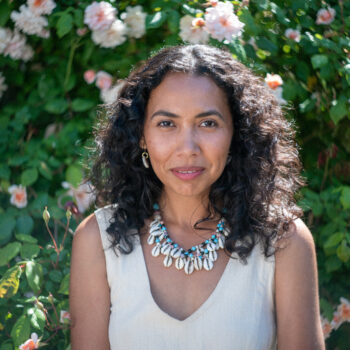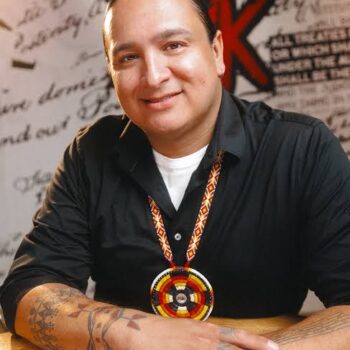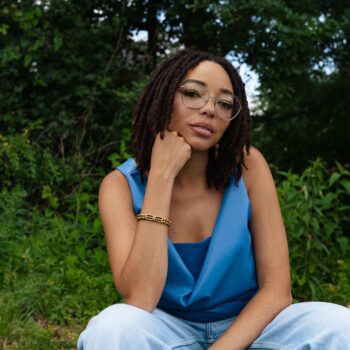
In a country where land has historically been central to wealth and power-building, we must carefully consider how we want to work together towards land reclamation. Kailea Loften in conversation with Nick Tilsen and Brea Baker
At the start of 2026, Brea Baker, author of Rooted: The American Legacy of Land Theft in the Modern Movement for Black Land Ownership, sat down for a conversation with NDN Collective’s founder, Nick Tilsen, and Guest Editor, Kailea Loften. Together, Brea and Nick spoke to how profitable it has been for white America to pit Black Americans and Indigenous Peoples against each other and how this helps account for why the reparations and Land Back movements have been at odds with each other. Yet, as they underscore, these movements would be stronger together.
In a country where land has historically been central to wealth and power-building, we must carefully consider how we want to work together towards land reclamation. While this can take myriad forms, here Brea and Nick offer a few thoughts on what bridging our movements together and collectively building new systems can look like.
Kailea Loften
Nick, what is the story of land in the context of Indigenous and Black histories on American soil?
Nick Tilsen
The immediate context is that Indigenous people were here before there was an America, before there were settlers. Our relationship to the land was not transactional; it was spiritual. In most Indigenous languages around the world, there’s a word that expresses the idea that we’re all related and interconnected.
When settler colonialism started expanding to this part of the world, they brought an extractive worldview. There was the taking and stealing of Black people from other parts of the world and bringing them here for slavery. Indigenous people were also forced into slavery in this part of the world, too, which is not often talked about. Especially in Central America and Mexico.
The political and legal systems were set up not only to steal the land, extract the resources from it, and exploit the people, but they also worked to maintain the exploitation of both Black and Indigenous people.
All of this is what largely built the so-called American democracy.
Kailea Loften
Brea, to further expand, could you share a bit more about the history of disunity between Black and Indigenous people?
Brea Baker
Something that Kyle Mays, the author of an Afro-Indigenous History of the United States and the forthcoming book, When We Are Kin, writes about is how Black and Native people across American history, in particular, have not been incentivized to build solidarity.
And it’s not going to come easy for us. He’s very spot on in the sense that, to what you just shared, Nick, our context in this land is different. Black people were in chains and forced here against our will, and Native peoples have been experiencing the genocidal stripping away of their ancestral homeland.
These harms are happening simultaneously on the land.
Some of the largest Indigenous nations were made to participate in a racialized form of slavery. During the Civil War, you find Black and Native peoples on opposite sides of the conflict. On the other side of the Civil War, there were unspeakable amounts of violence and land theft from Indigenous nations. And some Black people — who had previously served in the Union Army and were now serving as Buffalo Soldiers — participated in that harm.
You have freed men and freed peoples who are experiencing a lot of anti-Blackness from tribal nations as well. And you have HBCUs being founded on stolen Indigenous land with the express goal of making Black people better for this new society that they have to be a part of.
There are many different moments of tension. And the reason I list them out that way is that it is rare for our disunity to occur when our two groups are together in our own bubble. It is when this not-so-invisible hand of white supremacy and capitalism comes in and messes with our two groups that disunity is allowed to fester. That’s why I’m really interested in what our solidarities look like.
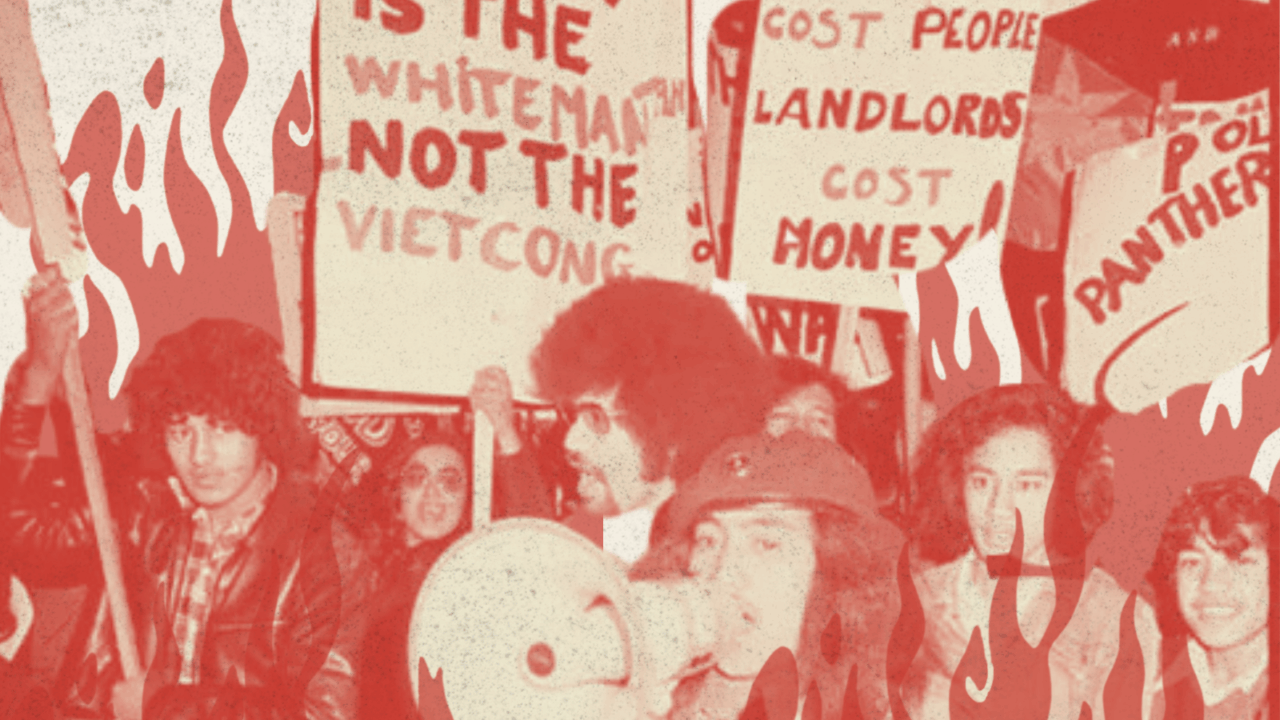
For instance, the magic that maroon communities were able to build. The abolitionist Native nations who fought alongside Black folks across the Midwest. Black and Native folks who have fought for civil rights side by side, who fought for Black power and Red power. While we need to acknowledge the truth of how we’ve harmed each other, we cannot let the past keep us from building present-day solidarity. We have to learn from it while continuing to build towards a better future
Kailea Loften
This framing of us being consistently pitted against each other is important.
Brea Baker
We are pitted against one another because it is profitable to do so. That’s critical to name. Black people’s history in America was tied to labor exploitation. Native folks’ history in what is called the Americas was land theft and genocide. And at the core of both of those sins is land. If they were successful at enslaving Black people but had no plantations for us to work, then the practice of slavery would have failed. If they had taken all the land but had no one to work it, then that project would have failed.
The demand for one fed the demand for the other. And the idea that Native people and Black people would rise up together and refuse to work and resist in all the ways, potentially arming themselves — that idea was a threat to empire.
Our solidarity is that powerful. They’ve had to incentivize us out of it because, otherwise, you don’t get the richest country on the planet. You have to pit groups against one another to maintain the project of land theft and of labor exploitation.
The systems that were perfected against Native people and against Black people are now being leveraged against other groups of people who are coming into this country. We need to see these connections because sometimes I fear we become tunnel-visioned. I talk to Black people who believe that they can only focus on Black liberation. And I’ve talked to Indigenous people who are like, “Sorry, I gotta focus on what I’m doing over here, and I don’t have time or energy to be in solidarity with you.” But it’s actually more costly not to because we are so much more powerful together.
It sounds so cliché, but truly, when you think about the amount of energy they’re investing in keeping us apart, it’s obvious they have so much more to lose if we do unite.
Kailea Loften
That’s exactly it. And that’s the opportunity: bringing the two of you into conversation is part of figuring out how we begin to move outside that tunnel vision together.
Nick, what do Black reparations and Indigenous land back look like together? And how can tribal sovereignty advance the work of Black reparations?
Nick Tilsen
I love this question. I think that we have to get away from the notion that they are separate.
Land Back and Black reparations at scale are not possible unless they’re bound up with one another. And to be clear, Black reparations and Land Back are not transactional things.
These are important elements in the liberation of our people. They are intertwined political, economic, and social justice solutions. You can’t do one without the other because they’re braided together. They created a situation for us to be pitted against one another by promising, for instance, 40 acres and a mule on stolen Indigenous land. And then never honored any of that, leaving folks to fight it out over the scraps left by this unsustainable system.
When I think about Black reparations, Indigenous Land Back, and Indigenous sovereignty, I see them as avenues for us to collaborate and build power collectively. For example, I think some of the advancements stemming from the Black liberation movement that led to civil rights in this country have helped Native people. Even though we’re in a time when those are all being rolled back.
It’s important to understand that Indigenous nations do not have a racially based relationship with the United States. It’s a nation-to-nation relationship. It’s a political relationship because tribes and nations have treaties that are supposedly in the United States, the supreme law of the land. And therefore, when you violate treaties, you weaken the Constitution. There’s a legal precedent set in federal Indian law that protects Indian people and tribes under a different classification.
The empire and the regime of the United States do not like the presence of sovereign nations operating within its borders. The United States government poses a constant threat to sovereignty. So when Black folks and tribal leaders, through tribal sovereignty, create pathways forward together, they can challenge the power structure in powerful ways — politically, legally, spiritually, culturally, and economically.
When advancements are made in tribal sovereignty and sovereign nations, with the political analysis that we’re trying to create a better world for all people on Mother Earth, not just for tribes and tribal members; when tribal nations start acting like actual sovereign nations instead of quasi- sovereign nations under a federalist system, I think that has the ability to create systemic change.
But I want to be very clear that when tribes solely act as semi-sovereign nations under the federalist system, it can backfire. Meaning that tribes themselves can actually implement things that oppress Black folks, other Indigenous folks, and other marginalized people. Acting as sovereign nations means having our own politics and values, which we will implement, whether or not those politics and values are at odds with the United States government.
I’m naming all of this because I’m not a cosigner on tribal sovereignty above all, all the time, if tribal nations and sovereignty are being used as a tool to oppress people. The question remains: are we going to operate as sovereign nations, or are we just another facet of localized government under the United States federalist system?
Brea Baker
I think you just offered up such a great vision of what is possible. I saw a quote online by Amber Stark, an Afro-Indigenous person who shared that a predominantly white Senate should not decide what reparations or Land Back looks like. Black people and Native people, we need to be our own mediators. We need to be the deciders.
And I think hearing you describe how Land Back and tribal sovereignty can create justice for so many of us reminds me that we don’t always use our imaginations. We’ve been forced to put incrementalism on this pedestal. This idea that we just kind of slowly chip away at the system, in which case you can’t imagine something outside of the confines of the system. We’re only imagining two steps ahead, and not imagining a world where the box is actually a sphere. Where we get rid of a box altogether.
I think that shortsightedness is something I struggle with. But as you were talking, I felt that sense of possibility.
Nick Tilsen
It is required that we lean into complexity and dream. Why do we want Black reparations, and why do we want Land Back? We should be asking that over and over and over.
When we think about a path forward, we need to reimagine what a democracy looks like that is just and equitable for all of us. Quite frankly, at this moment in history, we need a vision for how we will create that. And I think that’s probably one of the most beautiful things that can come out of the convergence of these movements, allowing ourselves to radically dream and radically create.
We have to build new patterns of practice. There is anti-Blackness that lives in our society, that lives within Indigenous Peoples’ cultures and movements, because we’ve lived in this extractive, exploitative, racist society. There are also anti-Indigenous sentiments that live amongst Black people and Black culture that are far-reaching. This means we must heal while we organize, create, and build something new.
Kailea Loften
I’m appreciating the call to hold complexity while dreaming.
Brea, you wrote a book, Rooted: The American Legacy of Land Theft in the Modern Movement for Black Land Ownership. You write about why land continues to be central to projects of wealth building. Why is that, and how does some of your own story surrounding access to land reflect your understanding of that possibility intergenerationally?
Brea Baker
To be plain about it, this country was built because land was stolen and because that land was worked by people who experienced deep brutality in the process of having their labor exploited.
And so, not only did this country become rich from land, but it also established a system in which private property was the path to citizenship. At the time, political power-building was also closely tied to whether you owned land. And you had to be white. So land ownership wasn’t just about wealth building.
I believe that Black people are following the cues of this nation in saying that, if what this nation heralds above all else, and how it builds its power and its wealth, is through land, then for me to be taken seriously and be a stakeholder in this nation that I’ve built against my will, I also need land.
For Black people, we tried the go back to Africa thing, and I would argue that it was unsuccessful. Maybe some other people are still dreaming of that and want to do it. But for most of us now, we’re on a new continent, and we have to figure out how to survive. And here in America, land is how to do that.
That was more so the case back when emancipation first became law of the land, because the economy was agricultural. At the time, there was literally no way you could imagine putting food on the table for your family and housing them without a piece of land to work on and call home.
Now, we all have different relationships to work and labor, and to rural landholding and land stewardship. But I still think that real estate and private property are placed as the pinnacle of what it means to be savvy, and to participate in capitalism. You’re trying to acquire something that builds and accrues across time. So I think that’s a straightforward reason behind it.
Underneath all of this, though, is this deep desire to find belonging, to find a homeland. I’m constantly, internally, at war with that. There’s a part of me that believes the African continent is the only homeland we could ever know as a diaspora. There’s another part of me that’s like, “My family has been here in North Carolina since at least the 1800s. Could be longer. And who am I to leave them? Literally, their bones, their blood, their contributions, their unpaid debts behind? I want to get what they’ve worked for here.”
There’s that internal identity crisis happening within Black people, whilst also trying to have a piece of something that we feel like our ancestors died for. We can’t bring them back to life, but I damn sure want the inheritance that should have been passed on.
Kailea Loften
I hear and feel you on all of that. Especially regarding the identity crisis as it relates to finding a place to call home.
Nick Tilsen
We all live here now. We have the right to build new culture. We have the right to build new systems. This idea that we’re going to return to our cultures, as they were back then, that’s not it. That’s not the move.
We have to give ourselves the right and the license to build. And our political and economic systems have to reflect the culture, and vice versa. Because if we don’t build regenerative economic and political systems, our culture will be extractive. Collectively, our lived experience of being on this land for hundreds of years together is valuable to what we are building. Our struggle and our ancestors who gave their lives didn’t do so in vain. That should inform how we move forward collectively. And I think we do have the ability to build something beautiful and new.
Kailea Loften
I resonate with this concept of continuing to let ourselves be informed, while giving ourselves permission to keep building.
Noting that this entire series stems from the understanding that America is in an identity crisis, I’m curious to know how each of your works seeks to reclaim what it means to be Black and Indigenous in America today, and what future visions are currently sustaining you in this work?
Brea Baker
For a long time, racial relations in this country have been code for what Black and white people think of each other. It’s just such a flattened narrative that erases Native peoples and many other groups, while continuing to center whiteness. I’m not interested in my only vision of racial harmony being sitting side by side with my oppressor or my oppressor’s descendants and singing Kumbaya.
I want racial harmony to look like this conversation right now. We’re having this conversation in the year that America turns 250. I want the next 50 years to look different. I want us not to be afraid of people of color being the majority.
And I want us not to be afraid of pursuing bold visions like reparations and Land Back. I want to be as vocal about Land Back as I am about reparations. And I want other groups to feel the same. That, as you said, Nick, we can create a new culture, and we don’t need to be afraid to color outside the lines.
That’s what I’m excited to do: color outside the lines and see what else is possible.
Nick Tilsen
One of the things that we’re doing is creating toolkits for tribes on how to ban ICE from tribal land. We’re getting our independent sovereign nations to actually issue bans on ICE. And that’s huge. Getting tribes to flex their tribal sovereignty to advance human and land rights.
Whenever there is a threat to a people, there’s also an opportunity. Right now, ICE is attacking everybody. They’re out here killing and kidnapping in the streets. They’re kidnapping and killing Black people. They’re kidnapping and killing Indigenous people. They’re kidnapping and killing white people. Everyone is being targeted right now. This is an opportunity to build power, to build a base of people who are willing to organize with each other and risk their lives side by side. This is what we saw in Minneapolis.
We need to understand that resistance is as important in this moment as building. We have to push ourselves in this moment to do both. That’s what we’re doing at NDN Collective; it’s what we’ve always been about. Our model has always been to defend, develop, and decolonize simultaneously.
One of our roles is to continue politicizing tribal leaders and Indigenous people. We provide political education. For instance, we take up the responsibility of addressing anti-Blackness so it doesn’t fall on our Black brothers and sisters to carry the torch. But when it comes to anti-Indigenous sentiments, we want other folks to take up the torch on that. The more our movements focus on educating each other, the better.
We are also continuously building movement infrastructure to support and sustain people over long periods. NDN Collective is not a movement. The people are the movement. But you need infrastructure to sustain movements. Infrastructure helps move resources, build narratives, create models, and generate connectivity between people.
The powers that be want Black and Indigenous people to be treated as less than. They don’t want us to have collective power. So we need to share examples of how our solidarity can challenge the power structure that they’re trying to maintain. It inspires us, too, because as human beings, we can get all up in our headspace. We can be too intellectual about all of this.
We just helped the Eyak get some of their land back through a place called Sea Otter Island. Sitting there on this piece of land that we literally got back. Doing a ceremony there that was outlawed at one time. Bringing in our Black brothers and sisters. It is real. It’s happening right now. We’re actually creating it. What we are doing is real.
Kailea Loften
It is happening right now. Through the work that both of you are a part of.
Brea Baker
This conversation helped me to visualize what is possible. It’s inevitable that we will win.