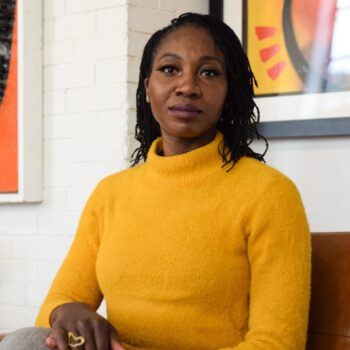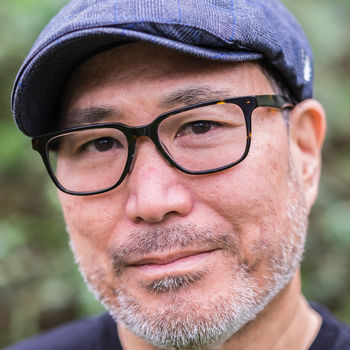
If we’re going to work to bring diverse groups of people into conversation and ultimately solidarity, we will need an updated politics of togetherness capable of bringing nuance to intersectionality. Trevor Smith in conversation with Amara Enyia and Scot Nakagawa
Trevor Smith, Executive Director of the BLIS Collective, sits down with Executive Director of the Movement for Black Lives, Amara Enyia, and the Executive Director of the 22nd Century Initiative, Scot Nakagawa, to discuss the effectiveness of centering race and identity in how we organize.
Trevor Smith: What is the act of centering in social justice movements, and how did we arrive at this as a widespread practice?
Amara Enyia: Often, we are talking about centering the voices of those most marginalized, and so when I think about centering, I think about a circle, and what is in the middle of that circle. And there are implications to that visualization.
I’m informed by a non-hierarchical cultural orientation that believes that the formation of the circle is what we are working towards, and that nothing or no person should be at the center. When a group of people is pushed out of the circle’s formation, it creates an imbalance, and I see my work as bringing them back into the formation. Not pushing them into the center of the formation, because doing so inadvertently creates a kind of hierarchy that can cause issues with the rest of the circle. And that dynamic plays out a lot.
We don’t dig into any of this or parse it out because we fear being perceived as insensitive to others’ plight. Which means we don’t deconstruct the implications that centering groups of people has in our organizing and power-building work. It can get dicey.
Instead, we should be talking about the centering of values. There’s a class analysis to be offered here. For example, the concerns or the level of activation for a middle- or upper-class Black person versus a poor or working-class Black person is different. Kamala Harris being the Democratic nominee might have resonated with a middle or upper-class Black person who is not experiencing what poor and working-class Black folks are experiencing on a day-to-day basis. They’re both Black, but their activation thresholds differ. So even within a racial identity, you’re going to have various layers of difference that are going to determine what that activation point is. However, if we can agree that genocide is wrong, as a value, ideally, that value should stand regardless of where you sit on the socioeconomic spectrum.
With centering identities, you’re always going to encounter fissures and fractures within a movement. But if we shift to centering core values, that might provide us with better scaffolding to move populations across racial and class identities.
Scot Nakagawa: People need to center, by which I mean focus on, the experiences and struggles of the people they’re organizing. I saw how not doing this can lead to unexpected consequences when I was working with a group called Change Lab, which focused mainly on Asian American leaders. This was in 2012, around the time of the biggest movement for Black Lives Mobilizations and Trayvon Martin being killed. And I saw Asian American activists “centering” Blackness to the point where they became illegible as Asian American leaders to the people in their base, and at a time when the base was becoming politicized and increasingly divided — a process to which this “centering” contributed. It was a good-faith effort to transform the community in a way they believed would make us better allies. But instead it weakened us so that, as allies, we might be, in principle, right on point, but in terms of power, we were on shakier ground.
We instead need to think about multiple centers and overlapping circles of influence. For example, I hear from the field that certain groups of people are tired of the fact that only when red lines get crossed for white people do they ever seem to take action broadly enough to make real change happen. It’s a real dynamic. But the reality is that, because we live in a hierarchical country, the higher up you are in the hierarchy, the more insulated you are from the realities on the ground and the consequences of the decisions and choices you make. That’s a structural problem, and not just an attitudinal one.
I see that dynamic as an all-too-human failing. Race exaggerates the negative impact because racial equity and inclusion are load-bearing democratic architecture. Exclusion weakens democracy and makes it vulnerable to authoritarianism, which has taken many forms throughout history, each concentrating unjust power.
So, if you want to organize white people to take action, you have to disaggregate them as a group and center the most likely allies in order to understand where the organizing opportunities lie.
Trevor Smith: It sounds like both of you are saying that there are challenges that arise with the ways in which people generally practice centering. So how did we arrive here?
Scot Nakagawa: Well, I can throw out one thing: foundations. I believe philanthropy has played a big role in all of this — not intentionally and not out of negligence, but because of how we’ve been structured over the last 50 years or so. Around the 80s, as things shifted in a neoliberal direction, nonprofits proliferated across the country in order to pick up the slack left by government defunding of critical services. Nonprofit advocacy groups, originally conceived to build the leadership and infrastructure for future movements, were professionalized out of necessity as they became permanent employers of workers who were owed good working conditions, wages, benefits, and opportunities for advancement.
Traditional organizing practices became less effective because wealth polarization grew as neoliberalism insulated corporations from democratic decision-making and the industrial core of our economy was hollowed out. The industrial worker was the primary subject of traditional organizing networks, and the social capital built in the company towns where they lived provided the context that made organizing possible. And so, as the basis for old-fashioned Alinsky-style organizing — company towns, communities where almost everyone works for the same employer and shops at the same grocery store — collapsed, advocacy and organizing groups became professionalized. Ultimately, it became harder to act without ever-larger investments of outside capital.
Philanthropic capital subbed in for social capital, membership dues, etc. And that philanthropic capital basically kept organizations able to continue organizing and advocating. So that was great. But the downside is that foundations have become part of our organizations’ and organizing culture. Among the things they do is fund short-term and by category, and that kind of funding drives competition and makes it difficult for groups to plan ahead and survive defeats.
Amara Enyia: I appreciate what you’re raising Scott. Yes, on the role of philanthropy. I have to double-tap on that because, when capital began to flow, it fundamentally altered the terrain of our work, and we see that to this day in many instances.
There’s something to be said for recognizing the fundamentals we have to contend with. One of these is the phenomenon of global anti-Blackness, which has its parallel at the domestic level. But internationally, we can even go back to the resolution that was just introduced a couple of weeks ago at the United Nations on the trafficking of enslaved Africans, and how the Transatlantic trafficking of enslaved Africans fundamentally altered and set the direction of our current racial capitalist global order. The impact of that cannot be understated or ignored.
We have to recognize that this system of racial capitalism terraforms. It creates the conditions for its own survival and perpetuation until it cannibalizes itself and destroys everything. There was a time when, in the U.S., there was a connection between your racial identity and your politics. And as we’ve gone through iterations of the neoliberal era, now that link is not as strong. You cannot tell that a person is going to be pro-poor people, or pro-working people, just because they are Black, right? We also had a Black president who was sitting at the top of empire and advanced empire’s agenda.
We have to recognize that, as time goes on, the connection between our race and our politics cannot be the sole connection. There has to be something deeper, which is why a lot of my work focuses on the human rights landscape. Human rights recognize that there are some fundamentals to which, by virtue of our existence, we are entitled. And that is the case regardless of your gender identity, regardless of your sexual orientation, regardless of your socioeconomic status. Regardless of how we parse our identities, we’re going to be multi-layered.
I am an Igbo, African, Nigerian, American, living on the west side of Chicago, who grew up with parents and other immigrants from Nigeria. In Igbo, we have a proverb that, in English, translates roughly to, “Let the kite and the bird share the same branch. And the one who would interfere with the other, may its wings break violently.” It essentially is like “live and let live.” You’re queer, fine; you like spicy food, fine. This orientation is about self-determination and finding harmony and balance in our ability to live as ourselves with each other.
So if that is the value that undergirds how we live, then my race, my socioeconomic status, it all becomes less important. And if we built institutions on that set of values, then by virtue of our existence, we are all entitled to and deserving of human rights.
Trevor Smith: It seems like humans, particularly in the United States, group ourselves by race. By centering values over identity, are we undoing the centering of race? Should we be doing this?
Amara Enyia: This is a very ironic discussion, because I’m the Co-Executive of the Movement for Black Lives.
Trevor Smith: And I’m the executive director of Black Liberation, Indigenous Sovereignty.
Scot Nakagawa: I’m gonna say it’s a really thorny question. You need to be race-explicit to achieve racial equity. You have to actually make it vividly clear what the problem is.
But it can be problematic how we go about doing this. I’ll give you an example from the Asian American community. There was a controversy for a while because Asian American organizations would say they are Asian American and Pacific Islanders, but the Asian American groups monopolized all the resources, and the Pacific Islanders got almost none. And then that terminology also assumed Native Hawaiians had the same political status and service needs as Pacific Islanders generally. Native Hawaiians, though, are really Indigenous people fighting for recognition of Native Hawaiian sovereignty in the U.S.
And then when you look at the continental U.S., Asian Americans as a majority do not identify as Asian — they identify with their individual ethnic groups, driving more division, as Asians tend to get lumped together. They come to it because it’s a political category you occupy, and it’s an identity you can occupy that makes you feel legible to those in power and leverage for advocacy.
All of this led Asian Americans to take on disaggregating “Asian American and Pacific Islander” in order to stop allowing white supremacist categories to make so many diverse needs of the community invisible behind race. We need to see each group of people as separate, understand their needs, and then see how they fit together. That’s not an easy thing to do. It’s going to require dialogue. It’s why I think the BLIS Collective is doing really good work: you’re fostering dialogue between two groups of people who historically haven’t organized together, except in exceptional instances. We need to remember what Audre Lorde told us, “The master’s tools will not dismantle the master’s house.” And as we confront race, we have to think about how we are confronting race itself as the primary way that most people think about human difference. Maya Angelou said, “We’re so much more alike than we think we are.” To me, that is where the hope for the future is.
Trevor Smith: What has to be true across constituencies for “together” to feel real to people? And to be something that people want to be a part of?
Scot Nakagawa: Historically, anthropologists say that there’s this thing called the sacred canopy that envelops communities. It’s a set of shared beliefs that leads to a shared ethos and creates a community identity rooted in something like solidarity.
Modernization and now post-modernization are tearing these canopies apart. And people now find themselves isolated and alone, feeling lonelier and lonelier all the time. We also have a difficult time making meaning without that canopy. We end up seeking it out in lots of different places, including, for some, conspiracy theories, cults, and online white nationalist sites.
What’s been happening as the canopy has been shredded is that, when we get into dialogue with one another and make assertions, we no longer have that unifying ethos, or at least it is confounded by our reliance on vastly different evidence for our beliefs. It’s really hard to see how to be together in this context. But I do believe that we can build new sacred canopies by investing in the spiritual life of communities and lifting up joy and love in the organizing we do. We want our movements to be places where people can feel empowered and less alone, and where a shared canopy of compassionate resistance and hope binds us together. I think this is what we need to do to be powerful. People can feel this intuitively.
We also need to stop pushing for everybody to have the same one big neutral ideology to avoid offending others. I don’t believe in that at all. People get involved in social movements because of ideology. Ideology is the key. It’s when your ideology contradicts your reality that you start to become radicalized. Through the work I do, we prescribe that people find their ideological kin and form circles with them, like springs you can tend to and care for. These should become places of respite and joy, celebration, and building strategy and tactics. You should also bring more and more people like you into your springs. And at trigger moments — times when it becomes possible to turn things in our favor — each of these springs feeds into a shared river. The river should be so powerful as to make authoritarianism ungovernable.
This whole practice is rooted in the idea that pluralism is the underlying architecture of a true democracy. And in pluralism, if you want to live in a free country, you have to respect everyone’s right to exist. So you must commit to protecting every other spring, because those springs are also protecting you, and they are the underlying infrastructure of the movement. At a time like now, when we’re in such great peril, I think a lot is possible if we adopt this framework.
I’ve been doing this since 1979, and I haven’t seen such a big opportunity, in spite of the fact that we’re in tremendous peril. The threshold of power has shifted at a time when a supermajority of Americans are concerned about losing democracy. We build the canopy across the springs and rivers that we need with the joyful embrace of freedom and community.
Amara Enyia: I want to touch on spiritual and cultural work in organizing. A lot of times this work is in the realm of strategy and tactics and hitting our targets, and our campaigns, but there’s something about the spiritual and cultural that informs strategy, and is essential in folks being galvanized to be agents of change for themselves. If we don’t tap into that aspect of the work, then we might have great campaigns that go nowhere.
Something that we’re doing at the Movement for Black Lives is building what we call community care networks. These are networks of care that are not tied to any government. It requires people to be part of rebuilding the fabric between and amongst ourselves. Even at the most basic level, do you know who your neighbor is? Have you seen them? Do you know their name? Part of our organizing work at this time is to have networks that rebuild that fabric. Because no matter the threat, whether it’s political violence, environmental or climate disaster, or other forms of insecurity, we are going to need to be connected to each other to protect ourselves, and to resist.
If folks are not connected to each other, when there’s a wildfire, for example, it’s every person for themselves, every family for themselves. Doing this work now means we’re getting over the first barrier of building trust. Ultimately, we need to see someone else as a reflection of ourselves. That way, when the state comes to snatch you off the block, or when they are bombing folks to smithereens in Gaza, I see that as my family and me too. That’s the level of relational and spiritual work that we’re doing, and it also requires pragmatic organizing.
Care is an ethic. We have to hold care as our baseline. From here, we can start to build something that can resist, protect, defend, and advance.
Trevor: If you were to speak to an organizer 250 years from now and give them advice, knowing what you know now about organizing across identity, what would you say?
Scot Nakagawa: The first job of an activist is to inspire people. I was taught that a really long time ago by a kind older activist because I was basically competing for the cultural landscape in Portland by “decorating” the city with political slogans, but doing it in a way that was angry and rage-filled. He told me ugly isn’t inspiring, so make it beautiful. And I did learn that this attitude made me much more effective. Make what people long to see, see themselves as beautiful, make them feel good — make them laugh, feel joyful, and even be a bit smugly proud of themselves.
We’ve become really good at cultural criticism, which is useful, but we need more than just critics. We need people thinking way ahead and asking themselves big questions about where we will go from here and who we will be in the future. We need people calling in joy for the love of freedom and helping others imagine what could be.
Additionally, recognize the power of networks. At this time, people are adopting distributed organizing and distributed leadership. We should have been doing that all along. The point of network building is to provide each node with some independence and connection with the understanding that, with each new node added, every other node’s distributive power grows. This infrastructure gives us more leverage by broadening our reach, allowing us to communicate more broadly and effectively. And as Amara pointed out, they also become the sites of mutual aid and support. We should have that all the time, not just in crises.
The last thing I’ll say is don’t underestimate the power of the sleeping giant that is racial resentment and misogyny in America. When you step up, you need to make sure you’re organized while recognizing that the most effective campaigns are ideologically and culturally diverse. When everybody’s kind of same-y, it’s hard to create the critical mass behind you to get things done. Look for ways to communicate across the ideologically diverse spectrum of actors who will benefit from your cause, and think expansively about that.
Amara Enyia: Seconding what Scott said. We need visionaries. We need builders. There’s a kind of energy that it takes to dismantle and tear down. There’s also a kind of energy that it takes to build. To create. What this means is that it is not sufficient to resist — to resist fascism, authoritarianism, racism, etc. It is not sufficient to operate in a defensive posture. First, because we have to ask, what are we defending? Are we defending existing systems (that were already problematic?) This time that we’re in requires the builders and the creators to step to the forefront. It requires us to actually build the world from the blueprint that we have outlined, which recognizes the fundamental rights to which we are entitled, and values interconnectedness and interdependence. It requires us to first look at each other, to see ourselves in each other, and then to look up so that we see the bigger picture of who we are collectively, what we owe each other, and the kind of systems and structures we must create to make our understanding a reality.