How a worker-led coalition won Philadelphia’s POWER Act (the Protect Our Workers, Enforce Rights Act), and how they’re fighting to make it real.
A few years ago, one of our members — a Black Caribbean immigrant nanny working in one of Philadelphia’s wealthiest neighborhoods — asked her employer for a written contract. She had that right under the city’s Domestic Worker Bill of Rights, which domestic workers won in 2019. Instead, she was fired on the spot. After that, she was quietly blacklisted in the neighborhood’s parent Facebook groups, a form of retaliation that could itself be deemed illegal in many labor violation cases.
I’ve spent years working as an organizer alongside Philadelphia nannies, caregivers, and housecleaners to win critical labor protections and the dignity and respect all workers deserve. The nanny’s story finally made us pause and say what we all felt: the law we won wasn’t working. We won one of the strongest pieces of legislation in the country to protect domestic workers, but employers ignored it because there was no real consequence. If no one enforces a right, it’s just a suggestion. Labor protections are crucial for all workers, and particularly for domestic workers: in Philadelphia, domestic workers make an average of just under $10,300 a year, and 59% are the primary income earners for their households. 90% are women, and 87% are people of color, according to US census data. Almost all of our members are immigrants to this country. Wage theft is widespread and almost nobody receives benefits.
That realization led to the POWER Act (the Protect Our Workers, Enforce Rights Act), which Philadelphia’s City Council passed unanimously in May 2025. The law expanded protections and labor enforcement for 750,000 workers across the city, particularly protections against retaliation, including around immigration status, like our nanny member experienced. It took three years to win, and it was won by domestic workers, restaurant workers, and temp workers, most of whom are immigrants, Black, Latinx, and working class.
The provisions in the law are groundbreaking: it pulls business licenses, bans city procurement contracts, and creates a public bad actor database for frequent flyer employer violators; gives the city’s Office of Worker Protections the tools it needs to enforce all existing labor laws; increases fines and puts more money workers directly into the hands of workers; creates a worker justice fund to mitigate the emotional and mental health impacts of worker abuse for people who don’t have healthcare and access to mental health supports needed for that trauma; and so much more.
What we learned during those three years is what I most want to share with other organizers. A law is only as strong and impactful as the ongoing campaigning and organizing that keep it alive after passage.
We started by listening, which is harder than it sounds when you do it on a large scale with people who all work in different private homes. Our member leaders conducted 200 in-depth interviews with domestic workers about their work experiences. We spoke with workers in nanny parks, libraries, consulates, their homes — wherever domestic workers are, we show up for them. About a quarter said they had experienced wage theft. Nearly half reported violations of the Bill of Rights, the very law meant to protect them. The law was there, but employers broke it without concern.
Sitting with workers and asking them in detail about their experiences was the first step in organizing. Some of our strongest leaders emerged from those conversations.
We took time to reflect on what we heard. We held retreats with about twenty member leaders to ask why these things happened. Why, if retaliation is illegal, did a worker who spoke up suddenly have to prove her immigration status? Why did every domestic worker in the city hear about that threat on WhatsApp within minutes?
The city could take six months just to call an employer, and investigations dragged on for years. At every step, enforcement failed.
Retaliation became our main focus and we brought the rest of the broken system into the conversation: employers only had to return stolen wages, workers hit dead ends trying to collect, and there were confusing deadlines for different ordinances. Lawyers had known about these issues for years, but a list of problems from lawyers doesn’t make a campaign. Workers naming these problems in their own words does.
Workers created the solutions.
We made the POWER Act a fight for all workers, not just domestic workers. With the Bill of Rights we had already done what we could for domestic workers in Philly, given the restrictions imposed by state law. So we looked for others with the same problems, such as restaurant workers and temp workers organizing through staffing agencies, many of whom had been incarcerated, and built a coalition that no single industry could break apart.
Then we did the slow, steady work. For a year and a half, we met every week with workers and organizers, along with lawyers from Community Legal Services, the Workplace Justice Lab at Rutgers University, and Temple’s Sheller Center, as well as the team of Councilmember Kendra Brooks, our legislative prime sponsor and herself a former domestic worker who also worked as an organizer. We moved at a pace everyone could follow. If only a trained employment attorney could understand a rule, it wasn’t ready. We needed everyone in the city to understand what we were asking for, not just lawyers, and for the laws to be implementable in all worksites.
Every idea was tested twice. Lawyers checked it against the city charter and state law. Workers checked it against real life and brought the ideas of what they knew they needed. Through countless organizing committee meetings domestic workers developed ideas for what they knew would materially improve their lives. A public database of repeat-offender employers, a fund for workers facing retaliation, and shifting the burden of proof to employers after a worker speaks up. All these ideas became part of the law because workers developed it themselves.
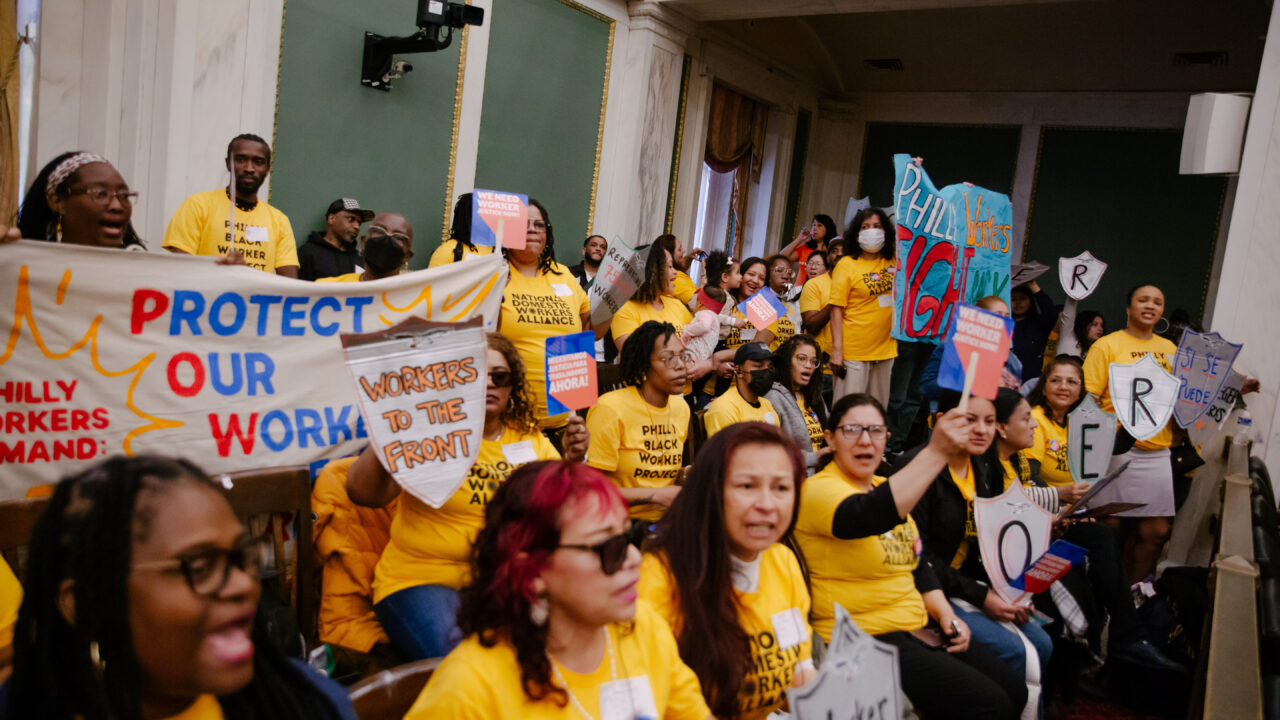
For two years, we went to City Hall every week. We attended open council sessions every Thursday morning, lobbied, took action, spoke at public comment, held up giant signs, and wrote op-eds. We spent as much time helping workers prepare to testify as we did writing the bill, because a worker telling their own story to a council member has a greater impact than anything an organizer or lawyer can say on their behalf. The coalition showed up organized and ready, wearing matching shirts and following a plan, and lawmakers took notice. Alongside the Philly Black Worker Project, El Comite de Trabajadores de Restaurantes, and the Philadelphia Council of the AFL-CIO, we fought for protections for all workers, regardless of immigration status, relationship with the carceral system, worksite, or language. At every step we were backed up by Councilmember Brooks, who understands that without people power legislative wins are empty.
What moved lawmakers most was their personal connection to domestic work and our tenacity. Domestic work is personal, and almost everyone in Philadelphia (and the country) has some connection to it. Many lawmakers were raised by domestic workers or had grandmothers and great-grandmothers who did this work. When a room full of women who looked like their foremothers told them what was happening behind closed doors, it reached them in a way a policy memo never could.
But even then, the mere familial connection wasn’t enough. We were fighting big business lobbies as well as apathy and antagonism towards low-wage women of color, immigrants, and US-born Black workers.
I’ll be direct about why this matters so much. It’s easy to see worker leadership as a luxury. When Amazon, the Chamber of Commerce, the Restaurant and Lodging Association, and the hotel industry fought us hard, I knew the odds. If it were just me, Nicole the organizer, against an Amazon lobbyist, I would lose. But it was never about paid organizing staff, lawyers, or Councilmember support. It was hundreds of domestic workers and other low-wage workers who built real relationships with lawmakers, meeting them face-to-face every time. That’s why we won. I now believe worker leadership is more than a moral or effective choice. If you want to truly change workers’ lives, it’s the only choice. When the bill was formally introduced, a veto-proof majority of the council had already signed on. In May, it passed 16-0. As one of our retired member leaders put it the day it passed: ”We’re not asking for favors, we’re demanding justice.”
And then the real work began.
The POWER Act is 44 pages long and amends seven existing labor laws to strengthen them. Winning it took three years. Putting it into practice is a campaign of its own, and we’re treating it that way. We have an 18-month plan, training sessions where immigrant workers teach the Office of Worker Protections how to investigate cases in private homes, and a new organizing push in Philadelphia’s wealthiest neighborhoods to identify repeat-offender employers and hold them accountable.
We are not naive about what we are up against. Business interests didn’t go away when the mayor signed the bill. They’re close to City Hall and would gladly kill the law by making it impossible to enforce. The current federal climate has made immigrant workers — the majority of those who fought for this law — understandably cautious about filing the claims on which the law depends. The economic climate makes the threat of losing one’s job very real. If anyone thinks you can pass a law and then just watch it work, they’re mistaken. Printing a million know-your-rights flyers won’t, by itself, change the power imbalance. Organizing will. And that’s why the win is bigger than the law itself. Along the way, we built worker leaders, deepened a multiracial coalition, and showed that working people who have no wealth still have power, enough of it to beat the people who do. New campaigns are already emerging from it, including legislation for temp and staffing-agency workers that we are now helping to build.
The women who clean Philadelphia’s homes and raise its children, and the workers who cook its food and staff its warehouses, built this law and will make it real. Underestimate them at your own risk.
Nicole Kligerman is the Pennsylvania Chapter Director of the National Domestic Workers Alliance. This piece is adapted from NDWA’s case study on the POWER Act campaign, available in full here.