A Conversation About Blackness and Criminalization with Black Alliance for Just Immigration
The politics of divide and conquer are as present as ever, and so how do we gather all that has happened already and take that technology that we have developed — that comes from our creativity, that comes from our hearts, that comes from our spiritual spaces, that comes from our learnings of being in community, and being on these battlefields together — and sharpen those tools?
Miski Noor: Nana, I want to start with the fact that your organizing experience is both deep and wide. And so, I’d like to just start with grounding us there. Please tell us what brings you to this work.
Nana Gyamfi: I come to this work because it’s part of the work of Black liberation, which is really important to me. It’s been my life’s work in different ways and forms, whether it has been as an organizer coming up in the ‘80s and ‘90s — because I’m old as dirt and twice as funky — or whether it’s been as a movement attorney that has represented folks who are organizers, who have engaged in protest, who’ve been targeted by the state in one way or another. Whether it’s been as a professor in the Pan-African Studies Department, where I was able to work with young folks who were organizing and trying to get young folks into organizing, or operating now as the Executive Director of BAJI (Black Alliance for Just Immigration). It’s all been about Black liberation. How do we build the power that we need in order to change the conditions of our people and have us be more free?
MN: Thank you for that. To continue with what you named about building power, please bring us into the current moment: with the unrelenting attacks on immigrants by this current administration in the White House, how is BAJI responding in this moment, and what does your work look like? I am particularly interested in the Black migrant ecosystem that y’all have been working inside of.
NG: I think what we’ve been really trying to do is see how we engage in the work that we engage in, which, yes, is organizing work. There’s a civic engagement piece which we just sort of bind up in a discussion of our power building team. There is legal and policy advocacy work, there is work around culture shift and narrative building. There’s work around research and reports.
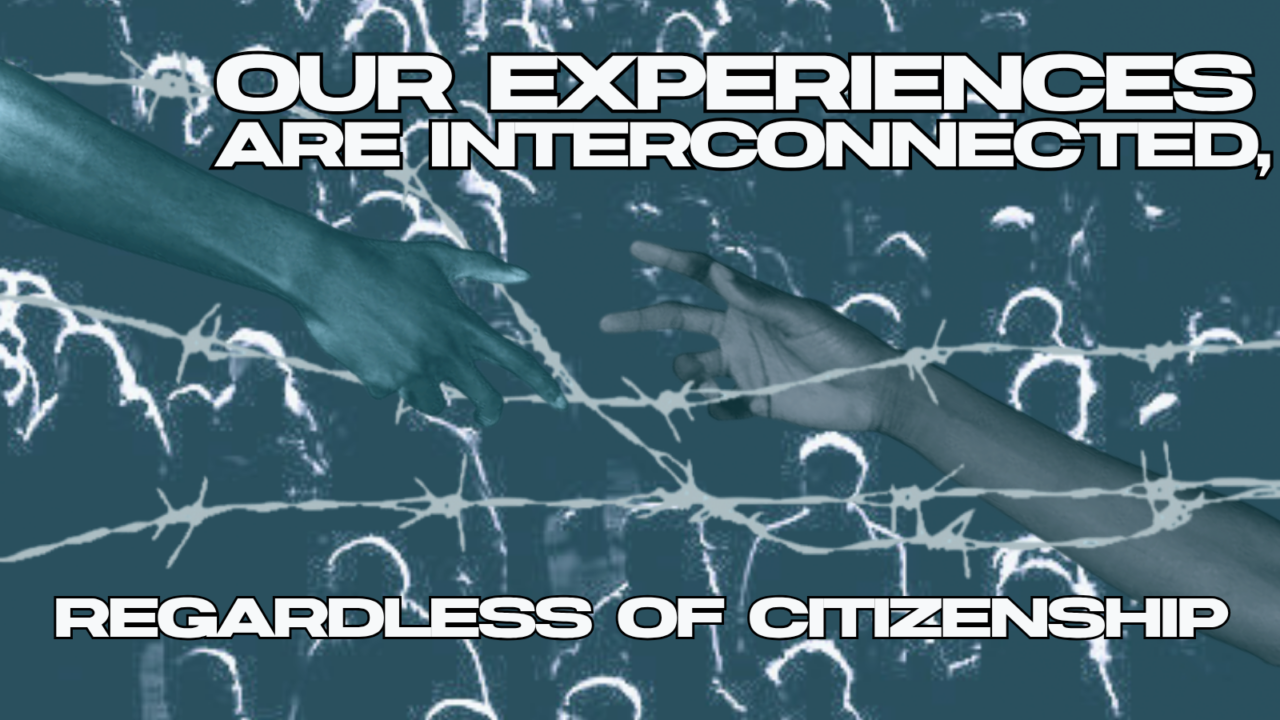
So that’s how we’re connecting all of the dots, giving ourselves and our communities more spaces, more ways to be able to jump into this work, helping them to understand that some of this work they’re doing already. It may not be under the title of an organization but, you know, you’re already in the process of fighting for Black liberation in the space that you’re in. And it’s really about how do we bring all of that together so that we’re aligned, so that we’re moving in a way together that allows us to actually do so in a powerful way, which is what the Black migrant ecosystem is about. It’s not a coalition. It’s really a mass organizing space where Black individuals, regardless of immigrant status or citizenship, are able to come and work together. You don’t have to be part of an organization, you know. You don’t have to be part of a 501(c)3. You might be part of a cadre or collective, you may not be. It might be just you and there’s work that you’re doing in your community: you’re concerned about what’s happening with your community, and you want to jump in and see what you can do.
So it’s a place to get information about what is happening. It’s a place to share information about what is happening in your neighborhood, what’s happening in, you know, your local community or statewide community, or happening with your group of folks that you’re engaging with in terms of Black folks, and particularly Black immigrants. It’s a space where people can get some training or technical skills that people are looking for. It’s a space where people can talk about some of the things that they’re afraid of, some of the things that they’re concerned about in a safe space. Because it’s a space that’s open to all Black people, where we really want to lift up the best of queer feminist abolitionist values, centering the people who are the most marginalized, the people who are the most impacted by all of these oppressive systems. So we have a consistent crew of people that show up and show out, you know, in terms of getting and sharing information and really being willing to dig in. And we’re excited about moving that to being more in-person as well as continuing the virtual work that we’re doing, and seeing how we can have this space also be more intergenerational. How do we use the information and the technology that people have been using and see how we can apply it in this time? We have people who have been fighting in the Civil Rights movement, the Black Power movement, the war on drugs (which was really the war on Black people), the Movement for Black Lives; there’s so many lessons just there, and those aren’t the only movements that Black people have been a part of, that Black people have led, including Black immigrants. So let’s say we got folks still kicking and doing the darn thing in their 80s, right? All the way to these young folks that we see walking out of schools. How do we gather all that has happened already and take that technology that we have developed — that comes from our creativity, that comes from our hearts, that comes from our spiritual spaces, that comes from our learnings of being in community, and being on these battlefields together — and sharpen those tools? To get clarity, learn lessons, and repent for the past, in terms of transgressions, and work with each other, heal some wounds, so that we can be even more powerful as we face a more snarling, snapping foe than some of us have in a long time.
MN: Thank you so much for sharing with me the expansiveness of the network y’all are building and the connections it is making, Nana. I’m going to bring us back out wider to one of the goals of your work: to cultivate global Black solidarity. And so, for people who may be unfamiliar with transnational solidarity work, what does that mean? What does your international work look like in particular?
NG: This, to me, is like the crux of really our power, this transnational work. And I think that history bears that out, right? Where we have gotten action is when it has been transnational. Some cases we know, and in some cases that we’ve read and learned about, have to do with people that were in the Black Liberation Army. People that depended on some transnational solidarity. That’s why Mama Assata was still in Cuba. Our folks remember, even within the Black Panther Party — not even going to the military side of it — even with the Black Panther Party, they went to Algeria. You had people that went to Tanzania. You had people that went to Ghana, right? What do we learn from Black queer folks in Ghana, in Uganda, in Nigeria, about what it means to be in situations where your existence is criminalized and you don’t want to leave? So we’ve had that solidarity that is on the “We Got Us” level. That has enabled us to do what we needed to do in terms of our liberation movements.
When we decided that we were concerned about Black folks in South Africa, and we were going to make sure that that apartheid regime ended, that was a transnational effort. Haiti is even in people’s brains, because of the transnational effort of Black people. If it wasn’t for that, nobody would be talking about Haiti. And to the degree that we hear people now talking about Sudan, talking about the Congo, etc, it’s been because of a transnational effort. So there’s a number of things that we look at as we’re looking at how we engage transnationally. One piece of it is the work that we are doing as part of the Cross movement table over at M4BL, being a lead at that table and really looking at how liberation movements or movements for power were successful and what are the lessons we can learn from that. What are the lessons that we can learn from our cousins and siblings in these other countries who actually have been in positions of power, who are the left — I’m gonna use that language — who are progressive, who are looking towards liberation. And what are the lessons we learned? What works, what doesn’t work? What technologies they may have had, what tools, what things they didn’t see coming? How do we make sure that we see that coming? What are the things there? Part of it is about the political education piece, so that our folks are not saying things like, “this is not our fight”, but also, that people are understanding what is the fight, why it is they’re fighting, and what are some of the tools with regard to that fight. Part of it is showing up in civil society on the international level, and being part of coalitions or conversations that are regular with our folks that are on the continent, with our folks that are in the Caribbean, with Black folks that are in South America, and in Central America, and in Europe, and in Canada. Really engaging in conversations, comparing and contrasting, and seeing how we can be in collaboration with one another on some of these issues that we want to deal with, in our home countries, in each other’s countries, but also just on a global level. And then we’re trying to engage in the global institutional spaces. So, you know, engaging with the UN Permanent Forum for People of African descent. When UNPOL, which is the UN agency that looks at police and policing, came to the U.S. to do a report, we were engaged both in Los Angeles and in New York in terms of testifying and organizing events. We also organized ourselves with respect to the Inter-American Human Rights Council, and we’ve done reports with them. That’s mainly been about Mexico, Central America, South America, and the Caribbean to some degree, these different international institutional spaces that we’ve also been in. So, we’ve been trying to engage in these conversations.
MN: So my next question kind of continues on the same thread. Can you talk to me about how Black people, regardless of immigration status or citizenship, are impacted by anti-Blackness? What are the connections between the prison industrial complex and immigration detention practices, and what are the consequences for Black communities if we do not understand how the two work together?
NG: So, it’s a serious situation because what we see happening right now is this expansion of the police state. It’s partially because there hasn’t been a good understanding of how anti-Blackness and criminalization are connected, and how that then becomes something that impacts people, even when they’re not Black. When we look at the criminalization of Blackness that is resulting from the enslavement of Black people in this country, and obviously outside of this country, it’s rooted in imperialism, colonialism, and enslavement — chattel slavery — that’s what it’s rooted in. When you’re talking about those three things, you’re automatically talking about militarism, right? Because that’s how you engage in imperialism and colonialism. You’re automatically talking about that sort of domestic form of militarism, which is policing. So it starts on that criminalization side and that side is a side that doesn’t come out of any sense of justice. That doesn’t come out of any sense of righting the wrong. That only comes out of a sense of punishment and control, particularly of Black people. And we say “racial capitalism,” but as Ruthie Gilmore has pointed out, there’s no such thing as any other kind of capitalism. Automatically you’re saying racial. Automatically you’re saying gender. Automatically you’re saying poverty. You’re already saying these things, but just using that term for now, in terms of racial capitalism, it is anti-Blackness that comes with a big side of profit, right?
And so when we look at slavery by another name, we see that literally the law was manipulated through the use of white power and white control to create scenarios in which Black people could just be rounded up and imprisoned for the purposes of money. Whether that was debt collection, or whether that was because they were leased out to private entities, or because they were substituted, like the California firefighters, for the cost of hiring people that you actually gotta pay a wage and health insurance and pensions to. That creates this frenzied situation, which just extends the frenzied situation of the transatlantic kidnapping and enslavement of people. And of course, one of the ways that that more recently shows itself is in the ‘94 crime bill, which starts out here in California as California Three Strikes in February, and then becomes this national issue in September. California did it first, as I tell people, liberal old California, good old Cali, the state of the sunshine and the beach.
Now, you wouldn’t think immigration was civil the way that they’re coming with the largest police forces ever between Customs and Border Protection and ICE, the detention prisons that are everywhere, and now the masked people, mainly men, that are running around grabbing people. You would not know this was a civil process, but it is civil. And so, it brings that racism, that anti-Blackness in particular, from this criminal punishment system into the immigration system, which is supposed to be civil, because Black people who are migrants are living right alongside Black people who are citizens. We’re all dealing with that over-policing. It’s not like they skip over and say, “oh my gosh, Miski, I see you’re not from here. Good for you, you know, continue going.”.\ And so, the over-policing, the over-charging, the over-sentencing, the coercive plea bargaining, all of these things lead to us being disproportionately imprisoned in the same ways that African-Americans are. The difference being that if you don’t have U.S. citizenship, then you find yourself now facing another system, which, again, is supposed to be civil but which has the same anti-Blackness that results in Black immigrants being 8% of the immigrant population, but 20% of those are facing deportation; which results in 76% of those Black people facing deportation because of criminal grounds.
When you start looking at the Caribbean, those numbers spike: 98% of Jamaicans who are deported are deported on criminal grounds. And, of course, we know these criminal grounds don’t have to be anything serious. Generally speaking, if you get 25 to life or something, they’re not deporting you, they’re making you do your time, right? So all of that then has provided this space for more private prisons, because so many of these detention prisons are private prisons. More police in the form of ICE cops. More connection between ICE and immigration enforcement and local law enforcement through these 287G agreements with various county sheriffs. But also, at this point, just through the passage of laws, right? That is happening both on the federal level and on the state level. And what does that mean? As I said recently to a group of Black folks in Mississippi, raise your hand if you think you don’t look like you come from some other country, because I’m here to disabuse you of that. And so, whether you’re Black and they’re looking at you as a citizen, or you’re Black and they’re looking at you as an immigrant, you’re still being looked at as a Black person who they have the capacity to take up. We see the violations of people’s rights — completely disappearing people off the street by people who aren’t identifying themselves, grabbing people and separating them from family and community, even when they’re doing things like showing up for their court appearances as they’re supposed to do. This surveillance, where they’re just giving up all the information on people on Medicare, all the information on people who pay taxes, all this information is gonna come back and is already coming back to all of the people in this country. And so, I think it’s critical that we see what’s happening with immigration enforcement as the tip of the spear for the creation of this mega-police state that includes the National Guard, that includes the Marines, that includes all these entities that we see descending on DC after we saw that same dissent in Los Angeles that allegedly was immigrant focused.
MN: To expand on that a little bit, can you talk to me a little bit more about the increased surveillance and its impacts on the carceral system and the targeting that Black people experience as a path towards criminalization.
NG: It’s so interesting. I remember when they first started putting up cameras and people were thinking of them as a positive thing. Not everybody. But the description, the narrative, was that it was a positive thing. First, it was a positive thing because it was keeping people from running the light. I don’t know how the camera kept people from running the light. People are still running the light, they’re just on camera, but okay. Then they tried to make it seem like cameras are keeping people from stealing things, or from committing crimes. And again, cameras do not do any of that. All they do is just record people, collect people’s faces, and enable people to engage in facial recognition. Then slowly but surely people start to give up their rights, and it becomes normal for people to give up their rights. We see that in how people now are so willing, in the simplest of situations, to give up their rights. You go through the TSA line and they say, “stand here so we can take your picture.” People just stand there. But if you say, “I opt out,” they act like it’s a personal affront, like you just insulted their mothers or something. Sometimes they’ll actually fight with you, and then other people look around and are like, “oh, I don’t have to do this?” No, you don’t. You can opt out. But people are so used to the gathering of biometrics. It’s considered a normal thing to most folks, when actually I remember a time when people would have protested loudly and were protesting loudly.
I’m thinking about this video I saw in DC where the National Guard and ICE and some other folks were walking through Georgetown. The look on those white people’s faces: classic. Classic. They were looking around — if you know Georgetown, D.C. — those white folks from Georgetown were looking around like, what part of the game is this? You didn’t hear these people were coming to DC? Oh, you just thought they were coming for Black people. Not you, right? And so I think it’s just critical that people are clearer about the ways in which surveillance that looks simple and looks like it’s just for these people over here, is actually where the test is. And then it becomes for everyone. So it’s important to make those connections.
MN: Okay, so that was actually my last question for you. I think this is going to be so helpful for so many organizers. Thank you for your time.