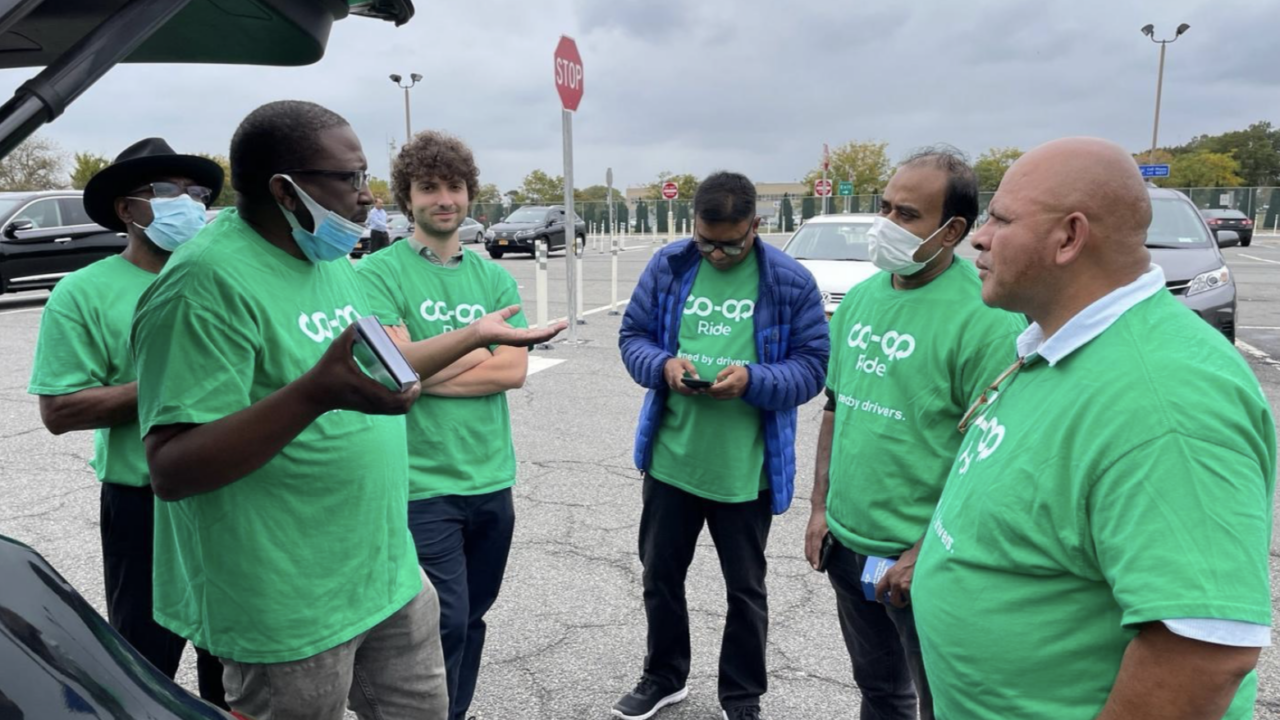
Part 2 of The Drivers Cooperative Series. The three installments of this series follow the first five years experience of The Drivers Cooperative.
In every sector of the capitalist economy, firms have developed business practices that routinize the extraction of surplus value from workers through production of commodified goods and services. This appears as the designation of “Key Performance Indicators” toward which managers optimize the operations of the firm. This instrumental rationality hides a political choice—whose interests are we optimizing for? From experience, we have learned that the firm under worker ownership, or under a strong union contract, can optimize for the most pressing needs of workers, rather than for maximal wealth extraction for outside investors.
This means that the worker-owned firm can demonstrate that “high road” labor practices are possible. The high-road firm will however exist in constant tension, internally and externally, as it attempts to compete in a market dominated by low-road firms. Sector-wide unionization, or regulation of the sector to mandate high-road practices as a new baseline, can universalize the worker-friendly innovations of the cooperative or unionized firm, as we see in the example of The Drivers Cooperative in the rideshare gig economy. In the rideshare industry, exploitation of workers is routinized through piece-rate pay, as described in this installment. What’s old is new again. As Marx explains in volume 1 of Capital, the “piece-wage is the form of wages most in harmony with the capitalist mode of production.”
In scarcely 15 years, Uber has called an entirely new low-wage workforce of over 800,000 drivers into being. Contrary to company promises of freedom and prosperity, driver incomes are in the lowest 10% of all occupations in the United States, and rideshare drivers are one the of largest low-wage occupational groups. Rather than providing a respite from the biases that lace our society, faceless algorithms have proven to be a mere automation of the arbitrary tyranny of the boss. Drivers often decry work for the platform as “slavery.”
While the growth of low-wage work has been a fixture trend of the last fifty years of neoliberalism, the rise of Uber is a new inflection point. For decades, corporations have toyed with language to occlude their essentially hierarchical relationship with their workforce as one of employer to employees. Walmart calls its employees “associates,” Starbucks baristas are called “partners,” and at IKEA managers and bosses are both “coworkers.” Uber, Lyft, and the other employers of the “gig economy” turn this kind of rhetorical fiction into a legal reality. They do this by misclassifying workers as independent contractors.
Employees have very specific rights under federal and state laws: a right to an hourly minimum wage and overtime, a right to organize under the National Labor Relations Act, a right to employer contributions for Social Security and Medicare payroll taxes, as well as state-provided unemployment insurance, and workers’ compensation insurance. These rights were won at the federal and state level primarily through policies of the New Deal era.
Independent contractors have none of these rights. Thus, through simply classifying workers as independent contractors rather than as employees, gig economy platforms are able to render the entire legacy of New Deal era labor law protections into a dead letter.
While this has numerous ramifications, what it means most significantly is that drivers have no guaranteed pay per hour—they are paid per trip, in other words, by piece rate, an exploitative employment practice forced into decline by the labor movement of the 19th century and early 20th century. The labor movement of those centuries demanded a fair day’s wage for a fair day’s work, leading eventually to a movement for a general strike on May 1, 1886. The strike of hundreds of thousands of workers on that day ended in breakthrough victories, with many employers agreeing to shorter workdays, and also led to the martyrdom of eight anarchist labor organizers. These events are now commemorated as International Workers’ Day: May Day. The fight for time rate—-rather than piece rate—pay lies at the very origins of the labor movement.
Successful campaigns for time rate compensation forced employers down the path of technological development and surveillance, what Marx terms “intensive” exploitation of optimizing the output of each hour of labor, rather than “extensive” exploitation of maximizing labor hours.
In the digital age, piece rate is back with a vengeance, enabled by misclassification of drivers as independent contractors, and lies at the crux of gig economy exploitation (and not coincidentally, to an even greater extent in the construction industry, which also relies heavily on exploited immigrant workers).
Uber has been widely criticized for classifying drivers as independent contractors, often by supporters of the yellow cab taxi industry. However, it is important to note that misclassification of drivers in this sector did not start with Uber. It started with the taxi industry itself, in New York City.
The job quality problems of the taxi industry have led to recurring class struggle now for over a century. This struggle has shaped the regulatory structures of the industry. The most foundational structure of the sector is the taxi medallion system, created with the passage of the Haas Act in response to the Great Taxi Strike of 1934. The Haas Act created a limited number of taxi medallions, essentially a permit allowing its owner to operate a vehicle for street-hail service in the City of New York. In a fateful decision, unlike other permits which cannot be sold or transferred and must be periodically renewed, medallions are issued once by the city, and then may be traded in a secondary market by their purchasers.
Around half the medallions were allocated to owner-operators, and half were allocated to fleet owners, who employed drivers under a more conventional worker-boss relationship. The medallion system opened the door to effective unionization by the mid-1960s by independent New York Taxi Drivers Union Local 3036. However, the system also led to the commodification and eventually quasi-securitization of the medallion itself, to the great detriment of drivers.
Fleet drivers had somewhat stable livelihoods until 1979, with various payment schemes based on splitting the metered fare with the fleet owner, and with a strong union contract—established through strikes and elections supervised by the city government in the 1960s (Mayor Wagner refused to deploy the NYPD to break pickets at taxi garages, dramatically strengthening the union’s hand in negotiations). The union contract provided for a time a measure of stability to the job of driving a taxi, while a vibrant rank-and-file movement in the union called for a more far-reaching reorganization of the industry under municipal or cooperative ownership.
In 1979, in the midst of a broad shift of the political-economic norms of New York City governance toward neoliberalism, taxi fleet owners successfully pressured the City to allow them to classify drivers as independent contractors and begin renting out taxis to drivers by the day, a practice called “horse hiring” that had been banned decades before. The union at the time was unable to stop this cataclysmic setback, and settled for an agreement that retained collective bargaining rights and the union contract, while drivers lost virtually all other rights as employees.
Not all was lost. Some retired New York City taxi drivers today still collect union pensions under plans that were won by Local 3036, but the legalization of horse-hiring opened the door to a precipitous decline in industry working conditions. Independent contractor status became the framework of the taxi and limousine industry, and did not face systemic challenge in the decades leading up to Uber’s arrival in New York City in 2011, aside from campaigns by the Machinists Union in the late 1990s and early 2000s that won collective bargaining rights for some limousine drivers under the National Labor Relations Act.
The lines between worker and owner have long been blurred in the taxi industry. Drivers own around 3,000 of the 13,587 medallions that have been issued, with the balance owned by outside investors, and some drivers lease out rather than drive their own vehicle. Around ten thousand more drivers rent taxicabs by the day or week, and around 85,000 drivers work on the other side of the industry, driving for Uber and Lyft, for a total taxi/rideshare workforce of around 100,000 drivers in New York.
Since the turn of the millennium in particular, industry actors inflated the value of taxicab medallions, with credit unions providing loans to drivers based on these inflated valuations. As a result, many of the 3,000 drivers who borrowed to buy a taxicab medallion found themselves in the nightmare situation of being “under water” on their loans when the rise of Uber burst the medallion bubble in the mid-2010s. The response to this crisis focused on restructuring the debt on leveraged and securitized taxi medallions, bringing much-needed relief to about 2,000 drivers, but has not yet sought to root out the foundations of exploitation in the industry in the pay-to-work structure of the medallion system itself.
While taxi industry owners can be rightfully blamed for creating driver misclassification, Uber brought it to an entirely different scale. Now over 85,000 New Yorkers try to make a living driving for Uber, most full-time, without any guarantee of making anything at all when they wake up and log in to the app each morning.
Faced with this reality, drivers and their allies have tried different strategies to win better pay, benefits, and rights on the job. In New York, driver organizations successfully won pay regulations that set a per-mile, per-minute minimum. Similar to regulations that already existed in the taxi industry, but with the twist that rates are to be adjusted by the Taxi and Limousine Commission (TLC) based on the “utilization rate” of drivers at each company. Despite shenanigans by the companies to game the utilization rates by limiting how many drivers can go online (the infamous “lockouts”), the regulations have by all accounts led to substantial pay increases. A victorious lawsuit filed by the New York Taxi Worker Alliance has ensured that drivers are covered by New York State’s Unemployment Insurance system, and the Machinists have succeeded in creating a Workers Compensation Insurance system for drivers, reassembling some of the basic rights that drivers would have as employees, while the piece-rate pay system remains intact.
In California, in 2018 a labor-backed coalition attempted to hit the misclassification problem at its roots, winning passage of legislation that created a simple test to determine if drivers should be considered independent contractors, and winning lawsuits forcing Uber and Lyft to reclassify drivers as employees. Unfortunately, the companies were successful in overturning the legislation in a referendum in which many drivers voted away their own rights, enticed by the supposed freedom offered by independent contractor status.
While these union-backed strategies attempted—in some cases successfully—to raise the floor in the industry, meaning the basic standards that all companies were required to uphold, The Drivers Cooperative approached the problem of job quality from a different angle. It attempted to raise the ceiling, demonstrating that superior “high road” labor practices are possible in the industry.
We did this in two ways. First, we analyzed the standard pricing on New York City rideshare trips. While the companies use black-box algorithms that de-link driver pay from rider fare (algorithms which function differently for different riders and drivers for the same trip), the minimum driver pay is set by the TLC. Uber tends to pay drivers the bare minimum allowed by the TLC, while taking an average 25-30% commission from riders (more on longer trips) over these minimum driver pay rates.
In the co-op, we found that we could peg per-mile and per-minute driver pay rates at 10% over the TLC minimums, charge a 15% commission to cover the co-op’s operating costs, and still have pricing that was often 5% less than Uber’s quote for the same trip.
While it was challenging on a grassroots marketing budget to generate very high volumes of on-demand trip requests and ensure a match between rider demand and driver supply (termed “network effects” in the biz), the “high road” pricing model basically worked. Riders paid less, drivers earned more, all through the lower commission that the co-op took.
This provided proof of concept, but we found that we would need to build a better app to scale in on-demand rideshare (which we have since done, more on that later). At the same time, we found incredible potential for impact and scale in another segment of the transportation market: paratransit.
Since the passage of the Americans with Disabilities Act in 1994, following an intensive campaign by disability rights activists and subsequent litigation, every public transportation authority in the United States has had a requirement to offer curb-to-curb “equivalent service” for people with disabilities. In New York City, the MTA runs the “Access-a-Ride” program to meet this mandate, outsourcing the majority of trips to a set of prime contractors, who then hire subcontractors to do the work. These types of prime- and sub-contracts for prescheduled transportation are a major source of business for local transportation companies, while Uber and Lyft dominate the on-demand market.
The Drivers Cooperative became an Access-a-Ride subcontractor, and rapidly grew to become the 10th-largest ground transportation company in New York City by early 2022.
We did it with an innovation that elevated pay and working conditions for drivers in a way that could hold a key for transforming the rideshare industry more broadly.
Like rideshare, paratransit is paid on a piece-rate basis. However, working conditions and pay for drivers in the paratransit segment of the industry are often as bad, and in some cases worse than in on-demand rideshare. While per-trip pay may be slightly higher than on Uber even (despite multiple layers of commissions taken by brokers and their subcontractor in the long chains of contracting in the industry), driver pay is a function not just of how much each trip pays, but how many trips drivers can do in a day: the utilization rate again. The ideal for a driver is high utilization—many trips with very little “deadhead” time (time driving without a passenger).
With paratransit trips scheduled in advance over the course of a day, trips can be cancelled, leaving drivers with a hole in their schedule, or routes can be illogical, leaving drivers with long distances of “deadhead” miles to drive between trips. Both conditions can depress driver earnings. We saw that despite relatively high per-trip pay (even after broker and subcontractor commissions), there were high levels of driver churn in the Access-a-Ride program because cancellations and bad routing left drivers struggling to meet their daily earnings goals. Often drivers would quit in the middle of the day due to issues with routes provided to us or resulting from cancellations or unexpected traffic. This resulted in lower service quality for riders, many of whom had special needs requiring a skilled and trained workforce.
Just like in on-demand rideshare, the root of the problem was piece-rate pay. Drivers had no guarantee that they would get enough trips each day to make a decent day’s wages.
We did the math, and realized that the co-op could create an hourly pay guarantee—a first for the gig economy—which could be sustainably funded through the co-op’s 15% commission. Instead of waiting until the end of the year to issue dividends, we could return some of the co-op’s revenue to drivers every day to help members who had a bad day on the road and missed their earnings targets. We decided to run a pilot called the “Economic Security Program.”
The approach was simple. Drivers were signing up for shifts. We guaranteed drivers who signed up for Access-a-Ride shifts that if they attempted all their trips (in other words, if they kept driving for the co-op for the day even if a trip in the middle of the day was canceled), the co-op would guarantee them a minimum of $30/hr gross of their vehicle expenses (which vary by driver/vehicle) for the duration of their shift, calculated from first pickup to last drop-off, or their scheduled shift end if their last trip got canceled.
Drivers kept all their earnings from their trips, less the co-op’s standard 15% commission. We used the commission to cross-subsidize driver pay. If they made more than the equivalent of $30/hr from their piece-rate pay on their trips, they would keep it. However, if they made less, the co-op would pay out an extra “top-up” payment to bring their daily earnings to $30/hr. It was a hybrid that blended the best of piece rate pay (the opportunity to make more) with the best of an hourly wage.
The program was wildly successful. Driver turnover dropped almost to zero.
We started out running the program by doing daily calculations of needed top-up payments in Excel, which was a bit laborious. Eventually, we automated it with custom code. We called it the “Economic Security Program.” The pilot, which ran from February 2022 to September 2023, paid out $9,007,230.30 for trips, and $225,116.52 in Economy Security Program guarantee “top-ups” to bring hourly wages for participants to at least $30/hr.
To build on this, we began developing a route optimization tool that would allow us to increase utilization more, guarantee more on-time arrivals, and boost driver pay still more through getting more trips done in less time. We learned that the problem of routing we were solving in practice is actually a well-known computer science problem, called the “Traveling Salesman” problem. The problem set is a given list of doors a group of “traveling salesman” needs to visit. The challenge is to assign each “salesman” a route that optimizes the use of their time, and allows them to get to each door in a specific time window. This dilemma may look familiar to organizers who have ever tried to cut turf on a large scale for door-to-door canvassing. We had stumbled on a unique scenario where a classic problem of math and computer science could be solved to improve job quality for drivers.
We realized that maybe we didn’t need to reinvent the wheel. Seen at a level of abstraction, the traveling salesman problem in paratransit is essentially the same problem that UPS and Fedex solve every day when they schedule deliveries of millions of packages. We realized that we didn’t need to build a new tool from scratch—we creatively repurposed an existing API for routing package deliveries by building a wrapper that would input the specific parameters and data we needed for Access-a-Ride. As we further improve this tool, it will allow the co-op to further increase utilization, opening the door to higher hourly guarantees.
While providing guaranteed hourly pay and creating a route optimization tool may not sound like a socialist breakthrough, it was a rupture with fifty years of piece-rate pay in the industry. It demonstrated that if our small co-op can guarantee drivers an hourly wage, then the industry behemoths certainly can.
And if they can guarantee hourly pay, that means they can provide drivers with employee status.
The above-market pay standards created by The Drivers Cooperative also support a broader hypothesis: if unions can raise the floor in an industry, co-ops can raise the ceiling.
Imagine if a worker-owned alternative operated in every industry in the United States, experimenting and demonstrating that better standards are possible?