Listen to the interview here.
This interview has been edited for length and clarity.
OPENING
EMANUEL NIEVES
Hello and welcome. I am Emanuel Nieves. I am the Director of Policy and Research at Liberation in a Generation. LibGen is a national movement support organization that works to build the power of people of color to transform the economy, who controls it, how it works, and, most importantly, for whom. We at LibGen are really excited to be partnering once again with the team at the Forge to guest edit this special edition on corporate power and its various intersections in our lives and in our economy.
Building off of previous efforts that we’ve done here at LibGen to bridge the gap that we see between anti-monopoly researchers, policy advocates, and grassroots leaders, we’ve curated a series of conversations with varying groups of experts to explore and connect on these issues that intersect with corporate power.
Joining me today for this conversation is Sue Holmberg, a political economist and associate director for research at the independent business team at the Institute for Local Self-Reliance (ILSR), an organization that for the past fifty years has worked to build local power and to fight corporate control. Susan holds a PhD in economics from the University of Massachusetts Amherst. Also joining me today is Lenore Palladino, an associate professor in the Department of Economics and School of Social Policy at the University of Massachusetts Amherst. She’s a research associate as well at the UMass Amherst Political Economy Research Institute and a senior fellow at the Roosevelt Institute. Lenore holds a PhD from the New School University in economics and a JD from Fordham Law.
We’re going to be diving into a conversation about the conscious and unconscious ways that we are contributing to corporate power and concentration. How our collective monies — public, private, direct, indirect, intentionally spent or not — contribute to the economy that we have today. The one that at LibGen we call the oppression economy, through which we see wealthy elites and big corporations using the tools of theft, exploitation, and exclusion to build wealth, to buy more political power, to ultimately rig the rules of the economy and democracy in their favor.
COMING INTO THE WORLD OF CORPORATE POWER & ECONOMIC JUSTICE
EMANUEL NIEVES
Before we jump into the conversation, Sue and Lenore, what brought you to this world of corporate power, of concentration, of monopolies, and to the fight for economic justice? And maybe I can start with you, Sue, and then we’ll go to you, Lenore.
SUE HOLMBERG
Thank you so much. I’m so glad to be here. I guess my consciousness about economic justice started really early. It’s personal. I was raised by a single mom who was cobbling together working-class jobs, catering and cleaning houses, and she even worked at a Lutefisk factory, which is a great shout-out to Minnesota. And just living in that kind of precarious environment set me off on a career path of trying to understand how could this really intelligent, educated person be so vulnerable and what’s wrong with the system that we’re in? If I was asking that question today about her, it would be so much worse. This was the 80s and the 90s, and we actually had stable housing and food. So that really drove my inquiry into economics. And then, as I was finishing my PhD, the housing market crashed and I joined the Roosevelt Institute, which was really at the vanguard of talking about the financial industry and a bit about corporate shareholders and what they were doing to the economy. And likewise, I was drawn to ILSR because of the work they were doing on monopoly power. And it’s just really amazing to see how much thought has developed, and evidence, and research, and advocacy in the last fifteen years around these issues.
LENORE PALLADINO
Yeah, so thanks for having me too. It’s so great to be here with you all and with my friend Sue. It’s a great question. So I come from a family where my grandfather worked for the GE (General Electric) factory. He worked a steady job for thirty-plus years. He didn’t go to college. He was a POW (prisoner of war) in World War II and got this job to support his family, and then had a pension that helped me go to college. So that sort of story of the white ethnic working class, becoming middle class, is very much my family story. And all the women in my family were public school teachers, so part of unions. And then, when I got to college, I started engaging in labor organizing in Chicago and was in college at a time when there were major protests against the IMF (International Monetary Fund) and the World Bank happening in the United States.
There was a growing global justice movement for labor issues and against corporate power. And I was really lucky to start working with Jobs with Justice and really right at the beginning of landing on my own, sort of see these stark issues of structural racism in Chicago and also reflected around the world, and hearing from all these leaders in the labor movement about corporate power and how harmful it was. And I did a lot of labor organizing and political organizing for a long time. And really, the question became, where is the money going? And I think that’s what drew me more in this part of my life to focus so much on what corporations are actually doing. We know the harms, we know how it’s affecting working people, how corporations and economic inequality perpetuate racial injustice, but where’s the money actually going? And I think that’s where I’ve been really focused on for the last couple of years. What are the rules that shape [and] enable us to have this incredibly extractive economy?
AMAZON’S GROWING PRESENCE IN PUBLIC PROCUREMENT
EMANUEL NIEVES
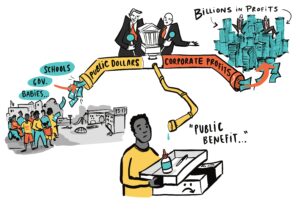
Sue, last year you and your team put out a really important and expansive report (Turning Public Money into Amazon’s Profits) that looked at some of these questions about how a large amount of our money, specifically our public purchasing, procurement dollars, are being captured by Amazon.
People know what Amazon is, but many people might just associate it with being a consumer-facing company, two-day prime, personal shopping mostly. Some other folks may also know it as a huge player in web services: whenever half the Internet’s down, it’s probably because it’s on Amazon’s web service. But I imagine that fewer people think of Amazon as something that’s really connected and ingrained to how our local governments source office supplies, cleaning materials, the paper that they print, whatever thing you get at the DMV.
In my limited experience with the topic of public procurement, it tends to be framed as a tool for the government to support community-rooted business, so you’re creating a vibrant local economy. But your report obviously tells a very different story about procurement and who is involved. And so my first question to you is, how big a player is Amazon in this public procurement space?
SUE HOLMBERG
Really, really big. Its reach is growing quickly, and also it’s just getting started. From our research, we estimated that local jurisdictions — so cities, counties, and school districts — spent $2.2 billion with Amazon in 2023, which is a fourfold increase from 2016. And notably, school districts account for 70% of the spending. Statewide, it’s a little harder to tell because there’s not great transparency, but we estimated at least $250 million with Amazon business in 2020. We didn’t track it from 2026, so that’s just our first benchmark. But that’s very likely an understatement.
And at the federal level, they’re moving into the General Services Administration. It’s called a Commercial Platforms Program. The federal government is trying to set up an e-commerce system, which is great. But Amazon, in the first two years of the pilot program, captured 96% of those sales. So even though they talked about this as a great place for competition and so forth, it’s completely dominated by Amazon.
EMANUEL NIEVES
That’s a huge amount of money, particularly when you mentioned that 70% of these dollars were coming from school districts, which we know are some of the public institutions that are really struggling with budget resources. And most often, the ones that are facing budget cuts are being told to take on more students, do more with less. And so I guess my follow-on question is, how has Amazon gone about basically quietly building this thing that has become the go-to place for purchasing basic supplies for these government institutions? And, how did you find those answers?
SUE HOLMBERG
How did they do it? It started quietly ten or so years ago, a classic revolving door story. Hiring, first, Anne Rung, who was an Obama administration official, to run the Amazon business side and just continue to hire people at the local, state, and federal level to inform how they were going to set up the system and the kind of policies they wanted to push forward. How they really sold it to different governments was their narrative. Procurement comes with a set of principles and norms around transparency, and competition, and accountability, often about supporting small businesses. And they were pushing all of that. They knew what they needed to say and they have been advancing that narrative. And part of our report was disabusing people of this notion that they are fostering competition and helping small businesses when it’s in fact the opposite.
How did we figure it out? We FOIAed (Freedom of Information Act) a bunch of local governments, cities, counties, and school districts that serve 51 million people, 128 governments. We also FOIAed 122 state agencies and we also FOIAed the federal government with no luck with most of them,. But the Department of Labor actually came through quite a bit. And we looked at contract documents and interviewed public officials, procurement experts, and a lot of suppliers. And this is after Stacy Mitchell and Olivia LaVecchia had collected data from 2016. So we were able to kind of track what had happened.
EMANUEL NIEVES
You mentioned FOIA, which is the Freedom of Information Act. What does it allow you to do, and how difficult is it for people to get that information?
SUE HOLMBERG
Yeah, we have rights as citizens to ask for certain information, and it’s a balance because if we’re imposing too much cost on public employees, they might ask for money. So there is some give and take there, but we basically sent the same form to all of these different communities and received back their purchasing information for Amazon. And some of it was just an incredible detail. We have a citizens’ guide on our website that is a companion to our report. So, in terms of just how to do this, we have it all laid out and I can share that with you.
THE (EXTRACTIVE) PRICE OF DOING BUSINESS WITH AMAZON
EMANUEL NIEVES
That’s helpful. On another follow-up, Amazon is a huge business that carries with it a lot of power to dictate how we engage with it and how it engages with us. And it’s usually like any other big business: the balance is more in their favor than it is in ours. And so for these local governments it doesn’t matter the size of any institutions, they’re all small relative to Amazon. To be able to engage with an Amazon and the system that they’ve built over the past decades, what have been the general terms of engagement that Amazon has put on these institutions to be part of this thing that they built?
SUE HOLMBERG
To answer that, it’s kind of helpful to understand how procurement contracts work. A city or a school district will put out an RFP — request for proposal, — and they’re soliciting competitive bids. They want suppliers to provide price lifts and delivery commitments and other kinds of terms. So it’s very clear and transparent what is happening. Those proposals end up in the public record and it locks in low prices and helps the supplier plan out their business trajectory. It also provides appropriate volume discounts and just general transparency. So then you have group purchasing contracts. So one school or city will negotiate a contract, and then the other schools or jurisdictions can sign on and use that. It’s a template. But what Amazon has done is set up a group purchasing contract that a lot of communities are using. In fact, more than half of the city’s counties and school districts that responded to our FOIA requests reported signing on to an Amazon business group purchasing contract.
In Amazon’s group purchasing contract, there’s no clear and transparent commitments and terms. Instead, it says pricing will be subject to the market, and there’s nothing that actually is what a contract should be. We call it a Trojan horse contract, but it’s really been effective for them because the communities, the jurisdictions that have signed onto the contract, have definitely purchased more from the company. So it’s doing its job for Amazon, but it creates this false sense of oversight and is exposing these local governments to wildly fluctuating prices that would often exceed what they would be paying under a standard fixed price contract with a local vendor.
Meanwhile, in the fine print, Amazon’s saying, we won’t be vetting or monitoring any of these suppliers, so they could be coming from wherever all over the world. And there have been huge issues of fraud within sellers and that sort of thing. So it’s also not very safe. When you work with an independent supplier, they will stand by their product and it’s not counterfeit, and so forth.
EMANUEL NIEVES
In the report, you put a name to this, which is dynamic pricing, this “prices will be subject to the market” thing. When I read the report, I thought on a personal level, dynamic pricing, like an Uber in the middle of a rainstorm or after a basketball game is going to cost you a ridiculous amount of money, or buying an airline ticket close to the holidays or over a weekend is going to cost you a couple of hundred more dollars.
But when you all laid it out in the report, I just thought that’s kind of wild for a bunch of reasons. But at the scale of government, it’s really something else. And so I wanted to ask you a little bit more about how this dynamic pricing plays out in those terms? You mentioned it’s exposing local governments to wildly exceeding prices. Are there any specific examples that you all highlighted in the report that give some context to that?
SUE HOLMBERG
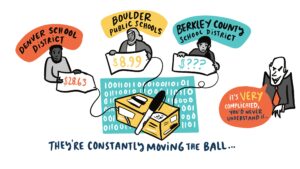
When I first started reading about dynamic pricing, I think it was a Vox article that said happy hour is dynamic pricing. There’s always been analog dynamic pricing, but what we’re dealing with now is on such a different level. These are algorithmic-driven price fluctuations that are constantly moving. They’re constantly moving the ball, and they’re based on, with Amazon, these opaque formulas based on huge troves of data, and they’re making adjustments based on shopper behavior and time of day. And Amazon is such a dominant player that they have this huge effect on prices in terms of pushing up market prices and just prices across the economy.
They are able to access their third-party supplier data and price information, as well as their competitors’ price information, in a nanosecond, and they’re able to constantly react to it. So it has this effect of continually pushing prices up. And it’s so common to think that Amazon is always offering the lowest price. We came across one official who said, “Well, of course it’s Amazon. Of course I’m going to get the lowest price,” because they’re just assuming that competition is there. But when you have a monopoly like that who has that kind of access to the data, it’s even more impactful than collusion. So the prices are even higher than if they were colluding with—
EMANUEL NIEVES
They were working with somebody else.
SUE HOLMBERG
Exactly, yes.
So, just as examples, we looked at 2,500 frequently purchased products like Elmer’s Glue and Bic pens, Lysol cleaning wipes, and copy paper, and jurisdictions spent $3 million on these commonly purchased items. And had they consistently received Amazon’s lowest price, they would’ve saved 17%. So if you’re thinking about the Denver School District, which is huge, they spent $5.7 million on Amazon business in 2023, if their prices had been 17% lower, they would’ve saved a million dollars. And think about how many teachers [that could hire], just a huge amount. So Amazon charged Boulder, Colorado, $8.99 for a twelve-pack of Sharpie markers on a particular day last year, and charged Denver Public Schools $28.63 for the identical product on the same day. Another day last year, Iowa City School employees each ordered identical cartons of Frito-Lay snacks. One paid $26.22, the other paid $34.31. So it’s not about local market conditions.
EMANUEL NIEVES
Lenore, I want to bring you into the conversation. So, in the report that Sue and her team published, they walk us through where the money Amazon is taking in from this business line comes from and what they’re providing local governments for those dollars, but the report also shows just how little of this money stays in and benefits communities. In fact, a really wild example in the report shows that while Berkeley County schools in West Virginia spent $1.3 million with Amazon business in 2023, just $142 went to sellers based in the state. And about a third of that went directly to Amazon, while the rest went to third-party sellers, mostly located outside of the US, mostly in China.
I want to talk about who they’re doing this for. They aren’t doing all of this to simply extract resources for the sake of extracting resources. They’re doing all this and more in service to something bigger. And so I wanted to ask you, what is driving a corporation like Amazon to be so extractive and so aggressive among these institutions, in the example of Sue’s report, but in countless other examples throughout the entire economy?
WHO IS [INSERT CORPORATE NAME HERE] DOING THIS ALL FOR & WHAT’S DRIVING EXTRACTIVE CORPORATE BEHAVIOR.
LENORE PALLADINO
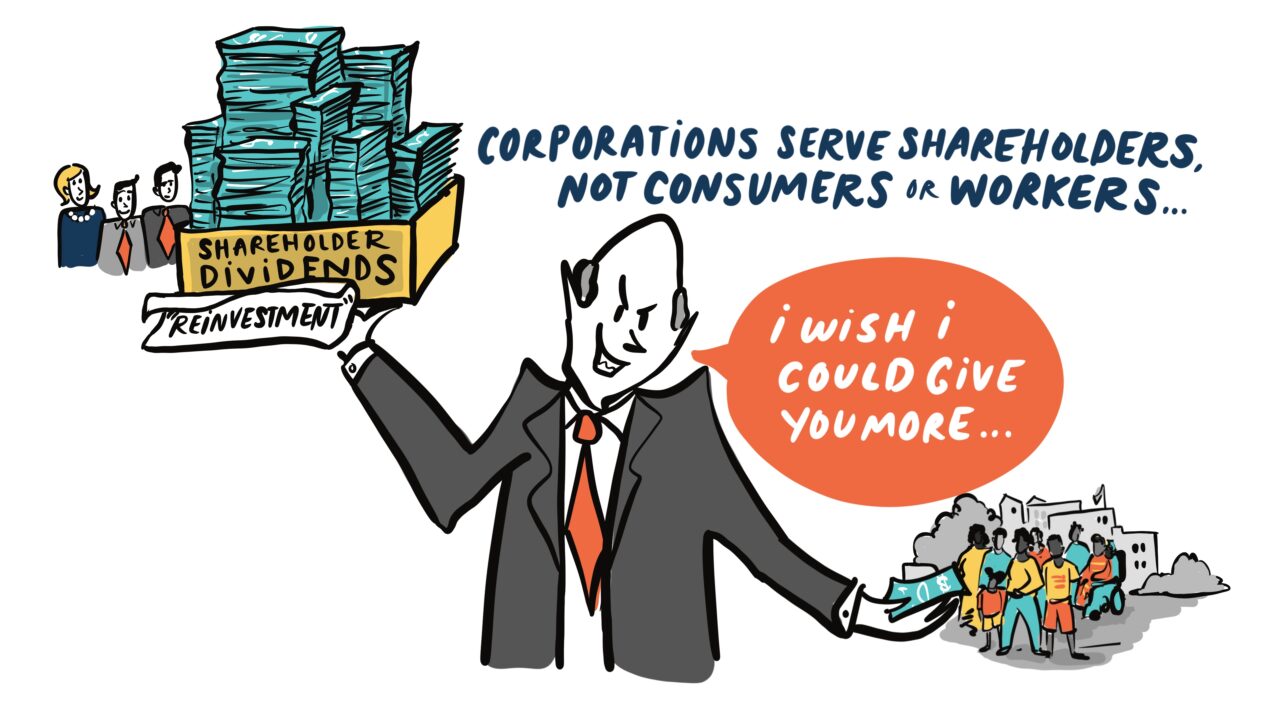
It’s a great question, and there’s certainly many different answers we could give, but what I’ve really focused on is the problem of shareholder primacy or the idea that the whole purpose of a corporation is to make as much money as possible for shareholders. And so they’re supposed to extract money from public school districts. They’re supposed to cut labor costs to the bare bone, even when it hurts the quality of their product. So this is a problem not just for Amazon, but across our entire economy. And it’s something that is kind of invisible until you see it. We all have this idea that corporations, okay, they’re out there making profits, but we sort of still have this mythology in our culture that, “Oh, well, they use those profits to reinvest in their business. They use them to pay workers.” What you really start to see, if you look at what’s actually happening, is that most large corporations are using the majority of their profits to make shareholder payments.
And part of the reason is simply that the leaders of most of our corporations are incredibly large shareholders in the companies they run. So it has two values for corporate executives. On the one hand, they make lots of money, and on the other hand, they get to keep their jobs because activist shareholders are happy. So we have this whole system that’s really set up to extract value from customers, from workers, and from communities, in this really important case of Amazon. And they can defend it by saying, “Well, this is the law. This is what we are supposed to do.” And so that’s really the place where we get stuck in needing to make real cultural and real policy changes.
EMANUEL NIEVES
I was listening to a podcast where Bob Iger, the CEO of Disney, was talking about the legacy of Walt Disney and how the company works to carry out all the things that they do, from the parks and the movies to everything else that they do and own. As part of this, he was talking about how they approach bringing their ideas to life, not so much from a cost perspective at first, but from making an idea great in reality, and if it makes sense for them. But at the tail end of that exchange, he said they approach their work in this way because they’re trying to serve shareholders as well as customers.
I found it interesting because of the ordering of those two, suggesting to me that, even though it’s their customers that sustain all that Disney is, does, has been, will be, it’s their shareholders who seem to me in that reading to be the most important group to the company. You do mention it before, but am I reading it correctly?
What informs the thinking and the motivations of a corporation like Disney, like Amazon, like “insert name here,” to really elevate shareholders above others? And then the other question is, you mentioned that some of the largest shareholders of these companies are the same people running them. And so I wanted to ask you, who are these shareholders beyond the head of an organization? Are they everyday investors? Is that the right way to think about it?
LENORE PALLADINO
So shareholder primacy is really a way that the wealthy elite get to perpetuate being a wealthy elite. Really, it’s kind of that simple if you think about it. We have a corporate governance system that’s set up so that shareholders are the only ones who make decisions for corporations; they elect the board. And so they make the major decisions about when a company merges, who’s on the board, who its executive is, etc., and they’re the ones for whom the corporation is supposed to be operating. This has been the case in state corporate law for a long time. How it’s been interpreted has really changed over time. So I won’t get into the whole history, but really, how it works now is that shareholding is actually incredibly concentrated.
We have this mythology in our culture that we’re all shareholders because for half of US households that hold some money for retirement, most of that retirement account is held in the stock market through a whole chain of first our employer and then an asset manager, and they’re buying stock on our behalf, etc. So we feel like shareholders, but shareholding is incredibly concentrated such that the wealthiest 1% of households in the US actually holds somewhere between 40% and 50% of all corporate equity. And the bottom 50%, when you flip it, holds just about 1% of all corporate equity.
Shareholding is incredibly concentrated by wealth, by income, and, notably, of course, because this is the United States, by race. So I was just looking at the most recent data from the Federal Reserve and Black and Latine households, they use Hispanic, but those two categories, as defined by Federal Reserve data, each hold 0.7%, not even 1% of all corporate equity. So this idea that “we’re all shareholders” is this myth that just serves to perpetuate these extractive practices. And I think that it’s part of how it’s been justified politically is by saying that we’re all benefiting from this system.
There’s other justifications that have been made by academics and by business leaders themselves who say that shareholders are the most important group because they’re contributing what corporations need to succeed. They’re contributing the financial resources that a corporation needs to actually produce the goods and services that it produces. And this is also mostly a myth these days. It hasn’t always been that way, but in the last generation, our lifetimes, our largest corporations have actually spent more money making payments to shareholders than they have gotten money from shareholders to finance their operations.
I have a project called The Myth that Shareholders are Investors. We use this term “investors,” and it’s in our national securities laws, investor protection. We use this term “investor” to refer to people and groups buying financial assets, buying stock in this case, but they’re not investing in the sense of what most of us understand investing to be. Investing is improving something. In the case of a corporation, it should be improving its production process. A company can invest in its workers. But when we buy a stock on the stock market from somebody else selling it, that money never goes back to the corporation.
So again, this idea of shareholders being this core group that’s the most important, it’s actually really the opposite, right? Shareholders these days are the least important. If you ask most people what company stock they hold in their retirement account, we have no idea. We’re holding index funds for those of us who are lucky enough to have an employer who gives us some type of retirement account. We don’t know. And in contrast, workers who have no voice in the business decision-making process of a corporation, even if you have a union, which is an obviously incredibly important institution in the workplace and in society. Unions are limited under labor law to bargaining over what’s called the terms and conditions of employment. Workers are not involved, even with a union, in the business decisions of the organization. What company can operate without workers, right? So when you think about who is getting to make decisions and who is most impactful on a company, it’s flipped. It’s shareholders who make the decisions, but it’s workers who make the value. And that’s really lifted up by these myths about who shareholders are and the shareholders’ importance to a company.
EMANUEL NIEVES
Yeah, that’s really helpful. There are two things you mentioned that I just wanted to lift up. One is this myth around shareholders and investors being the same thing. And the other piece is that, over the last four decades, corporations have been spending more money basically making these payments than they have been getting from investors or asset holders or whatever the term might be.
And there’s one way in particular that I know these shareholder payments are happening that you’ve talked about, it’s these share buybacks. Sometimes you might see it on the New York Times or CNN or wherever, any social media you might be on, “X company is going to make the largest buybacks of shares in the history,” and it’s usually in the history for this quarter because three or four quarters down the road, they’ll do it again. Could you just talk a little bit about that?
LENORE PALLADINO
So maybe I’ll define stock buybacks, and then I’ll just tell a little story about how important they are that you just triggered in my mind when you said what you see on social media, because it’s been going around Instagram and TikTok the last couple of days.
So companies that have their stock publicly traded on the open stock markets, that’s the New York Stock Exchange, Nasdaq, etc, they can go to the open stock market and do what’s called a stock buyback or a share repurchase, it’s the same thing, where they spend their own corporate money to repurchase their shares and put those shares basically back into their internal account. What that does is it mechanically raises the value of all the stock that’s still floating around the market because you have a company that’s worth the same amount of money, but you have fewer shares of stock out there. So it’s like every slice of the pie gets a little bit bigger. So the value of each share of stock goes up.
They do these stock buybacks in tremendous amounts, right? Billions of dollars at a time because they’re a way to keep the financial institutions, the traders on the financial markets happy. So much of the stock price of a company is tied to what financial analysts think of that company and what financial institution leaders think of that company’s prospects. And so stock buybacks are a way to signal to the financial elite that we are going to focus, no matter what, on raising our share price.
Every year it’s a new record. They’re expected to spend about a trillion dollars this year, a trillion with a T, on stock buybacks, and they contribute nothing to the company’s production process. None of that money, forget the workforce or making things better for customers, none of that money goes to simply buying more machines or supporting whatever their production process is or just improving the process that they’re supposed to be actually focused on, which is producing goods and services. They’re also completely unregulated, and they’re a great way, again, for corporate executives to increase their own pay because corporate executives are not paid like the rest of us. They might make some nominal salary, but the vast majority of their wealth is tied up in stock, and often, tied up in whether or not their stock price goes up can trigger all kinds of other bonuses and other rewards for them. So they care a lot about making sure the stock price continues to go up for, again, those reasons I mentioned, their own wealth, and also keeping their job.
And it was interesting because I saw just a couple of days ago there was an influencer who went up to an elderly man working in a grocery store. I think it actually was in Michigan, and he started asking him questions, and the man said, “I’m 88 years old. I worked for GM (General Motors), but they cut our pensions in 2012, and so I had to go back to work.” His name is Ed Bambas, I think. And he then proceeded to tell a really heart-wrenching story about his wife getting sick and needing to go back to work, etc. And this went viral, and the influencer raised about $1.7 million for him. And there were a bunch of heartwarming follow-up videos about him receiving the check and how grateful he was and everything.
And I wanted to make my own video, though I never would, but just sort of scream from the mountaintops. GM cut this man’s pension, along with hundreds of thousands of other workers in the post-auto bailout period. But then last year, for example, they announced $10 billion in stock buybacks. So what are we doing here, right? We’re looking at this in some ways, as a heartwarming story of people supporting a person at the very end of their life who shouldn’t be having to work eight hours a day. But at the same time, we’re missing the fact that it’s not his fault, it’s the fault of these large corporations who are prioritizing enriching a very small group of households in our country at the expense of everyone else.
And I thought this GM example — GM hasn’t invested in the EV transition the way they should have — they’re a really emblematic company in American corporate history. The fact that there are still people out there who have been suffering for thirteen years because of the loss of the pension that they earned. That was something that they earned, and that was taken from them in the auto bankruptcy. And then the company gets to turn around and continue to spend billions of dollars on stock buybacks. It just shows how flawed our corporate structures are, because everything that they did was perfectly legal.
EMANUEL NIEVES
Yeah. Thank you for that. You had mentioned something to the effect that corporations can mechanically raise their price. I’m not breaking ground here; this is just a legal way that they can manipulate their stock. There’s many other ways to think about it, but that is one way to think about it, which is legal stock manipulation.
WHAT POWER DO WE ALL HAVE TO DEMAND CORPORATIONS BEHAVE BETTER?
Many of us are alarmed by the rise of corporate power, particularly as you’re seeing it in full naked display over the last year, and what that does and what that means to us as workers, to our communities, to our neighborhoods, our towns, and our everyday lives. As people who are concerned about these issues, but also own stock in these companies through our 401(k)s or 403(b)s, I wanted to ask you, broadly, how much power do we have in that setup? How much power do we have to demand that an Amazon or some other corporation behave in a way that’s better for us, less extractive, less exploitative, less harmful?
LENORE PALLADINO
Like every demand, it has to be made collectively. As an individual, you don’t have a ton of power, and even if you have a retirement account through your employer, you have a pretty limited set of options. Some employers and some asset managers — who are the ones actually taking the money, pooling everyone who works for your employer with hundreds of other sets of employees, and then buying a set of financial assets to go up in value — might say, “Oh, you can opt out of owning gun stocks or certain kinds of sin-based stocks.” But other than that, it’s pretty tough. And we’ve seen really the rise and fall of this idea of ESG (Environmental, social, and governance) investing over the last couple of years, which was the idea that, “Oh, if we just kind of shift portfolios to be less exposed to fossil fuels and less exposed to gun companies, then we’ll improve social outcomes.”
But really what’s happening so quickly is that our financial institutions are becoming so concentrated and so powerful that it’s actually very hard to think about how we might put pressure on them, except that those of us who are in public and union pension funds, our funds are the ones that are backstopping the big private equity companies that are ruining our healthcare system, that are increasingly engaged in destroying retail, that are taking over childcare. And sometimes there’s all these regulations we’re working on and state-level efforts in this moment of really such impossible ability to make change at the federal level. But I just think if our public pension funds and union pension funds stop supporting these financial institutions, they wouldn’t have any money to manage anymore, and they wouldn’t be able to engage in all these extractive practices.
We didn’t talk about private equity so much. They operate differently because they have a different institutional setup, but the outcomes are the same: terrible outcomes for workers, terrible outcomes for customers and communities, and, in a lot of the care sector, terrible outcomes for patients and families. And it’s our money supporting it all, right? And so on the one hand, the answer to that question is really something that I think people who are listening to the Forge and who have been part of organizing are familiar with. It’s very hard to think about how to challenge something as an individual, but there’s a ton of power in collective demands, and I think that our financial funds are a place that we should be putting a lot of energy.
EMANUEL NIEVES
Thank you. I just want to bring in something that we had in another conversation about private equity and childcare. And the person that we spoke to in that conversation mentioned that she was an eighteen-year provider of childcare, and she recently closed her doors because the resources, the public resources, aren’t there. But what she was seeing from other small providers that were kind of in the same situation was these PE (private equity) corporations coming in and buying them out, not only doing that, but then also making them sign NDAs, non-disclosure agreements, and forcing them basically to operate the business as if it was theirs, take the heat, all that, and then do away with them once those terms were done.
LENORE PALLADINO
Yeah, it’s terrifying. And I’ll just add that I think that for those of us who are engaged in thinking long-term, we’re going to need to fight for major federal resources, for example, universal childcare. We’re seeing a really important campaign right now in New York, the Mamdani campaign has committed to free childcare, and there’s going to be, I think, a huge effort to make that happen. We have to have guardrails in place such that when we make big public investments, we don’t inadvertently set up the conditions where financial institutions can just come in and extract a ton of value. And that’s happening right now in healthcare and childcare. And I think as organizers and policy people, we have to be really proactive about putting these guardrails in place while we fight for increased public support and funding for social needs.
THE IMPACT OF AMAZON’S PROCUREMENT PRACTICES ON COMMUNITIES
EMANUEL NIEVES
Yeah, that’s important, and actually a good segue to you, Sue. Earlier in this conversation, I had mentioned this really mind-boggling example in your report about this school district in West Virginia spending $1.3 million with Amazon in 2023, and just less than $150 going to sellers based in the state. And so my question is, overall, based on the research that you all did, how much of these dollars were actually staying in and benefiting the community? And then what’s does the impact of Amazon’s growing presence in this space mean for local suppliers, and what are we losing?
SUE HOLMBERG
We gave that one statistic, but generally, we did not see money going into local communities through the Amazon platform. It’s not happening. When sellers have to operate on Amazon, they’re paying 45% of their sales revenue, which is insane. It is untenable. And the really sad thing is that so many local officials think they’re supporting small business by going with the Amazon platform, and they’re losing this industry, these office supplier companies. Furniture, janitorial goods, and office supply workers, the number of those companies has dropped from 650 to 450 over the last decade, which is a huge jump. And when we lose these businesses where, first of all, they’re providing such excellent service. They’re guaranteeing next day delivery, and ”Oh, you want a special box for each student in your classroom? Great, we’ll put that together. Oh, you need your copy paper delivered to the back office? Sure.” All of this service that, you know, how Amazon is, it’s like it’s amazing if you can find it sometimes at your house, half the time it gets canceled, so forth. So we’re losing that direct service of this industry.
But then the broader impacts are when we’re not spending public dollars on the local businesses in our towns and cities. That money, that’s property tax money and sales tax, it’s all going out. And when we see the school budget issues, and this is happening all over the country after the pandemic funding kind of dried up, and all these kids have such huge needs because they lost so much schooling. And these budgets are just under so much weight to then go to the idea that we are just siphoning this money out to these shareholders that Lenore is talking about is something we have to stop. We have to think differently about how we spend these public dollars.
EMANUEL NIEVES
For them to take a 45% cut is pretty outrageous. And to your point about untenability, for a small business that’s just starting off, or a Black-owned, or a Latino-owned, or a woman-owned business, historically, as entrepreneurs, it’s tough as a first-time small business owner. But all these groups have really difficult issues accessing credit and capital. And for you to take that leap and to hope that being part of this ginormous thing is going to work out in your favor is a huge leap of faith.
And honestly, it’s a trap. To me, I see it as a trap that Amazon puts out to be able to take in more revenue, but also to take out more competitors, if you will, and to own this space. And in fact, you all mentioned something about Amazon’s purpose with this, I’m paraphrasing, is to control. At 45%, that’s basically the end result: they’re going to control you, they’re going to control your community, they’re going to control the market, and take these resources out of them.
WHAT’S ENABLING RISING CORPORATE POWER & WHAT CAN WE DO ABOUT IT?
EMANUEL NIEVES
There’s something, Lenore, you’ve talked about and others have written about, but these issues aren’t unsolvable. And in the case of corporations, I think there’s this reality that we often miss, which is these organizations, these corporations, they’re not just something that’s just out of divine intervention. They exist because of us, through our governments, we’ve given them the power to exist, to operate, and to be among us. And so on the flip side of that, we also have the levers available to rein in these institutions more, to redirect them in ways that aren’t just about rewarding shareholders in this gamble that they’ve made purchasing a stock. And isn’t about Amazon coming in and taking advantage of local communities that think they’re doing the right thing.
And so, what are some of the ways that government, local, state, and or federal, all three have enabled these issues, these corporations to get bigger and to be more, just more omnipresent and more harmful to us?
LENORE PALLADINO
Where to start? Maybe I’ll give one piece that probably people know less about, which is that we have this really weird setup in the United States where corporations are governed according to state law, and they can choose to incorporate in any state they want, whether or not they have any connection to that state, whether or not they have a facility there, they have workers there, even customers there. And for historical reasons, most of the big ones choose to incorporate in the state of Delaware because it’s the most business-friendly state. So if you are an Amazon or any other big company, GM that I mentioned before, or you can choose to incorporate in any state, and we don’t have any federal corporate law to actually govern your behavior. We have this weird system where our federal financial market laws are really the ones that we try to use to regulate both their financial market activities, but then also to cycle backwards into governing their actual practices through what shareholders can do.
So this is a long way of saying that one really simple policy solution would be to have federal corporate law, and then we could work to build the political power to regulate corporations so that they’re not creating all this harm. But just the simple fact that we don’t even have federal corporate law is a huge barrier to a lot of the types of changes that we’d like to see. And then I also think we are going to be in a time of major structural change, whether we like it or not, so much of the federal government is being destroyed, the administrative state is being destroyed. And so something that I think we need to really think about proactively, and a lot of people are, is what is the type of federal financial regulation we want to build when we have the political power to make the federal government serve the public interest again. I don’t think we should go back to just relying on the rules that were set up in the New Deal in the 1930s.
We need to take into account how corporations have changed and how the financial sector is rapidly changing. Private equity is now so dominant, it’s not just a sort of side activity in our economy anymore. So I think thinking big and thinking structurally, I think there are a lot of great people in groups already starting to do this, but, and I feel this personally, even though it’s so tough right now to imagine having that kind of political power again, we need to be ready. We need to be organizing and strategizing now so that we can really put in place the major types of reform, structural reforms to our corporate regulation and our financial regulation, when we have the political will.
SUE HOLMBERG
I totally agree about evolving, but I also just want us to remind ourselves that we have great laws on the books that just weren’t enforced for decades, that do put up really strong barriers to outsized corporate power. So our antitrust laws certainly need improvement and need to adapt and strengthen, but it’s a really, really good start. And they’ve been, in some cases, just ignored, like the Robinson-Patman Act, which regulates price discrimination so that Pepsi can’t offer Walmart better deals. That’s just been ignored, which has completely changed, for example, the grocery landscape.
And our tax system for sure. The reason Amazon got such a foothold is because they were gaming state sales tax. They started in Washington. Bezos called it a small state strategy so that even though he was eyeing California, if he was operating in California, you would have to collect sales tax in California. So he was constantly gaming sales taxes, and it is a huge reason they got this early dominance over e-commerce. So that’s one example.
THE POSSIBILITIES FOR REINING IN AMAZON’S GROWING ROLE IN PUBLIC PROCUREMENT
EMANUEL NIEVES
Sue, maybe to close this out here, in the context of Amazon and this procurement issue, what have you found that people are doing or can do now to address these issues? Obviously, you and Lenore mentioned structural change, existing laws on the books, but what have people been able to and are able to do now to limit themselves, free themselves, of engaging with Amazon through this platform for basic supplies? At the state level, at the federal level, is there anything broader, bigger picture, forward-facing that people should be considering taking action on or putting pressure on legislators to mitigate these issues at those levels?
SUE HOLMBERG
Yeah, I think the local action is such a fun part of this report because we were really able to connect with small business owners and local officials. It takes just a few people to make this decision. Sandy Grodin, who is one of the suppliers, basically took his books to his city council and said, “Look at this. I cannot survive if I am a third-party seller on Amazon.” And they agreed with him, and they changed their policies. And someone in Missoula, Montana, raised the alarm about Amazon, and it was seeing more and more public purchasing at the county level, and the county commissioners changed the policy. So it’s really fun to work at the local level. This is what I love so much about working at ILSR: all of these citizen activists, they can get this information, they can FOIA this information. Again, go to our website and find out how to do that. And it can actually make a difference. And we’ve found this with our dollar store research. We really sounded the alarm on the problem with dollar stores and how they’re fueling food deserts, and communities all over the country are pushing back and finalizing ordinances to prevent these stores from coming in. So there’s a lot to do.
Federally, it’s a lot tougher right now. State-wise, we want to see more transparent systems in place, including big cities like New York, where it was also very hard to access any real information. Set up a system so that citizens can see how this money is being spent. That’s a huge start. And also don’t allow an e-commerce platform to compete with small business owners. I mean, that’s just a recipe for gatekeeping exploitation. Federally, I’m really hoping that the Amazon lawsuit, the FTC (Federal Trade Commission) lawsuit, continues and makes a difference in how Amazon is structured and behaves. That was a pretty huge move by the last administration’s FTC, but federally is always a hard one right now. Lenore is right, we have to kind of game plan for the next administration, and we certainly have a lot of ideas about how to do that. But especially making sure that officials do not let Amazon get away with fulfilling their small business goals, if that makes any sense.
EMANUEL NIEVES
Yeah, it does. I’ll just add more to it. In the report, you all flagged that Amazon, through its platform, can then take credit for the government’s goal to have 23% of its procurement dollars go to small businesses — but that still means that you have to go through Amazon, that 45% cut — because they have these smaller suppliers featured on here, which is ridiculous.
CLOSING
EMANUEL NIEVES
I appreciate you both, so thank you, Sue. Thank you, Lenore, for sharing your time, your expertise today, and for the work that you all do each and every day. And so my final question is just where can folks find you? Where can they find your work?
LENORE PALLADINO
Yeah, I have a website, Lenorepaladino.me. That’s where most of what I’m writing gets posted. And then I’ll just quickly add, if I can, I think the other thing that people can do is just be involved, whether you have a union, join the Debt Collective, or join the Tenant Union Federation. I think there’s so much incredible organizing happening right now, and I think, as Sue said, the more that we’re bringing pressure to bear at the local level, the more that we’ll have the potential to have power at the federal level down the road.
SUE HOLMBERG
That’s right. You can find me at ilsr.org, and I’m also on Blue Sky, Susan R. Holmberg.
EMANUEL NIEVES
Well, thank you both again. For more conversations like this one, visit forgeorganizing.org. And then for more information about Liberation in a Generation, check us out at liberationinageneration.org. Or you can also email us at partnerships@liberationinageneration.org.