The TeslaTakedown campaign exemplifies how we can build meaningful structures that allow for strategic spontaneity and mass participation.
Historians are going to have hundreds of stories of how people eventually eliminated the MAGA regime. While we’re still living in it, it’s helpful to get as many lessons as possible about what works.
We are in a moment where political reality is moving faster than our institutions can respond. Across the country—and around the world—people are stepping into action without waiting for permission, structure, or formal campaigns. This is part of a living pattern of the last decade: uprisings, flashpoints, and decentralized surges of people power. We saw it with Occupy Wall Street, with the Ferguson, Baltimore, and Minneapolis uprisings, and even before that in Greensboro, North Carolina, when four young men sat at a lunch counter and sparked a movement.
Some of these moments are organized ahead of time, others erupt spontaneously. In early 2025, a very important movement emerged: #TeslaTakedown — and looking back is gonna help us look forward to what we need to do now.
The Birth of #TeslaTakedown
Within hours after Jimmy Kimmel was taken off the air, organizers launched the Disney boycott. By comparison, Tesla took much longer to start. This made sense: early in Trump’s term, fewer people were activated, more people were confused about the threats, and the role of Elon Musk was an unexpected twist.
In early 2025, reports grew of the Department of Government Efficiency (DOGE) raiding government offices and thieving people’s personal data. At that moment, Elon Musk wasn’t just a billionaire tech CEO—he was effectively a “co-president.” His leadership at DOGE gave him sweeping power over budgets, federal layoffs, and privatization efforts that directly harmed workers and weakened unions. Tesla, his most public-facing company, became the symbol of that influence—and, for many, the perfect pressure point.
Scattered social media posts began with people expressing outrage, selling their Teslas, and online attacks against Tesla. It could have remained a trickle.
Moving from a few reactive posts to organized protests took a little longer. In early February, a professor at Boston University saw a small protest at a Tesla showroom in New York City organized by the group Rise and Resist. She organized a similar action locally and posted about it on Bluesky. Within hours, others were picking up the idea—including significant influencers on Bluesky, to do the same in their own cities.
A few organizers quickly understood the challenge: Tesla’s brand rested on a progressive base of buyers, investors, and fans. Protests at Tesla showrooms could reach that base directly, applying both moral and financial pressure. But a crew had to form to build a cohered structure — one able to dance with the decentralized nature of what was already happening.
A handful of people began building a website — calling it TeslaTakedown. Alongside, they built a toolkit for local organizers, and connected the protests through an Action Network map. Groups like ACRE (Action Center on Race and the Economy) lent communications capacity, while Troublemakers—a Seattle-based climate justice group—provided digital infrastructure. A few volunteers were vetted and recruited to host weekly coaching calls and webinars for new hosts. As the legal threats heated up, the Civil Liberties Defense Center held a mass briefing that gave hosts and participants sound legal grounding in what their rights were and why the threatened prosecution of peaceful protest would not happen.
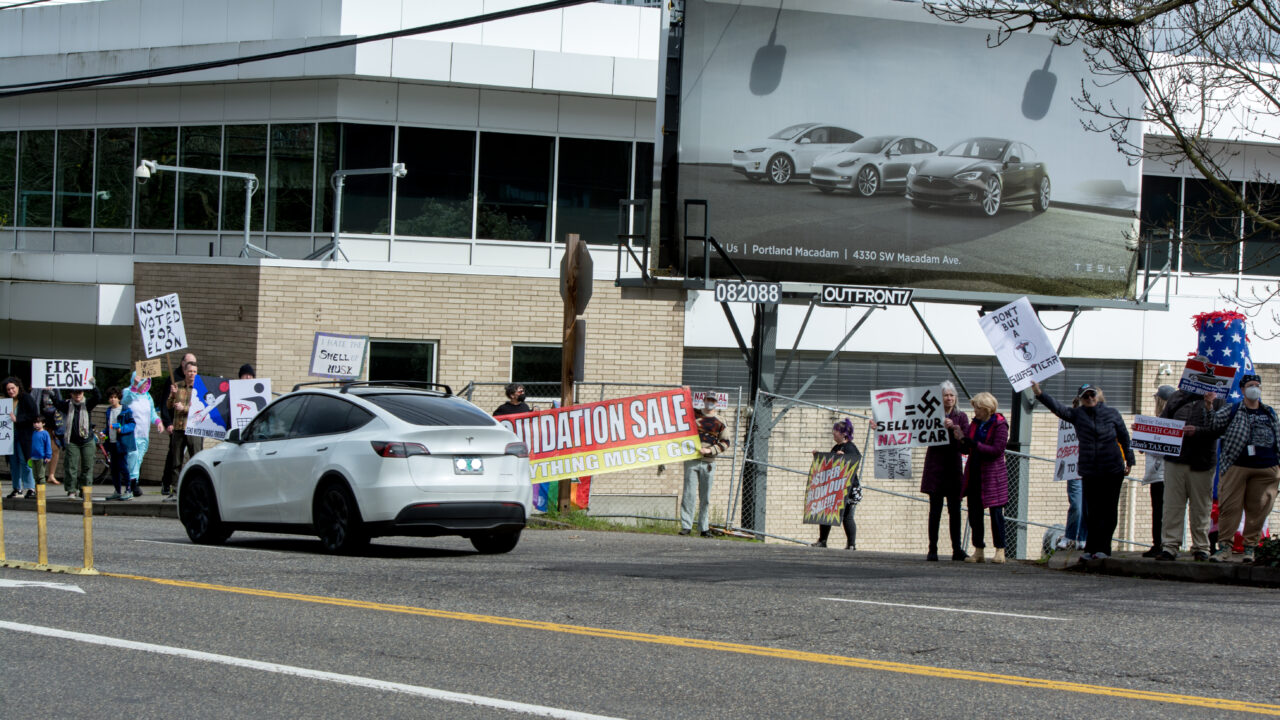
The result was an explosion of decentralized activity. What started as a few scattered protests quickly turned into hundreds. By March 2025, actions had taken place in more than 250 cities across the globe. Tesla showrooms became weekly gathering sites—regular times and places where communities showed up, connected, and built trust.
Presence Beats Planning
In the early weeks, #TeslaTakedown revealed several powerful lessons about how movements grow in high-intensity moments.
Presence beats planning. When anger and grief are in the air, people don’t need more strategic documents—they need something to do. As one organizer put it, “We gave people an outlet for their outrage.” While many groups were still writing memos or forming committees, TeslaTakedown organizers acted—and created a vessel for mass participation.
Regularity builds community. Many showrooms hosted actions every week at the same time. Protesters came to know one another. New friendships and organizing groups were born. In some cities, people who had never protested before became long-term organizers. A survey later found that more than half of hosts were organizing their first-ever action,and many had sustained weekly protests for over six months.
Fear and security matter, and individual and collective courage are the antidote. Many participants chose not to RSVP or join email lists, citing fear of retaliation from the administration or from Musk’s online followers. And that fear wasn’t unfounded. Organizers faced harassment, doxing, and threats from far-right actors like Laura Loomer and the Proud Boys.
Even the Attorney General Pam Bondi threatened protestors and attempted to conflate a few acts of vandalism with the movement. Still, they kept going—supported by a loose but committed network offering legal advice, coaching, and solidarity. One of the key pieces of legal advice came from veteran nonviolent direct action lawyers who reminded folks that civil disobedience was different than arson and despite the threats, there was nothing in the law that would allow prosecutions at a level the Bondi was threatening for civil disobedience tactics.
Key organizers who were doxxed came forward, told their stories, and showed up at protests and stepped into their (and our power). And the coaching network also organized very quickly to host safety trainings that hundreds of folks attended on short notice.
Try things. Many breakthroughs came not from central planning but from local experimentation. Protesters turned showrooms into dance parties, art shows, and joyful demonstrations. Creative tactics—like “I bought this before we knew Elon was crazy” bumper stickers—helped transform stigma into solidarity.
Helpful to have an active opponent. Every day that Elon Musk was in the news — making it easier to recruit more and more people. This is unlike the Target boycott, for example, which struggled because Target largely was not in the news — except where the movement created momentum. The TeslaTakeDown movement had a highly visible opponent who kept giving them grist for the mill.
A Movement, Not a Campaign
TeslaTakedown wasn’t a traditional campaign. There was no clear “win” statement, no unified demand. It was a distributed, emergent movement. (This uncertain nature is accentuated by the fact some people think it’s over, others think it’s still on going.)
Campaigns tend to move in planned arcs—mapping power, escalating actions, and negotiating specific outcomes. Movements move like weather: unpredictable, fast-moving, and emotionally charged.
With the movement creating buzz, institutions began to get involved. One of the most significant institutional interventions came from the American Federation of Teachers (AFT). In February 2025, AFT President Randi Weingarten released a public letter calling on union pension funds to review and potentially divest from Tesla stock, citing concerns over Musk’s leadership of DOGE and the company’s record of union-busting. The letter didn’t just signal solidarity—it gave permission for other institutions to take a stand. Within days, several state-level teachers’ unions, along with a coalition of university endowment managers, announced similar reviews of their Tesla holdings. The financial pressure multiplied, and Tesla’s stock slide deepened.
Faith-based investors soon followed. The Interfaith Center on Corporate Responsibility (ICCR), representing over $100 billion in assets, issued a statement urging members to reconsider investments in companies “whose leadership undermines democratic norms.” While ICCR didn’t name Musk directly, the timing and references left little doubt. The move added moral weight to what had begun as a cultural protest, showing how traditional institutions could align with movement energy when the ethical stakes were clear.
Meanwhile, artists and cultural workers lent their voices to the cause. The band Rage Against the Machine shared images of Tesla showroom protests at their concerts, and several well-known actors and musicians publicly removed Tesla logos from their cars. What had begun as a decentralized protest began to shift cultural terrain—owning a Tesla was no longer a badge of progress but a mark of complicity. Even Saturday Night Live joked about “Tesla shame,” a sign that the stigma had reached mainstream awareness.
Finally, local elected officials began to respond. A handful of city councils in California and New York introduced resolutions urging municipal pension funds to divest from Tesla until the company adopted fair labor practices and renounced anti-democratic affiliations. These weren’t just symbolic acts—they were signals to both investors and the movement that political legitimacy was shifting.
The actions at showrooms kept growing — again, urged on by each new wave of government firings and few other concrete actions offered to disconnected, angry, and frustrated community members.
Out of that seeming chaos, real impact emerged.
- Economic impact: Tesla’s stock dropped over 30% in early 2025, and profits plummeted 71% that quarter.
- Cultural impact: Tesla ownership became a mark of embarrassment rather than pride. Stickers, memes, and public disavowals from celebrities reshaped public perception.
- Political impact: Under pressure, Musk began stepping back from DOGE. By April, major media outlets were reporting his likely exit, framing it as a win for grassroots resistance.
The strategy worked because it combined economic pressure with cultural storytelling. TeslaTakedown framed Musk not just as a CEO but as a symbol of corporate capture of democracy. And in doing so, it created a moral divide—forcing consumers, investors, and politicians to choose sides.
Supporting the Spark
Movements like this don’t come out of nowhere. They emerge when organizers recognize energy and help it flow. That’s what made Standing Rock powerful in 2016. It wasn’t just the encampment itself, but the distributed actions that followed—divestment campaigns, solidarity protests, and coordinated calls for bank accountability. It’s also what the broader resistance to ICE raids in Los Angeles attempted in 2020, though without the same connective tissue. With LA, most groups and individuals were nervous to publicly publish toolkits or host office hours and coaching, given how intense the repression has been.
To sustain momentum in moments like these, organizations can play three key roles:
- Coaching: Support those experimenting on the edge. When something starts to spark, connect organizers with coaches who can help them think through tactics, risks, and media plans. Coaches need curiosity, optimism, and a tolerance for uncertainty. They don’t need to know what won’t work—they need to help test what might.
- Infrastructure: Offer communications, legal, and logistical support. When newer organizers face harassment or legal threats, standing with them can be the difference between collapse and courage. During TeslaTakedown, experienced groups quietly provided legal aid and comms help—exactly the kind of solidarity movements needed in early growth stages.
- Institutional support: Organizations should treat movement moments as part of their own work. That means taking time in staff meetings to ask: What’s moving right now that we could help strengthen? Do we have digital staff, researchers, funders, or relationships that could make a difference? Our job isn’t only to run campaigns—it’s to staff the movement itself.
Movement Moments and Fractures of Power
There’s no single tactic that will defeat authoritarianism. The work is to create fractures in the ruling bloc—to make alliances of the powerful unstable and contested. The TeslaTakedown helped do just that. Musk’s split from Trump wasn’t absolute, but it was consequential. It weakened DOGE, generated a major political scandal, and helped crack open new divisions within the authoritarian project.
Every generation faces these moments: ruptures where creativity, courage, and timing meet. We can’t predict which action will break through—but we can prepare to move when it happens. We can build networks of coaches, communicators, and supporters who are ready to catch and amplify what’s emerging.
The lesson of TeslaTakedown is not that one tactic wins—it’s that readiness matters. In the face of authoritarian consolidation, our best hope lies not in waiting for the perfect plan, but in moving with the stream of the campaign—recognizing when people are already in motion, and helping them flow toward power, purpose, and collective strength.