Listen to the interview here.
This interview has been edited for length and clarity.
OPENING
ADEM SENGAL
Hello and welcome. I’m Adem Sengal, a policy manager with Liberation in a Generation, which is a national movement support organization building the power of people of color to totally transform the economy, who controls it, how it works, and most importantly, for whom. We at LibGen are beyond excited to partner once again with the team at The Forge to guest edit this special edition.
For this edition, building on previous efforts to bridge the divide between anti-monopoly researchers, policy advocates, and grassroots leaders of color, we have curated a group of experts to explore the connection on issues that intersect with corporate power. For this conversation, we are speaking with four incredible researchers and advocates.
Our first two guests are Ron Knox and Candace Milner, who will first chart the history of monopoly power from Reconstruction through the last 50 years of corporate consolidation. Importantly, they will tell the story of how marginalized communities have always led the fight against corporate power by creating community-controlled alternatives before reflecting on current efforts to combat corporate power.
In the second part of this conversation, our other two guests will be Trinity Tran and Sean Gonsalves, who will be talking about the fights they are leading and supporting to expand access to public banking and public broadband, and how corporate power is showing up in these efforts.
WHAT DO WE MEAN WHEN WE SAY CORPORATE POWER & MONOPOLY POWER?
ADEM SENGAL
I want to thank you both for joining us here. And my first question to you both is, what are we talking about when we say corporate power and monopoly power? Those are terms that have some general sense, but I want to understand from y’all what those words mean in terms of who has power. And then I want to dig into how we got to our current moment. Ron, do you want to start us off?
RON KNOX
Hi, I’m Ron Knox. I’m a senior researcher and a policy advocate at the Institute for Local Self-Reliance. ILSR is a 50-year-old policy and advocacy institute that supports strong, local, equitable communities by fighting monopoly power and corporate concentration.
When I say corporate power, what I mean is a condition that you’ll find in the economy today in which a corporation wields the kind of power that I think a state would typically have. So, I think a lot about online commerce, just as one example. Typically, if you’re like a small business and you want to sell online, you could do this in a lot of different places, right? And the only real universal tax that you would come across if you’re this small business is whatever tax is charged by the government, sales tax, or whatever.
But we know that in our economy today, Amazon accounts for a monopoly share of online retail, right? Upwards of 70% of all sales for certain kinds of consumer goods, like books or kitchen supplies, and so on. So if you want to sell online and you want to reach a majority of the shoppers, you actually have to sell on Amazon. You don’t really have the freedom to choose other platforms, or at least you don’t have the freedom to ignore Amazon altogether. So you’re a small business, a small seller, you’re just forced to pay whatever Amazon says you have to pay in order to sell and succeed on the site.
That’s the kind of taxation power that really only the government should have. But instead, Amazon has this power to tax companies with impunity because of its monopoly. That’s the kind of thing I think about when I think about corporate power and what it means.
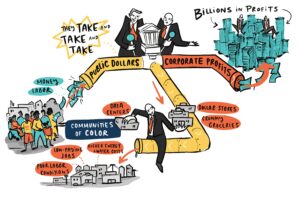
Then the second part of the question, I think, is more important: who has the power and who doesn’t have the power? The main thing that these monopolistic companies want to do is to extract. These are extractive corporations. They want to extract your labor. They want to extract wealth. They want to extract your resources. That’s their whole goal, and they don’t make these supersized profits any other way. So they tend to target communities that they think have the least amount of power to fight back against that extraction.
So, for example, where are the big tech data centers located? So today there are over 1200 data centers that are cited in the American South. And they’re often built in or nearby Black communities, where they extract enormous amounts of power and water, and they’re driving electricity bills sky high. And these companies assume that they’ll just face no consequences because these communities don’t have the political power to stop them. I also think about dollar stores, they’re really the same in a lot of ways. They come into a community, they extract wealth, they put the local grocers out of business, and in return, what do they do? They just deliver this unhealthy food at sometimes way higher per ounce prices than you would find even at just a regular grocer. So that’s how I think about that power balance.
The good news, of course, is that this power dynamic is really shifting at the moment.
CANDACE MILNER
Hi, everyone. My name is Candace Milner. I am a senior policy analyst of economic justice at Demos. Demos is a nonprofit public policy organization working to build a just, inclusive, multiracial democracy and economy. We work hand in hand to build power with Black and Brown communities.
So to this question on corporate power and what we’re talking about, I’m thinking about how corporations and the wealthiest people in our society, the billionaires and the multi, multi, multimillionaires, have control over our economic and political conditions. These big corporations take a lot of labor, and a lot of people have to work for them, and they are able to control worker conditions sometimes in full cities, just because of how prevalent they are as an employer in that city.
I also think about how they control the decisions we make. If you live in a town where you don’t have many grocery stores and your only option is one grocery store, Walmart, you don’t get to participate in boycotts in the same way because you don’t have those options, because corporate power and monopolies have taken that from you. So I think about how they have control and how they create or take away options from everyday people. We see this in elections, we see this in policy decisions, where elected officials who depend on corporate donations to run their campaigns and are at the will of these really powerful corporate lobbyists aren’t making decisions for the people, but instead for these donors who have shown this outsized problem.
At Demos, we talk about building power a lot because we do also believe in people power. We believe that when people work together, when communities work together, history shows us, and even current times show us, that they can counter this corporate power and they can have really meaningful wins in their communities. So I’m really excited to get into that.
THE LONG ARC OF REINING IN CORPORATE POWER
ADEM SENGAL
I want to step back a little bit and look at the long arc of how corporate power has been used. Ron, you recently wrote a zine on the modern fight against corporate and monopoly power, highlighting some stories where people are working now against concentrated power. And in that, you describe some of the history of anti-monopoly organizing. Can you tell us a little bit about that story? Who was leading that fight, and how are they able to make change?
RON KNOX
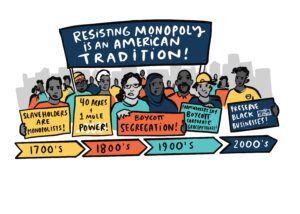
Sure, sure. So I mean, this tension that we’re feeling today between monopoly power, corporate power on one side, and then democracy and liberty, as those terms are defined in the American tradition, it’s always been part of our history, right? You go back to the founding of the country, Thomas Jefferson wanted a prohibition against monopolies written into the US Constitution. And indeed, one is written into a lot of different state constitutions around the country.
The Boston Tea Party was a revolt against the East India Trading Company’s monopoly over the tea trade back in those days. So our universal resistance to being dominated by a private enterprise goes way back to the beginning. But the modern anti-monopoly movement really rose in the years after the Civil War, when America was rapidly industrializing, and capital was quickly reorganizing itself into these much more concentrated pockets. These years saw the rise of the trusts, which were these collections of businesses all in the same industry. They were all capitalized into these massive umbrella corporations that dominated a particular industry. We know the oil trust, of course. That’s one that is very famous because of Standard Oil, but there was also a meat trust. There was a steel trust. There was a money trust, which was a big one, this highly concentrated core of wealth and capital that was based in Wall Street, but also in other financial hubs around the country. So you had this kind of new economy that had never really existed before in this industrialized way in America.
So you had this kind of grassroots resistance rising in different pockets all over the country. Suddenly, you had farmers in places like North Dakota and Minnesota who couldn’t finance their farms because they couldn’t access the capital from their Wall Street financiers. And then whatever they could grow, they were increasingly getting ripped off when they tried to ship the things they did produce on these increasingly monopolized railroads. You had ranchers that were forced to sell into these monopoly slaughterhouses. And then you had the shopkeepers on the other side and the consumers who were forced to buy from these same monopolies. And then you had workers who were suddenly finding that their wage labor was being exploited by these growing industrial concerns. So by the late 19th century, you had these people-led, very grassroots, often agrarian uprisings against the increasing monopolization and financialization of their worlds.
So you start to see this kind of organized form of leadership develop among these groups, and it was led by the National Grange and Farmers Alliance. They started making these demands of their local lawmakers from the State House all the way up to Washington, DC, to the halls of Congress. And they said, “You have to put an end to this. These newly formed companies and their financial backers are clearly gaining this kind of control that we’ve always resisted in America, this control over day-to-day life, over people’s livelihoods, people’s freedoms, liberty of movement, all these different things.” So they demanded that these lawmakers take action, and the lawmakers eventually listened, and the states passed antitrust laws. Congress passed the Interstate Commerce Act, and then shortly after, the Sherman Antitrust Act, which was our first antitrust law.
Beyond just the laws, the anti-monopoly movement of those days ushered in this sweeping political change that almost completely reorganized party politics in America. So there were these upstart parties, right? There was the anti-monopoly party, which was a short-lived thing in the late 1800s. And then there was the Populist Party. And these ideas ended up just getting funneled into and absorbed into the Democratic Party, and it ushered in these sweeping changes that led to these major economic changes in the country that really dominated the mid 20th century, including strong labor unions, a progressive income tax, highly deconcentrated industries, and so on. The anti-monopoly movement of that time really laid the groundwork for the post-American economic boom.
ADEM SENGAL
Yeah. And what I’m hearing from that story a lot is how working people were put in a corner with all of these powerful corporations and were able to fight back through grassroots organizing, through the leadership of the people who were most hurt by these monopoly powers. And the state of that economy at that time continues to see a lot of parallels now. It’s the economy that we’ve had in many ways for a long time, where the theft and exclusion and exploitation of working people, and especially people of color in many cases, was profitable for companies.
Candace, in a recent report that you wrote for Demos, titled “Public Banks for Racial Equity,” you highlight some of the ways that commercial banking has profited from the theft, exclusion, and exploitation of people of color. How has the role of banking and finance changed over the years, and what remains consistent in the fights that you’re engaged in today?
CANDACE MILNER
I think that what remains consistent is the role of the bank itself. Banks hold money, they distribute money, and they multiply money through investments, and that multiplying power is so important for building wealth. And in that report, we talked a lot about the racial wealth divide, which is widening today. Black households have $15 in wealth for every $100 held by white households. And if current trends in wealth accumulation hold up, it would take nearly eight centuries for Black households to amass the same level of wealth as white households.
I start with this because I think it really grounds us into understanding the power that banks have to multiply money, and that being their key role. Over the years, banks have been used as a tool to consistently build wealth for the few while extracting it from Black and Brown communities. We see it with slavery, with banks investing in the buying and selling of Black folks in the South who were enslaved. We see it throughout American history. We see that it is harder for Black and Brown folks to access loans for businesses than it is for white folks, even at different income levels. Post-war, when there were a lot of pushes for homeownership, we started to see redlining; Black and Brown communities were deemed as being risky investments. So banks were denying loans to folks in those communities, or the loan terms they got were very expensive, incredibly unfair, had really bad terms. That directly correlated to Black and Brown neighborhoods being undervalued, the homes in those neighborhoods being undervalued. So even when Black and Brown communities were able to get a home to start to accumulate wealth in this particular way, it wasn’t at the same rate as their white counterparts.
We’ve also seen that in the ’80s, when banks started to consolidate, the huge loss of community banking that we continue to see today. Many Black and Brown neighborhoods do not have access to physical banking branches and locations, so that means their only option for banking is a big corporation that they could bank through virtually or online. Also, those branches in a lot of places got replaced with payday loan centers. So now, in order to access your paycheck, you’re getting almost taxed a second time, but this time, not even by the government, just by a corporation who’s stealing from you, because you don’t have access to banks.
We all know about the 2008 recession, a big part of what led to that recession was subprime loans. So the 2000s come around, and they’re like, okay, maybe we should stop just flat out denying people the access to loans, but the loans we give them aren’t going to be good loans. They’re going to be really expensive, have higher interest rates, have crazy terms, and be longer than they should be. We’re going to give them the people that we kind of know can’t afford them. So what we’ve seen is one in five households defaulting on these home loans. And now their houses, again, are undervalued because they’re in foreclosure, and who comes and buys up all those undervalued houses? Corporations that can then flip them, sell them for a profit, and this is another way they have extracted from these Black and Brown communities.
I think another really important part of that is the investments. We see modern banks do have parts of their bank where they are giving back to the community. They are investing in goods that serve the community in particular ways. And we often don’t see that investment in Black and Brown communities. And if we do, it’s in very minute ways that don’t nearly begin to match the harm done in those communities, or those investments are not in the good things that we need from our communities. They’re not in libraries, in parks, in public goods that could really make a difference, but they are in things that help continue to line the pockets of the wealthy. They’re in fossil fuels, in prisons, in things that are considered “profitable” without thinking about at whose expense they are profitable.
ADEM SENGAL
Absolutely. The use of banks in many ways is that they supported the theft of Black bodies and slavery. They excluded Black people from accessing loans, from accessing wealth, and they exploited workers through that process. And then with the money that they did get, they just invested in accelerating the harms with investments in things that are destroying our environment and getting more money to wealthy people. It’s constantly pushing in that direction. When we’re thinking about how to fight back against that, it feels really hard.
I’d love for you to both show some examples of the resiliency and leadership in communities of immigrants, of people of color, of farmers, people who have constantly been pushed away from accessing wealth, from accessing freedom and dignity in their work. What are the examples that we have of when they’ve fought back against corporate concentrated power, and what can we learn from them?
RON KNOX
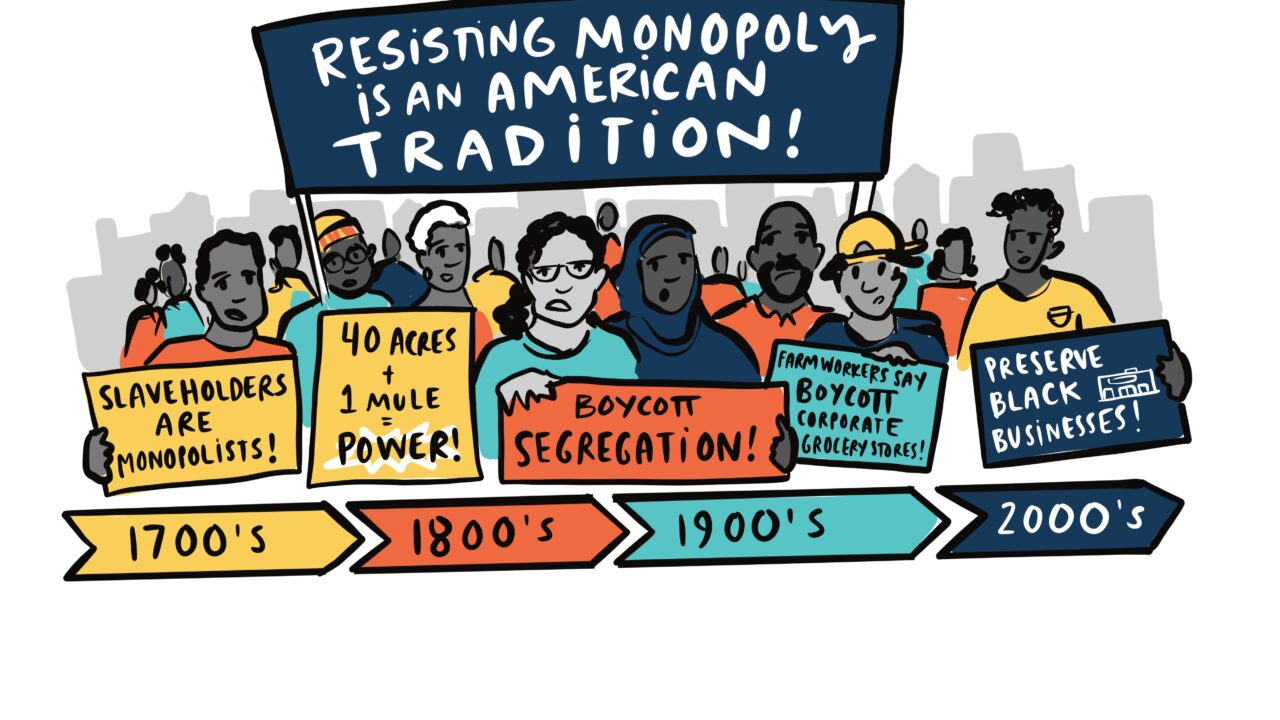
Yeah, I think the first resistance to concentrated power, in the way that we’re speaking about it, happened during and then immediately after slavery. Again, the people who have been marginalized and subjugated in America have long understood who has the power and who doesn’t, and then what it would take to get it. And in America, we know that those marginalized groups have often been Black folks and immigrants in all different eras, but certainly in Antebellum America. So abolitionists in America, both before and during the Civil War, inherently recognized what freedom would really mean beyond just the end of servitude. It would mean the broad and equitable distribution of otherwise monopolized resources. Slaveholders, plantation owners, were correctly viewed as people who were monopolizing those resources that needed to be distributed.
Frederick Douglass famously wrote, “Your slaveholder is ever a land monopolist.” And again, it was perhaps the most obvious instance of monopolistic extraction in American history, where you have these ultra-wealthy slave owners, plantation owners, land monopolists who accumulated their wealth entirely on the labor of enslaved people. It’s the origins of the monopoly extraction story in some ways. So, the demand then at that time of newly freed slaves during Reconstruction was this land redistribution away from its monopolized former slaveholders, plantation owners. These demands directly led to the Freedmen’s Bureau Bill in Congress that said every freed Black person in the South could receive forty acres and a mule. That was a direct attempt to break down that monopoly power. It didn’t happen as we know, and that has effects too. The result of this unbroken monopolization of land ownership has been the historic and systemic racialized inequality in America, as former slaves were not able to accumulate the same kind of land-based wealth as white folks had.
So that’s one instance of resistance in history, but there’s a through line all the way to today. I think about Black and Latino workers in the South and the West of America for much of the 20th century, particularly during the civil rights movement, who worked really tirelessly to organize themselves against concentrated capital and concentrated corporate power, particularly in places where you had what we call monopsony power. That’s a very powerful company that is the buyer of labor. In a place in America where Jim Crow was the rule, unions were not allowed, sometimes viciously broken. And so you had this lack of power, and this very correct and ultimately very powerful instinct to organize people power, worker-led power, and farmer-led power in the West and many immigrant communities really served as a counterbalance to that concentrated corporate power and really set up a model for a lot of the kinds of organized resistance that we see today.
And it was particularly strong in the civil rights movement. Martin Luther King Jr., at the end of his life, was leaning into labor organizing and union organizing heavily. You have Stokely Carmichael. You have these people who are really driven by this anti-monopoly kind of mindset and ethic to break down corporate power through the means of organizing people. The other thing I’ll say on this is that the result of this successful mid 20th century anti-monopoly sentiment was all over the country you had strong and often independent Black communities that were self-sufficient, that were self-reliant, that kept their wealth in the community at home and they didn’t have to rely on corporate power and get exploited and have to face the extraction of corporate power everywhere they turned.
I spent a lot of time in and around Dorr Street in Toledo, Ohio. And the history there is this independent community that had its own stores, its own banking, its own Black-owned small businesses. And it kept that wealth and that power in the community. And that was a boon to that community. And if you combine that with the union wages that folks were making, you ended up with this rising tide of power and wealth and independence in the Black community, all because there was not this kind of extraction happening all the time. And you go there today, and it’s dollar stores that are bookending Dorr Street. You have this kind of extractive corporate power all over, and this flood of wealth from that Black community that is still there, out to some corporate headquarters in some far-flung place.
So the anti-monopoly movement of the 20th century really did pay dividends. It wouldn’t have gotten to where it was without the organized force of people who were demanding their freedom and their liberty from corporate control.
ADEM SENGAL
On Dorr Street, that period of self-sufficiency, when was that?
RON KNOX
We’re talking about post-war through the civil rights movement, through the Black power movement of the early 70s until you had these converging forces of urban renewal, highway sighting, neoliberal forces that were really focused on returning power to capital, taking it back away from communities and from workers and small businesses. You had all these different forces, racialized forces, that were really kind of conspiring and left a lot of these once vibrant Black communities, and main streets hollowed out.
ADEM SENGAL
Yeah, you look through so many cities throughout the country, and you can see the marks of government policy that ripped through communities that had self-sufficient Black-led small businesses and built highways in order to get white people in the suburbs to downtown, and with the very clear intention of destroying these communities.
RON KNOX
Literally, exactly. And then you combine those forces with a bunch of increasingly consolidated supermarket chains, for example, deciding, “Oh, we don’t need to be in this neighborhood anymore. We’re just going to head out to the suburbs, and we’re going to build these 100,000 square foot stores, and that’s going to be the end of that.” So that’s a vacuum that the dollar stores fill, and every other predatory extractive kind of business fills, and we end up where we are today.
CANDACE MILNER
And to add to that, some of that resiliency that we talk about was in a lot of ways a direct response to the exclusion that Black folks had. I think about the history of mutual aid, especially in Black communities. And like you said, it dates back to slavery. When you read a lot of the history of Galveston and the communities that the celebration of Juneteenth came out of, there are so many instances of mutual aid, for things like burial. Another part of this is the resiliency and culture, right? A lot of the Black tradition of soul food or even Cajun food. When we think about New Orleans, or Geechee food, when we think about South Carolina, a lot of that also came from this resiliency of being excluded, given the scraps, but being so creative and so determined that something great and beautiful came out of it.
And those traditions traveled. The mutual aid that we’ve seen enslaved folks come up with, you see it in the North in Reconstruction, where the folks who owned those businesses on those Black wall streets and Black main streets also pooled their money to be able to cover burials, to be able to give resources to widows and orphans in their community, to help people when they were unemployed. It was these things that lived on.
And then, when thinking about that specific resistance, you also have to talk about SNCC (Student Non-Violent Coordinating Committee) and the sit-ins and lunch counters. And while those lunch counters were family-owned and small businesses, when you’re having sit-ins that are organized across states, they don’t get to monopolize who can eat lunch at a counter anymore, because you’re all getting boycotted.
When you think about the Montgomery bus boycott, those folks didn’t have cars, but when they are committed to say, “We are going to boycott,” that is a very clear example of fighting against a concentrated power. And in the West Coast, Chicano farmers, the way they organized and unionized, and how it led to farmers having the right to organize in California was huge. The Black Panther Party, their free breakfast program is the reason that kids have access to free lunch today across the country, regardless of race. They had clinics, they had legal aid, and these are all things that exist as a general public good in many places today. So I think it’s really important to think about how these fights against corporate power lead to us reimagining what public goods should look like.
CURBING CORPORATE POWER IN THE FACE OF SEEMINGLY INSURMOUNTABLE ODDS & CHALLENGES
ADEM SENGAL
Absolutely. Yeah, there has been a long tradition of self-sufficient communities, taking care of community members and fighting for what people deserve; that fight still is in all of us. But over the last 50 years of consolidation, it’s become a lot harder to win those fights. And the effort to win those fights still continues. We’re still seeing those wins, but what do we need to be vigilant of to protect those wins that we do get?
RON KNOX
I mean, look, the extraction never stops, unfortunately. So I think folks need to have an understanding of what corporate power is, how it can harm and extract from a community, and then how to fight back, right? These three steps to understanding and addressing the problem. I think so much of our national political dialogue and the atmosphere and the discourse today, it’s like someone playing a shell game on a New York street corner, right? Follow the ball, follow the ball, don’t pay attention to this other thing that’s happening over here where I’ve taken your money. And unfortunately, the Trump administration has really mastered this because there are lots of real things happening today that we have to pay attention to.
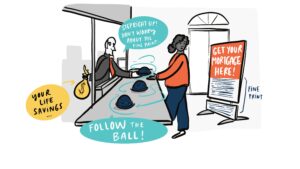
Our immigrant siblings are getting kidnapped off the streets, LGBTQ rights are getting rolled back, women’s rights are under attack. All these things are important, and all these things have to be addressed. But meanwhile, we have policymakers that come from this world of extraction. They come from Big Tech. They come from private equity and what have you. And they’re trying to shove this new kind of monopoly power down our throats and push it into our communities. So we have to stay vigilant against that. We have to stay informed. We have to stay educated. And more than anything, we have to get and stay organized. Whether that’s in your workplace, whether that’s among your fellow small business owners, whether that’s in your neighborhood, in your community, we are stronger together.
I know it’s such a simple thing to say, and it’s an idea that comes so naturally to people, but it’s so important to live it and to breathe it in, right? We are stronger together, and it’s true now more than ever before. And there is good news. We can see organized people and communities across the country who are really fighting back and who are scoring wins everywhere from the urban core, places in rural America, and everywhere in between. We’re seeing all kinds of important wins and pushbacks against corporate power. And it all comes from these three things, understanding what the problem is, identifying it and knowing how to push back, and you push back through being organized and standing together.
CANDACE MILNER
I’ll add to that, too, that language is so important, especially when thinking about economic justice issues. I get so frustrated when I hear issues just framed as a market failure. Prices are increasing because the market’s not good. Your eggs are $5 because the market’s not good. Your studio apartment costs $2,000 because the housing market is just so bad. And it’s like, well, who the hell is the market? We know who that is. No, your studio apartment costs $2,000 because these private equity firms bought up all the housing and they marked up the prices so some greedy CEO somewhere can be a billionaire. And that’s why we see all these LLCs (Limited Liability Companies) and all this lack of transparency around who owns what and who controls what, because they know when they can hide behind this elusiveness there’s no accountability.
So I think being more strategic and clear in our language about why these conditions are happening and who is behind them is so important. Being honest about that in a way that is very clear and takes away some of the jargon, I think, is just so important. When we have wins that come out of “the market was bad, but then it got better,” that doesn’t give people a historical understanding of how and why things got better, right? But saying “bread jumped from $1 a loaf to $3 a loaf, and then we started to boycott these companies who weremarking up our prices for profit, and then bread was affordable again,” it gives people a historical blueprint to jump back to of how to create these wins. And I think that’s really important in our political understandings and education to do it in a way that continues to give people the blueprint of how we win. So let’s continue to talk about them, connect them to our current lived experiences, but do that in a way that people can hold onto them and understand this is how we get there.
Boycotts work. They don’t feel like they work all the time, but they do, and they work because of solidarity. And when we continue to remind people of that, they’re more likely to buy into the organizing that’s happening. They’re more likely to want an organizing and political home and to be a part of that because they believe that change can happen because they can see it and connect it to a real thing in front of them, and not just a market or not just a random bad actor over there.
RON KNOX
Every single word of that was true and important and gospel, and yes to all of that. We can talk more about data centers because I think this is important, but what Candace was saying, they are also educational. There is a lesson here. So you have a data center that shows up in a community in places like Georgia and Virginia and Texas, and whatever. And suddenly, you have people’s electric bills going up. You have this immediate cause and effect, this inherent understanding that this is what’s happening. This extractive company that comes in using up a bunch of power, and so the electric utility puts the rates up, and then your bills go up, and people are mad as hell about it. And then they show up, and they organize themselves. That is a lesson.
You got to take that lesson from those data centers, and you got to apply it to everything else in our lives. You got to apply it to the eggs. You got to apply it to our cell phone bills. You got to apply it to the rent at the apartment complex owned by the big corporate landlord. You apply that same lesson, like you have an enemy. We are not each other’s enemy. We are in this together, but we do have enemies, and they’re up there putting these prices up, and they’re making our lives worse. There is just such a crucial lesson in that all over.
I also want to talk really quickly about boycotts because I feel really strongly about this. One thing that we talk a lot about is, you can’t shop your way out of a monopoly problem, right? And you can’t not shop your way out of a monopoly problem, either. But you think about the civil rights era bus boycotts. They were successful because it wasn’t just a boycott. It was a power-building exercise. There was organizing that was standing behind it and propping it up. So when that was over, there was power there.
That is the most important and effective kind of boycott. And when you have boycotts like that, where there’s actual organizing being put into it, there’s a plan. There’s somebody out there saying, how are we going to build it? How are we going to support it, and how are we going to get there? That’s where it becomes really effective and powerful, a really good tool in the anti-monopoly toolbox.
ADEM SENGAL
Absolutely. Yeah, and what I hear from both of you is that policy fixes that just work around the edges and don’t directly go at the corporate power that is concentrated amongst the most wealthy is just going to fall short. So in order to create a counterpower that grassroots power, that’s so essential.
THE PITFALLS & OPPORTUNITIES OF TOP-DOWN ANTI-MONOPOLY POLICYMAKING
I also want to just acknowledge that we all work at national organizations that work on policy, and we’re in an environment where we’re interacting with think tanks, academics, and researchers, and all of them have ideas around what to do here to really get at corporate power.
They’re really good ideas, but being in that ecosystem and talking in a very technical language can often feel removed from what’s actually happening in people’s lives. These corporations are also often hiding what they’re doing, and it’s not always clear that they’re the ones who have power. So what really happens when policymakers and people thinking about policy aren’t talking to people at the local grassroots level? What do they miss, and what can go wrong when they’re not working on the ground trying to build power too?
CANDACE MILNER
I think what happens is they get it wrong. I think what often happens is when you think about the way that policy experts, in a very specific way, have been trained, they depend on data points and the suggestions of the people in the room with them who tend to be people with privilege and don’t have that input with communities, then they don’t hear from the people who are most impacted, which is often Black and Brown communities. And while data is important — that research is important — if we don’t couple that with lived experiences of communities, we miss out on the full picture, and we end up pushing for policies that only benefit the few or the people who fit neatly into those data sets. This further isolates people with marginalized communities, especially people living at the intersection of marginalized communities.
We don’t live in controlled hypotheticals; we don’t live in a theoretical world. We live real lives with real nuance and real complexity, and grassroots organizers, their expertise is that nuance and that complexity. What they bring is an understanding of, ‘if you put this policy in place, that parent with two children who are school-aged, this is how it’s going to impact them on a day-to-day basis’. And I think those complexities, those nuances are what’s often missing from some of these policy recommendations, and it’s missing because that expertise of organizers isn’t being respected.
So I really think it’s important to not only have those grassroots folks, so you have a clear picture when you’re going into that solution-making mindset, but also because we know that we need a lot of different experts to make things happen. We have to respect the expertise of organizers because the expertise they bring is an expert of people. And if we really want to impact people and make people’s lives better, they have to be in the room.
RON KNOX
A hundred percent. And I think the people that are in the room are, oftentimes, whether in a physical room or in this metaphorical political room, people with the money. They’re people with the money, and they’re people with the interest and the ability to do the things, like fund the campaigns, give out the donations. When policymakers don’t listen to the grassroots, don’t understand what’s actually affecting people’s lives, you end up with what we’ve seen in Bessemer, Alabama, like in Baltimore, in Memphis, Tennessee, where we’ve seen Black communities rise up and try to fight extractive data centers from being built in their backyards, and policymakers are shocked.
This fall, in the middle of harvest season, you had what ostensibly would have been a normal run-of-the-mill meeting between farmers in Arkansas and a handful of staffers from Senator Tom Cotton’s office and other electeds. This meeting erupted into 400 people who sat in this meeting room for hours to plead for someone to help stop the monopolization and the financialization of their livelihoods, their seeds, their processor, their combines. This is the kind of thing that happens and is going to continue happening when policymakers do not pay attention to or indeed actively support these abusive extractive monopolies.
For us, when we don’t pay attention to, and even more so when we’re not led by the grassroots, we can lose our way as well. I think we’re all trying to strike this balance of like, okay, we have like these policy goals, and we’re thinking about like, how do you make these laws? How do you get people to do these big things that we think are going to help shape markets and increase fairness and increase equity? And so oftentimes, we’re talking to Capitol Hill staffers, we’re talking to people in state houses. Meanwhile, in people’s backyards on their main streets and their communities, they are engaged in hand-to-hand combat with some of the worst corporate actors on the planet, and they’re really doing it. I think that we have to find the correct balance between doing the big things,, the market shaping stuff, passing the laws, all that, and really understanding the conditions on the ground that are leading to this anger, this frustration and that I think are really the fuel that is going to continue to push the anti-monopoly movement forward and to hopefully break down the power of some of these extractive corporations.
CANDACE MILNER
I think another important part of having those connections to organizers is having real-life examples of what’s actually happening, right? I think a lot of times, when we talk about policy ideas, like what if person A does X, Y, and Z and X, Y, Z has never happened in the history of the world ever. So I think it’s important too because organizers, their work is listening to the community and hearing about their lives and knowing what is actually happening.
Organizers know that parents don’t spend SNAP (Supplemental Nutrition Assistance Program) money on this, that, and the other. They spend it on food for themselves and their children because they have to eat. Organizers know that having benefit cliffs keeps people from economic mobility because if I get this promotion, it doesn’t give me enough money to cover my groceries and my rent, but it does give me enough money to no longer qualify for these programs that’s keeping my family out of poverty. So I think understanding those nuances and policies, that’s where organizers come in and having real life stories that we can amplify to create a real narrative of what’s really happening in these communities is important instead of these bullshit narratives that are coming from folks who’ve never stepped foot in these communities.
BEING IN PARTNERSHIP WITH THOSE ON THE GROUND TO CURB CORPORATE POWER
ADEM SENGAL
I know that both of y’all are not just in these rooms with think tanks and academics and researchers. We’re in those rooms, but a lot of the work that we do to actually make a change is working with people on the front lines. So, how important is it in your work to be in partnership with people, to organize on the front lines against big business and corporate power? And what are you able to do when you do that?
RON KNOX
It is crucial. As we’ve discussed, these folks — the people on the ground who are actually fighting these fights and the organizers who are helping them do it — they’re often doing this work from a place of marginalization and powerlessness, or at least perceived powerlessness. That’s real bravery, right? That’s actual leadership. Putting your ass on the line to stop a data center or to stop an Amazon warehouse from being built. I always remind myself of this, what I’m doing right now and what I do in my nine-to-five every day, this is my job. When I go to bat against some monopolist or some pro-monopoly policy or policymaker, that’s how I earn my living.
When someone out there in the community is fighting a corporation, they’re laying it all on the line. Sometimes they’re fighting their employer. Sometimes they’re fighting their neighbor, you know what I mean? They’re fighting their landlord. That is what I mean when I say bravery. So the partnerships are absolutely crucial because that’s the living, breathing heart of the movement. And that should be our guide. The grassroots organizers and communities and people who are living and breathing it, they know. They know exactly what’s important, and they will show us. That stuff is the stuff where if you win those fights and if you actually make that change and you fight back against that monopoly, you’re making people’s lives better. But if you organize an Amazon warehouse or if you organize this tenant union against a landlord, you are really, really, really helping people. And that’s where the real fights should happen, and that’s what the grassroots needs to lead.
CANDACE MILNER
Yeah, for us, it’s the foundation of our work. When we come up with a new or bold idea, our first stop for feedback is our grassroots partner. And when we run out of ideas, which we do often, our first stop is also a grassroots partner. So it’s about ensuring that our partners are at the beginning stages of everything we do. But I think it’s also important because it helps us shape our priorities. There’s times where we have a grassroots partner who’s like, “Yeah, we see your report, but we have a really good chance to get this thing through. We need some technical assistance.” That’s our priority.
And I think being able to have a check and balance in that way is something else that our grassroots partners bring to us because we are clear that in our goal to build power, it is with these organizations, these state partners, these local partners. When we say we want to create public goods for the public good, we understand we can’t do that without the public. And that’s through these organizations, that’s with these organizations, that’s side by side. So yeah, I think that I can’t overstate the importance of not only being in communication with our grassroots partners and organizers, but also taking their lead, especially when it comes to the solutions.
ADEM SENGAL
We at LibGen also really believe that the only way that we’re going to have sustained, meaningful, generational change to an economy that actually works for us is when we build that power from the grassroots up and when we support the continued leadership of the people who actually know what’s going on on the ground.
FIGHTING AGAINST CORPORATE POWER WHILE NAVIGATING THE CONTRADICTIONS OF OUR CURRENT ECONOMY
I want to end on this question: Corporate power is so expansive and ingrained in our economy, and we can often find ourselves interacting with the very corporations we’re fighting against, whether by accident, by choice, or lack thereof. So given this, how do you personally reconcile and navigate the contradictions of the world we have to live in, where we have to or may have to do business with these awful, powerful corporations?
RON KNOX
I have to remind myself all the time that a monopoly is a monopoly because it’s everywhere, and in many parts of life it’s just unavoidable. And I just know that, yes, I’m using the tools of the monopolists to do the anti-monopoly work, but I’m trying to bite the hand that feeds as hard as I possibly can. Because I know that a better world is possible. And I know that this doesn’t have to be the status quo. It doesn’t have to be the way life is where we’re stuck using four or five different companies for everything that we do. The more that we can, again, look to the grassroots, look to communities and understand the ways that we can break down corporate power and that we can try to break the shackles of corporate control over all of our lives, the less that we’re going to have to face this dilemma in our work, in our lives, our social lives, that we’re just trapped in this kind of corporate loop.
CANDACE MILNER
For me, it’s important to be intentional about what grounds me, and for what grounds me is the world I want to see. I want to live in a world where our needs are met, Black people have a right to self-determination, we’re not living under racialized violence, workers have a say in their workplace, and communities have access to the goods that we need and want. And one, I try to vote and advocate in a way that supports that vision. But I think, as far as how we interact with these corporations, I try to prioritize solidarity. So I have a really hard line, I’m not going to cross a worker-led picket line.
But I think it’s important to be mindful. I think it’s important to give yourself grace and assess what you can do and do that. So I think that looks different for different people. Find ways to support mutual aid, find ways to support your neighbors, find ways to support your community, and don’t underestimate how important those small actions can be.
And I think just education as well. Sometimes folks aren’t doing things because they just haven’t heard about it, or they just don’t know. So I think that giving yourself grace, giving your community grace, and just finding ways to help each other learn, finding your hard lines, your strong lines that work for you, and just being honest about what you can do and sticking to it. I think that that is all you can do because, like you said, we can’t escape all of it, but I do think the part that we can commit to is really important.
CLOSING
ADEM SENGAL
I think it’s a great point for us to end today. Yeah. Thank you all so much for joining this conversation. How can folks support or stay informed about your work? Are there any upcoming actions or events you want to highlight?
CANDACE MILNER
Yeah, so you could follow Demos at demos_org on social media. You can also find our report on Public Banks for Racial Equity that we did with the New Economy Project on our website at demos.org, and any other research that we’ve put out either for democracy or economic justice, you can find there as well.
RON KNOX
You can find all of our work, all of our research, our writing at ilsr.org. I’m on the independent business team, but we have other teams that do incredible work at ILSR. You follow us on socials, ILSR_org, I believe, on all social platforms.
ADEM SENGAL
Thank you so much.