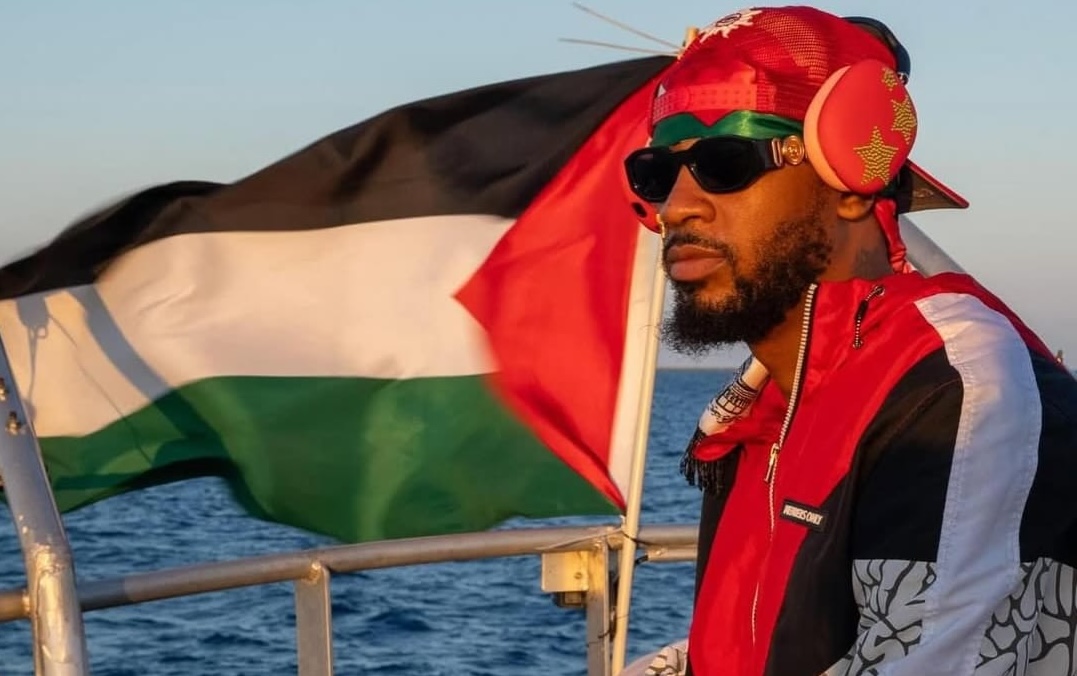
On July 26, Israeli occupation forces intercepted the Handala, the latest Gaza Freedom Flotilla ship sailing to break the illegal siege of Gaza amid mass starvation. A United Nations-backed organization has just issued an urgent report warning of a “worst-case scenario of famine” in Gaza. The Handala carried a stash of baby formula, food, and medical aid as well as 21 activists from 12 different countries, including well known labor activist Christian Smalls, the founder of the Amazon Labor Union.
When the Israelis boarded the ship, seven uniformed forces assaulted Smalls. According to the Gaza Freedom Flotilla, “they choked him and kicked him in the legs, leaving visible signs of violence on his neck and back… This level of force was not used against other abducted activists.” Smalls was the only Black activist on board the Handala.
On Thursday, July 24th, just days before the IOF boarded the ship while it was closing in on Gaza, Rising Up With Sonali host Sonali Kolhatkar reached Chris Smalls on the Handala and spoke with him about why he joined 20 others to risk his life to bring aid to Palestinians.
Check out the audio and subscribe here.
Note: this interview has been edited for clarity.
Sonali Kolhatkar: Welcome to the program Chris Smalls.
Christian Smalls: How you doing? Thank you for having me.
Kolhatkar: You are speaking to us from on board the Handala bound for Gaza. Why are you sailing to Gaza with the Freedom Flotilla? You are a labor organizer, known for your activism against Amazon and its attempt to undermine workers’ rights. How is Amazon specifically complicit in the genocide in Gaza, and how are unions, who should be the natural allies of the Palestinian people, also not doing enough?
Smalls: Yeah, absolutely. As you mentioned I’m the founder of the Amazon Labor Union, the first union in American history for Amazon workers. Amazon is not just complicit, they are actively participating and actively a part of the military industrial complex that Israel uses to target, surveil, and even kill innocent Palestinians every day.
AWS, Amazon Web Services, and other corporations have launched what they call the Nimbus Project, which invests $7.2 billion into Israel’s Iron Dome. So, when you’re talking about connecting dots, being here on the Handala is taking a stance as a labor leader from the U.S., saying that enough is enough, this is across the picket line for the working class, and that doesn’t exclude Palestinians and the people of Gaza.
And I hope to apply pressure to the U.S. Labor movement, that has been shipping arms for the last 21 months, every 15 hours to Israel.
Kolhatkar: Now, the Handala is named after a mascot that has become the mascot of the Boycott, Divestment, Sanctions movement (BDS), an image of a child with its arms crossed behind its back. And the BDS movement was based on a call issued by Palestinian labor organizations and unions. So, what is it that U.S. labor unions could be doing? Are we talking about dock workers? Are we talking about people working at manufacturing plants, weapons manufacturing plants, using their collective power to stop Israel’s genocide in Gaza?
Smalls: Absolutely. Yeah. Both. They could take a page out of Greece with the dock workers there. They have blocked arms shipments and they’ve been protesting and blocking the ships coming in from Israel, or going to Israel. And the same thing needs to be done in America.
You have the Longshoreman who have a long history of standing on the right side when it came to South African apartheid. They stood on the right side of history. And the AFL-CIO is a federation of labor unions, over 60 unions in America. They have passed zero resolutions since October 7th, 2023. And that’s a shame, because the blood is absolutely on their hands as well.
Same thing with manufacturers. These laborers are crossing the picket line, you know, and I don’t understand why they don’t see the connecting of dots when they all are against major corporations and billionaires—so they claim.
And the motto of their labor unions is “an injury to one, is an injury to all.” So, they’re not following that code right now, and I’m just ashamed to say that the U.S. Labor movement is a participant in shipping arms to Israel.
Kolhatkar: I understand you’re one of the only Black people on Handala right now, and not too many Black folks have sailed on the Gaza Freedom Flotilla. However, there is a lot of solidarity in the United States among Black Americans toward Palestinians. And I’m wondering if you can explore that a little further for us. Why is this important to you, not just as a labor leader, but as a Black person in America?
Smalls: Yeah, as a Black man in America, I guess I’m born with a target on my back. This is not my first rodeo going up against the status quo, or the system. The system is not built for Black and Brown workers and Black and Brown people.
At Amazon in particular, a majority of the workforce is Black and Brown. And I’m known to bring people together from all different backgrounds and creeds in my organizing efforts.
As a Black man on this mission, I want to represent the culture but also connect the fact that Black and Brown people always stood together in struggles from the beginning of time. Palestinians are right in our communities. They are our brothers and sisters. They are our neighbors. And we love one another. And this is just another way of once again standing together side by side in this struggle to end this illegal siege that Israel has imposed.
And hopefully, when all is said and done, we’ll be on the right side of history. And I’m not just traveling as a Black man. As a father of three beautiful children I cannot live and see endless genocide every day, waking up and seeing babies and women and children and innocent Palestinians being killed and slaughtered.
So, I’m just saying enough is enough as a Black man, and as an activist, and also as a U.S. taxpaying citizen.
Kolhatkar: You have expressed solidarity for Palestinian rights very openly for a long time. So, it’s not that this is something new for you. You’ve been wearing your keffiyah, you’ve had even visual solidarity even when you’re not directly talking about Palestine. And I’m wondering how that message is going to get to the United States, because although you’ve been doing a lot of interviews, there really isn’t that much media coverage in the United States of the Handala, even very much of the Madleen, which was the ship that came before, or in general of this attempt by activists to break the siege of Gaza.
Is this the same reason why labor unions are also silent, that there’s just this inability to see the humanity of the Palestinian people in U.S. institutions?
Smalls: Yeah, you know, unfortunately the mainstream media, the legacy media in America, is very, very much distracted with Jeffrey Epstein and other nonsense that’s going on surrounding Donald Trump.
And unfortunately, they haven’t been covering us as much as we would like. Same thing with the Madleen. You know, all these narratives are just wrong, if not propaganda.
So, we have to tell our own truth. And I say this all the time as an activist on the left: the left has to create its own propaganda. So, we are posting and sharing as much video and content as we can. I know I’ve done at least ten interviews as of yesterday. And starting off today, this is already like number three, but you know, that’s what has to happen. We have to tell our truths.
And the same thing when I had to take on Amazon, a $2.2 trillion company. How I was able to get the message out was just simply speaking truth to power. And that’s what we have to do right now on the Handala every single day, every moment, every hour as we get closer to Gaza, so that we continue to speak our truth to the power of Israel, and we hold our government accountable as much as possible.
And hopefully Americans will wake up—hopefully sooner than later. And the mainstream media is definitely failing American people by not telling the truth and putting out the wrong narratives.
Kolhatkar: Israel has already threatened the Handala, I understand, and we know what happened to the Madleen. Activists were seized, they were imprisoned, they were deported. And Israel is sort of promising that the people on board the Handala, like yourself, are likely to face the same fate.
I understand that you’ve also seen drones over you, that there were some attempts or potential attempts to possibly sabotage the Handala when your ship departed. What do you think awaits you?
Smalls: Honestly, we don’t know. You know, anything can happen. But, honestly, I’m very optimistic—unfortunately that’s one of my flaws—that we’ll reach the shores of Gaza, which would be a dream come true.
But you know, if they are to illegally kidnap us, we understand what we signed up for as activists, as volunteers, we know what we signed up for. We are prepared for that.
And I just have to repeat what’s true: Israel has no jurisdiction in international waters. Everything that we’re doing is completely legal. And if they intercept us, I think everybody—all 21 of us—have already vouched that we’re going to go on an immediate hunger strike. I already posted on my social media that that’s what I plan to do.
I’m not taking any of their “propaganda sandwiches” and water. I’d rather them give that to the people of Gaza who are starving right now. Instead, I will go on a hunger strike and stay in captivity as long as possible.
Kolhatkar: So, you, if you are a captured, you’ll go on a hunger strike. And yet you have family here in the United States. Chris, put us in your position. What is it that’s motivating you?
Yes, children in Gaza are being killed. There’s also mass starvation, and when Palestinians line up for food they’re often shot at, and Israel is killing hundreds of people a day. Is this what’s keeping you going and motivating you to risk your life?
Smalls: Yeah, absolutely. Bringing it back to my organized efforts against Amazon, I had to sacrifice time away from my loved ones. I stayed outside of the warehouse for over 300 days to get the union into that building.
This is no different. You know, we’re putting our lives on the line. This is a life-or-death situation. We rely on the people around us. A small mistake can cost everybody their lives when you’re sailing across a graveyard. This is the Mediterranean Sea, that’s claimed many lives. And that’s what motivates me.
I don’t want to see my children grow up in the world that we’re experiencing right now. These are very dark times for humanity, and it’s sad to say that a lot of people are turning a blind eye to it. They’re trying to ignore it as if this isn’t happening.
I’ve spoken to people that say, “yeah, this war has been going on forever. It’s never going to end.” And that’s just a shame that they have that mentality. And that’s what I try to put out there, that we have to stop with this same mentality and do something.
We all have a role to play, and I’m just doing everything I can while I’m able to, in my physical form, to shed light on and raise awareness of what’s going on in Gaza.
And hopefully more labor leaders, more labor unions around the world, take heed and take notice and step up and do more as well.
Kolhatkar: This action is of course, symbolic. Tell me about what you’re carrying to Gaza on the Handala that you hope will, at least symbolically, break the siege and show the world that it is possible to bring food, water, and baby formula into Gaza?
Smalls: Yeah, of course. We have baby formula. We have medical supplies. We have prosthetic parts. Of course, we have food and water. But most importantly, we have hope. We have hope and love and solidarity. And as you can see behind me, we have children’s drawings and we have a ton of stuffed animals.
I don’t see why Israel wants to stop a boat full of stuffed animals and toys and medical supplies and prosthetic parts. This is inhumane and beyond the scope of reality, really. And we have to, once again, hold them accountable and uphold the International Court of Justice which said that we are legally able to deliver humanitarian aid by land and sea.
So, if governments fail to hold Israel accountable, civilians have to step up. And that’s what we’re doing with this mission here on the Handala.
Kolhatkar: And I understand that this is also a challenge to other aid organizations? Of course, there are some very brave aid organizations desperately trying to work inside Gaza and many aid workers have been killed trying to help Palestinians. But then there are others that are waiting for permission from Israel.
Is this boat a way to say, when you have a genocide unfolding in front of you, you don’t wait for permission from the state that’s committing the genocide?
Smalls: Yeah, absolutely. You know, the Palestinian movement is known for resistance. And this is no different. This is a message and a form of resistance by doing what we have to do to make sure that we get through the illegal siege.
You know, other aid organizations, unfortunately, they may be stopped and they may give up, but that’s what they want us to do. They want us to give up. They want us to turn away, turn around.
But I can tell you right now from visiting many student encampments—I was at Columbia University, day one, week one. I visited many campuses across the world. I visited many students in the many protests I’ve been to. The younger generation is not going to give up. The younger generation is not going to turn around.
We witnessed that with the U.S. presidential election, that if you do not stand on the right side of history, we are not going to support it. And I know my comrades, the people I work with, the organizations, the Freedom Flotilla Coalition, we’re going to continue to send boat after boat, ship after ship, until Israel’s illegal siege is broken.
Kolhatkar: What has it been like on board the Handala? You are one of 21 activists. What are conversations like? How are all of you keeping each other’s spirits up and keeping your eyes and your hearts and minds focused on the people of Gaza? What have those intimate person-to-person interactions been like?
Smalls: It’s been, very family oriented. Everybody here looks out for one another. Everybody here takes care of one another. It’s a very tight ship. It’s an old ship that was built in 1968, which I think is almost as old as Israel.
But it’s not a selfie yacht, even though we have our moments of joy to keep our spirits up. We sing, we clap, we make sure that we uplift our spirits. We have daily meetings, and that’s what we have to do as a family right now.
We’re actually living with each other. We’ve been living with each other for the past few weeks. It is definitely tough at nights, when it gets a little intense—there are drones surrounding us every night.
We have to keep everybody safe, when it comes to community. That’s what community is: the person to the left and right of you. And that’s what we’re doing here together in this moment. And that’s the beauty of resistance and building this moment and this movement. We know that we can count on our neighbors and count on the one right next to us.
Kolhatkar: Chris, I wish you the best of luck. I will be watching the Handala sail across the Mediterranean, and I send my solidarity to you as well. Thank you so much for this time, and stay safe if you can.
Smalls: Thank you for having me. I appreciate it.