The three installments of this series follow the first five years experience of The Drivers Cooperative. They will draw out insights that can be applied by other activists in our context today, where the left increasingly wields political power, but faces the challenge of materializing meaningful economic change.
In May 2021, the front page of the business section of the New York Times featured an unlikely lead story: the launch of The Drivers Cooperative. With 2,500 drivers signed up, this was the debut of a new form of worker organization for the digital economy — a tech platform owned by its key stakeholders. This was a fresh, large-scale attempt at an old labor movement dream: worker ownership of the means of production brought up to date as a strategy for systemic change in rideshare, one of the largest and most exploitative industries in the United States.
It was a case of practice catching up with theory. The term “platform cooperativism” had been coined by Trebor Sholz in 2014, referring to the idea of user-owned digital platforms. The concept brings the idea of cooperatives as a strategy to challenge or transform capitalism into the digital age.
For five years now, The Drivers Cooperative has tested this concept at scale in the rideshare industry in New York City, with workers at the center from the start. This essay is a reflection on the first five years of this experiment — a completion of the circle, from theory, to practice, and now back to theory again. Our society is now in a different cultural moment, but if anything the questions that The Drivers Cooperative seeks to answer have only become more urgent. How can we go beyond making demands and winning elections to actually materialize– directly create– change in economic systems in ways that are felt in the lives of working people, and which point toward systemic change?
Today, organizers increasingly seek to answer this question with the tools of city government in hand. Before our current moment, a spunky group of rideshare drivers and allies confronted this challenge at the level of the enterprise. There are lessons from this experiment that can inform the new opportunities of today.
Five years ago, building and then launching The Drivers Cooperative was an opportunity that I had been awaiting for almost a decade. In the early 2000’s, I had spent six years building unions in the US fast food industry (at Starbucks, and then at Jimmy John’s) as a rank-and-file “salt,” followed by more organizing in other contexts. While union organizing is the indispensable foundation of worker power, I had begun to look for pathways to more structural political-economic change.
After so much conflict (I was illegally fired, my coworkers were illegally fired, so many people were fired…) and years of shopfloor struggle that had turned into battles of inches, I wondered if there might be a way to transcend this type of unending conflict between labor and capital, and achieve a kind of integration of these opposites in the world of work — essentially socialism in one company — as a waystation to a more equal and integrated society. Why not make an end-run around anti-union business owners and build a business owned by workers from the start? Could the worker-owned firm serve as an organizational form to advance social and economic transformation?
I knew there were many reasons to temper expectations for the results of such a strategy. Socialists have critiqued cooperatives as at best a source of prefigurative inspiration, but at worst a dead-end on the road to socialism since Marx penned Capital and before. The main argument against cooperatives is that they internalize capitalism’s contradictions inside a worker organization, and that worker-owned firms are then subsumed by market forces. However, the same can even be said of governments, and even of labor unions, and the left has never been shy about building unions or trying to get socialists elected to office. Perhaps it is more comfortable to critique and oppose — or negotiate, regulate, and legislate from a distance — than to face the challenge head-on of materializing the world we want by managing and governing. Too often, the challenges of wielding power to create a better world are used as excuses to avoid even trying.
From many years of organizing unions in my workplaces, so that my coworkers and I would have a greater voice on the job, I saw no reason to cede power over the means of production to management. From a rank-and-file perspective, it seemed that a worker-owned firm would have some room to maneuver to better reflect the interests of workers, even while we remain in a market-based economy (although it must be said, even under US capitalism, there is plenty of politically-directed economic planning; more on this below). Better to face the challenges and contradictions of worker ownership head-on, and perhaps find new pathways to change in the process, than to simply leave capitalist control of the means of production unquestioned.
I hypothesized that cooperatives can play a role in a strategy of re-engineering economic systems to put workers at the center. And I decided to look for an opportunity to put this hypothesis to the test.
From Research to Action
The work of building the cooperative started in 2019, when I convened a “Participatory Action Research project” with Uber drivers to explore cooperatives as a tool for systemic change in the industry. The Drivers Cooperative emerged from that project.
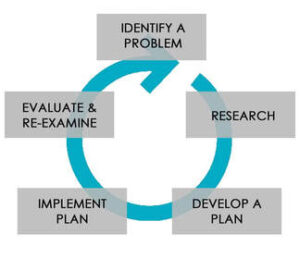
Rooted in Freirian pedagogy, participatory action research is an approach to activism that engages a group that faces a problem in an ongoing cycle of reflection and planning to inform action to solve the problem. This is followed by observation of the results of this action, which then inform a new stage of reflection, planning, and action. It is a method that blurs the boundary between education and organizing, generating theory to guide action with deep participation of those most directly affected by a problem. As a method, it tends to kick off a trajectory of change that transforms the participants, their organization, and eventually, the surrounding system and environment. That’s pretty much what happened when I won a Co-op Innovation Award grant to launch the project at a labor education center for Uber drivers in 2019.
Over 300 drivers expressed interest in the project. We held an election to allocate the two dozen available seats. For the following ten weeks, a group of drivers and research assistants met every Wednesday night and dissected the anatomy of New York City’s rideshare sector, an industry powered by the labor of over 80,000 drivers completing 600,000 trips per day, generating approximately $6 billion in revenue and an estimated $1.5 billion in gross profit for the platforms per year, while drivers are pushed into poverty by high commissions, vehicle costs that eat up fifty cents of every dollar drivers make, and not enough trips to go around.
Through the class, we came up with a multi-pronged strategy for change: a purchasing cooperative to allow drivers to reduce their costs through collectively-bargained discounts on insurance and other inputs of the industry; vehicle financing through a credit union, creation of legislation to facilitate a just, green transition to electric and wheelchair accessible vehicles; and the launch of a driver-owned platform.
We looked for a place to begin. History intervened. In March 2020, the COVID-19 pandemic hit New York. The crisis threw the exploitative (critical theorists might say necropolitical) foundations of the gig economy — and capitalism as a whole— into sharp relief. Excluded from unemployment insurance by their independent contractor status and defrauded by Uber’s early broken promise of providing financial assistance to drivers who were particularly at risk of COVID, drivers faced a fateful choice: risk their lives by going on the road to try to make enough money to pay the rent or stay home without any income, risking eviction. At the same time, trip volumes across New York City cratered as people began to quarantine.
In this context, a new need emerged. The elderly and others with compromised immune systems needed home delivery of food and other necessities. Drivers needed jobs that would minimize their exposure. Inspired by the example of public markets created by Milwaukee Sewer Socialist Mayor Dan Hoan during WWI, we came up with an idea — create a program for drivers to earn pay delivering food to those who needed to quarantine. We called it “Labor Delivers,” and raised $5,000 through crowdfunded donations for driver pay for a pilot.
The Labor Delivers program was a success. Drivers got paid to make home deliveries for a food pantry preparing meals for those at higher risk of COVID. The pilot soon touched off something much larger. As the COVID-19 crisis deepened, the Deblasio administration was looking for ideas on how to use federal emergency funding to help New Yorkers. The pandemic had become a state of exception in which the usual rules of the capitalist economy were suspended. Government was forced to intervene massively in the economy to ensure survival of the population and the system itself. We told interested supporters in City government about our model, and within a few weeks “DeliveryTLC” was announced, later re-branded as “GetFoodNYC.” In the program, New Yorkers could sign up to get a box of groceries delivered by TLC drivers. Drivers were eventually paid $40 million in wages for doing grocery deliveries in the program, a crucial employment lifeline in the early days of the pandemic. It was likely the largest municipal grocery provisioning system since Sewer Socialist Milwaukee’s WWI-era programs that inspired it.
This pilot and the subsequent scale-up by the City of New York showed us that labor can go beyond making demands. We can create new systems. This success helped give us the confidence to accelerate plans to launch the co-op. For the past five years, a group composed largely of the original drivers who joined the participatory action research project, plus allies that have joined along the way, have executed the plan that we came up with in 2019.
To date, The Drivers Cooperative has completed over 300,000 trips, recruited over 160,000 riders and over 12,000 drivers, and has generated over $12 million in revenue (around 85% of which has gone to driver pay), established a credit union partnership that allows drivers to escape from predatory lending, and with secured the introduction of legislation for a just, green transition of the industry. By its second year of operation, the co-op became the 10th-largest transportation company in New York City. We built an app (now on its third version), now available for use by driver cooperatives worldwide, which you can download here.
The co-op continues to operate today under worker self-management and narrow profitability — an improbable but unquestionable success for a company that came from a meeting of low-wage workers without any capital in 2019.
We learned many lessons along the way. We found that a worker-owned enterprise can pilot “high road” practices in a predatory industry, demonstrating that exploitation does not have to be the norm. We saw that worker-owned enterprises can be a source of worker power, and can use this power to transform industries by universalizing high-road practices through legislation and regulation. And perhaps most soberingly, we saw that the greatest barriers to the success of social movement organizing and cooperative entrepreneurship are not the opposition we face from predatory incumbents or other external factors, but that we are in fact our own worst enemies.