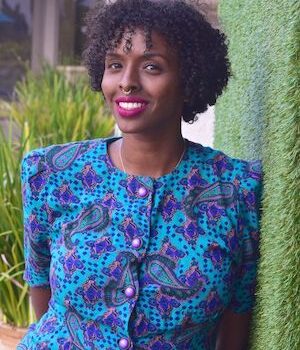
This interview was conducted in Fall 2025 with Valencia Gunder of The Smile Trust, about Razing Liberty Square, a documentary about the Black community of Liberty City and how they’re resisting climate gentrification.
Misk Noor:
Thank you for sending me the link to the documentary. I had a great time watching it. Vee, your organizing experience is both deep and wide, and I would like to start with grounding us there. Please tell us, what brings you to this work?
Valencia Gunder:
I’m Valencia Gunder, and most folks call me Vee, she/her, the Founder and Co-director of the Smile Trust, Executive Director of the Black Collective, and Lead MADD Scientist at the Freedom Lab based in Liberty City, Miami. I get asked this question often and watching my father go through his recovery is the first time I was brought into the work. I was around 12 years old. My father had been struggling with addiction for a while and when he got clean, he came to get me. I was the youngest of his children and my dad got himself together, got somewhere to stay, came and got his youngest daughter, because my other two siblings were adults at the time. My dad, not only through his recovery, was super active in NA meetings and he would be down at the village. The Mission in the village down here in Miami, is a shelter program that has drug recovery, in-house programming, and I would volunteer there. I would attend NA meetings with my dad as he was going through his recovery, and he ended up being a counselor for other people. I remember one of the first times I actually realized, of course in my adulthood, that my father was organizing but I look back on this conversation where I asked my dad, “Why are people always coming back to get their one-day chip over and over again? Why is it so hard?”
And I remember my dad having to ground me politically on what was going on in the moment. That’s when I realized that it was a system that was causing these things to happen and that this program was set up to help organize people into a community, so we could walk together toward recovery and if you mess up, it’s okay, there’s still home, and you could come back. I think that was the first time I was inside of a political home of sorts, in the mid ’90s. Ever since then I’ve been active. Even in high school on Saturdays, I was volunteering my time at the homeless shelter and passing out food. And I just always stuck to that. So I feel like that’s what brought me to my work; I’ve been just doing what people may call charitable volunteering for a long time. But it was actually in 2010 when I finally was like, “Okay, what the f— is going on?”
One of my favorite poets said, “The earth shook still,” when Haiti was hit with the earthquake in 2010. And that was in the moment where I was asking questions like, “Why are they calling the Haitian people these things? Why are they showing these dead bodies on the internet?” I was just really, really confused, but I felt compelled to activate and that’s the first time I ever activated for a disaster. And I’ve been working on it full time since 2010.
MN:
That’s beautiful. Thank you so much for taking me through that, love, and that’s such a good transition into the next question as we start to talk about Liberty City and Liberty Square in particular. The documentary we are talking about is called Razing Liberty Square and so I would love for you to tell us a little bit about how it came to be, why did it feel important that it exists? Who and what made it possible? And really you’re one of the key characters in it, so I’m curious how you got involved.
VG:
Yeah, so shout-out to Katja Esson. She’s the director. She’s not American, she’s not Black, and she’s not from Miami. She is a German filmmaker that has been in the film industry in America since she was in college. One of her first jobs was being a producer for a 2 Live Crew music video in the 90s, and she did a lot of organizing work back at home when they got rid of the Berlin Wall, and she’d been living in Miami for a while when she heard about Liberty Square. At first, she was just going to talk about the historic piece of the project, but when somebody told her about the sea level rising and climate gentrification, she knew this part of the story had to be added to the documentary.
I don’t remember the first time I met Katja. I just know that this German woman kept showing up to everything; every community meeting, every workshop I was teaching, when we were volunteering, when we were feeding people, she would show up and volunteer. She wasn’t showing up with cameras and or a crew. And we began to build a relationship, because I’m friendly, and I talk to all the volunteers because I’m grateful for their service and their support. And she finally asked me, I think probably after four or five months, “Vee, I’m trying to do a story on climate gentrification, can I interview you for it?” This was 2017, right after another disaster, and I said, “Sure.”
And it wasn’t until 2019, and I’m quite sure she had told me before, that I understood she was making a documentary about Liberty Square. And it was interesting because she was attached to me because of the climate gentrification piece, but I was also organizing Liberty Square residents at the same time. And so she was able to capture a lot of information and a lot of footage of me. And then I was also building out my house (because I brought my grandfather’s house), and you see that as a part of the documentary, and she was just around for all of it.
When I finally stopped and thought about it, it was during the uprisings in 2020, sparked by the murder of George Floyd. She told me again, “we are literally making a documentary about Liberty Square in this moment.” And while I was like, “Oh, okay.” I didn’t think the documentary was going to take off the way it did. But then she told me I was one of the main protagonists, and so then that’s how it all started. Out of all of the other protagonists, I had only met one of them, who is Aaron. I knew Aaron my whole life, but there were other protagonists and I didn’t get to know them until we were in the editing process.
So it was really cool how she was telling the story from different angles, from different people in the community ’cause we are all connected ’cause we’re from Liberty City, attached to Liberty Square in some shape, fashion or form. But we were not directly working together ’cause we were from different walks of life. That’s how we got to the documentary.
MN:
Thank you so much. My next question is about the beginning of the documentary when you say, “When I was a child, my grandfather would always say they’re going to come take Liberty City because we do not flood.” Please tell me more about why you said this and what this means.
VG:
I still remember sitting on my grandfather’s front porch when he said it and I was like, “Granddaddy, nobody gonna want Liberty City, look at it.” And being from the hood, you don’t always see the value in your own community because of the broken window syndrome. They make sure you understand that you’re impoverished and you’re living in squalor. But my grandfather, who had been in Miami for an extremely long time, saw the different phases of Liberty City and he also knew that information about it NOT flooding. And it wasn’t until later, when I went to school for international agricultural business, that I started learning a lot about the environment and the land. And then when I got home [from school], I was invited to a climate meeting in Liberty City in 2016 and heard so many other elders all saying the same thing my grandfather said: “They’re taking Liberty City because it don’t flood.” “It is because we sit above the sea level and it don’t flood, da-da-da-da.” So I was literally sitting there like, “Okay, so this is not something my grandfather feels. This is something the community is feeling and it is a fact”.
Our stories are always the truth. That is the expertise. And it was at that moment that I realized that my grandfather was speaking wisdom into me that I would use many, many years later, even after his passing.
But it was Ms. Paulette Richards, who’s still living, our elder here in Liberty City, who said the term “climate gentrification” to me for the first time in 2016. I always like to say her name when I’m speaking because it was her who gave us language. It’s a white professor at Harvard University who claimed he coined the term, but that’s not true because President Barack Obama gave Ms. Paulette an award for coining that term. So a Black woman created the term climate gentrification, and it was us as Black organizers working with scientists at FIU that actually proved that climate gentrification was a thing.
So yeah, my grandfather, although he didn’t have the science degrees and the maps –– none of my elders did –– but they just knew for a fact that this was happening in their community and it went from “they making shit up” to now an international phenomenon about climate gentrification. People now can identify it in their communities because Black people in Liberty City were brave enough, including my grandfather, to start speaking on something that they were feeling and experiencing even though they didn’t have the science and the data.
MN:
The story of Liberty City is not that different from many stories in a lot of Black communities across this country. And I found myself angry, but not surprised by the different tactics that they used, particularly to dismantle and disseminate the community away from each other, to take away the power that folks have by being in community with each other. Out of the hundreds of families who left Liberty Square, only five families returned when this documentary was being filmed. Could you share what are the other impacts that you have seen because of the climate gentrification that the community is facing there?
VG:
Yeah, so of course, we already talked about the families being displaced. Liberty City is expensive, and the more they complete Liberty Square, the more the property value of the neighborhood goes up. And I know to some people that’s exciting. I’m a young millennial and I tell people all the time in this day and age, it’s good that my property value is going up, but the problem is that most people in my community are renters. So if the property value goes up, then their rent goes up. So that makes it inaccessible to live there.
People are already dealing with the stress of living in these apartments, from leaking, mold and cracked ceilings. On top of that, over-militarization and over-surveilling in these communities is crazy. And the market value apartments look completely different from the public housing ones. They’re painting them differently, they have different windows, everything’s different. And it’s like they just threw something together for the poor people and then for those who can afford market rate, they built something nice and beautiful for them.
We are also dealing with the fact that Liberty Square is just one of the housing projects in Miami that is going through this and we have been trying to fight it on so many levels. Like right now, in this election that’s happening in the city of Miami, they are trying to pass an initiative that won’t require developers to have to get input from the community anymore, making it so that the commissioners can just make a decision without input from the people. So that’s another thing we’re battling now because our local politicians are in the pockets of these developers.
In this moment, gentrification is a huge thing that we are thinking about. But there’s also the extreme heat that’s happening in Miami, and the extreme food deserts that we’re dealing with. We used to be able to eat off trees walking down the block, but none of that is here anymore. People have hurricane season, and we have heat season too, and it’s starting to impact people’s ability to even live in the house ’cause it’s so hot because we lack tree canopy and things like that. So we are dealing with all of those things because more people are becoming unsheltered, so more people are being exposed to the elements and things of that nature.
Some good updates: we were able to get the list of people that were displaced from Liberty Square and called through them. And so now it’s closer to 200 families back inside of Liberty Square, so all power to the people.
MN:
Thank you for that, Vee. To continue on that topic, one of the things that you talk about in the documentary is climate resiliency and I feel like that’s also what you were talking about when you explained what the fight actually is looking like or how it is evolving now. But for folks who don’t know what climate resiliency is, can you say more about what that looks like, particularly in Liberty City and the work that y’all are organizing around there?
VG:
In my terminology, climate resiliency is the ability to withstand and bounce back after a shock or extreme stressor. So for example, you have stressors that people, especially Black communities or communities of color, face every day. That’s lack of access to food, inability to have housing, education, knowledge and transportation, healthcare, and things like that. These are extreme stressors, but then there are also “shocks” that can happen, such as a disaster or an uprising or a flood or a wildfire or something like that. So there are different levels of response and planning around each of those things.
Some of the work is becoming very, very popular now. People have been talking about mutual aid a lot since COVID. But I also tell people that we don’t need to just be practicing mutual aid because mutual aid responds to low-level stressors. What we need to be in the practice of is resiliency planning and that will have us doing more on what we would call operationalizing bigger systems to be able to respond to bigger stressors and shocks. So for some of the work that we’re doing at the Smile Trust, we have the Community Emergency Operations Center where we respond to communities, organizations or individuals that need help during a shock or extreme stressor. We do things like move mass food, medicine and water to different communities. We also train people on how to do these things. We do wellness checks and we’ve helped different organizations set them up across the country. We’ve actually done this work since 2017, but it’s becoming more prevalent in the moment now with the fact that FEMA got its services cut and Red Cross was already not showing up to our communities. People are realizing that we need to shift to resiliency planning for our people to be able to adapt. We are not trying to become the government, as they should be providing these services, but we can dare to be abolitionists in a real way to start operationalizing systems that make sense for our people locally.
We have the Freedom Lab now, which is our liberation laboratory in Liberty City where we address stressors every day. We got a free clinic here. We’re feeding people six days a week. We do community emergency response training and we certify people in emergency response. We have the Gap Program where we support people with rent payments. So we try to be in practice of our liberation here in this space and that’s every single day of the week except for Sundays. It’s the only day we take off. Then when a shock happens, like a storm or something like that, you see us expand our services to something larger where we do pop-up hubs throughout the state. Within like 24 to 48 hours, we could pop up between 50 to 60 hubs across the state working with a ton of organizations and organizers, and we’ve been able to scale this model and support organizations all around the country.
We also have worked in other countries too. We sent 300 tons of medical supplies to Haiti in 2021 because we are trying to help people realize that we do have what we need to help each other. We just need to operationalize the system and make it a system so that people can use it for the long run. People mistake mutual aid work as charity work, and it’s not. It is completely different. It’s the organized politics that we need to be in toward liberation that we’ve been in the practice of for a very long time.
I think it’s very important for people to know the difference between mutual aid and charity because I think oftentimes we think passing out random plates of food to random people is mutual aid. Now, in a rapid response moment, no matter who you are, if you’re part of our organization or not, we pass out food and supplies to everyone. But when you’re doing mutual aid work, that’s the everyday work of the stressor. So you want to have an organized community that understands. Usually with mutual aid, people come to you and this is not a pop-up thing. This is something that happens often so people know, “This is where I come to when I need these things. And this place is not always guaranteed, but most of the time, guaranteed between these hours on these days, I can show up and I can get what I need.”
And that is mutual aid. Mutual aid is also training up our own community members to serve themselves. So we also teach people how to be in service, how to set up these systems. If we’re going to do mutual aid, we have to understand that we have to believe that we have the resources and the talent within ourselves to be able to move this work.
MN:
Thank you for that transition to my next question. In the documentary, viewers are able to see you buying your home, MEYGA school, and Mop City barbershop, as spaces of resiliency that move us towards this world building that you’re talking about. And so I am curious what other examples outside of those three are inspiring you lately? What’s keeping you moving?
VG:
Shout out to Mop City Barbershop because that orange building is still there. The owner passed away a few years back, but his family is holding strong. They’re not willing to sell because their parents and grandparents worked really hard for that land.
They used to run something called a $2 House, where people could come, pay $2, and they could take a shower and they could eat. That’s a project I’m going to take on next year with them in 2026. So you’re going to have that Freedom Lab and the $2 House. Shout out to Phil Agnew, Isaiah “Zaybo” Thomas who are running Roots bookstore, a Black-owned bookstore in Liberty City. They just opened up this year, and it’s such a place of resiliency and liberation, a beautiful space for community and so I’m super excited about them. I want to give a shout-out to Miami Worker Center and Power U as well. They’ve been sitting on their property for 20-something years on 54th Street, and they’re in the process of expanding and renovating.
Shout-out to MEYGA. They switched over to African Square Park, which is across the street from Liberty Square and they’ve been functioning their school right out of that building and they’re still going strong, so shout out to Samantha Quarterman. She’s been catching hell from the politicians, but she’s still over there serving the children, and that’s what I love about her the most.
I want to give a shout-out to the Miami Urban League. It’s led by Black women, their staff is all Black, and they have over 4,000 units of affordable housing in Liberty Square. They’re building houses, they’re building town homes, and they’re building apartments to make it affordable for people like senior citizens to be able to stay in Liberty City. The Miami Urban League has been doing that work for a long time and I think that’s a great example of how the Urban League should be showing up in their city.
There’s also a local network of gardens. We could probably feed a lot of people if we all came together, which is why we are working on building a coalition together. The Green Haven project has a few gardens around Miami. They also harvest their land and bring it to the Village Freedge often. And shout out to the Village Freedge and the Dade County Street Response. That’s our whole medical arm of our movement work. Shout-out to Dr. Armin Henderson, who leads that work. And then I also think about the Circle of Brotherhood, who actually took an old elementary school and turned it into a community hub. So there’s some good work happening across the city, and a lot of people moving work.
MN:
Love that. Thank you for shouting out all those examples. That made me smile and it’s amazing to see how expansive the work really, really is. I’m going to zoom back out because as somebody who’s a movement communications professional, I’m very curious about all of the different ways we are telling our stories. And so I wanted to ask about the documentary itself because I thought it was really beautifully shot. And so I wanted to ask you as an organizer, why do you think it’s important for movements to utilize storytelling strategies such as documentaries?
VG:
I think it’s a cool way for us to be able to capture the history and what’s happening in our movement. I think oftentimes we do work and it’s not very visible. Also, I mean, I’m one of those people, I watch lots of documentaries, and I feel as if movement documentaries are super important in this moment for people to be able to look back. It is a great educational tool in this moment. We can teach people and it could be an advocacy tool. I’m tagged on TikTok and Instagram all the time when a person gets a clip of the documentary, but the biggest thing for me is the generations after me having something they come back to and they’re like, “Oh, we need to do something about this. What were they doing when this happened 50 years ago?” So they are able to really, really realize how we were being resilient in that moment, and not to romanticize anything, but to learn and be able to help operationalize systems that they need.
And I feel like documentaries are a great tool because then people don’t have to look far to get answers to their questions. Even in Razing Liberty Square, it was joyful for me to see what Miami looked like during the McDuffie uprisings, and for a lot of people to even hear of the McDuffie uprising and realize that Florida has been a part of the fight, and that the South extends past Georgia. It’s also important to be able to tell a story in different iterations. Miami is a very young city compared to the rest of America because we were not a part of chattel slavery. We were literally against that. We fought, we won, and Indigenous people were still in control of this land for a very long time. Even Black history in Miami is so different because of that, and then with Haiti winning their revolution in 1804, that also impacted South Florida. So we had all of those things happening here, and I feel like this documentary was one way to share that we’ve been fighting for liberation for a long time.
And I learn so much from people capturing and telling stories about different cities and I wish more people started to do that. Even when I visited Minneapolis for the first time and saw the large Somali community, I remember, Miski, I told my team, I said, “Well, how the hell did they get from East Africa to Minneapolis?” And I can’t wait for somebody to tell that story because I think those types of stories would help us think about climate migration, political migration, seeking asylum and refuge in another place. And, at least for me because I’m an oral learner, listening to stories and learning from people’s lived experiences is literally why I’m the woman I am today.
Razing Liberty Square is telling a side of the story where organizers, community leaders, elders all came together because our community was under attack. And not only were we able to tell the story of our fight, we were also able to share the history of our city. I hope more people think about making documentaries. I don’t care if only five people watch them now, you’ll be surprised that in 40, 50 years somebody will find it.
So write the story, capture the story, because the people’s stories are the truth. Those are the experts. And I believe the people first every single time. That’s the strategy, period. People know what it is that they need. They know what they need to survive, and we have to believe that. We have to believe that 100%. We know the government doesn’t believe, but we, the people, the people in movement, revolutionaries, need to know and understand that. When we hear these stories, capturing the story is not just for a quick hit on social media, but it’s also to capture the history so people can know what to do next in the future.
MN:
That’s right. Thank you for that, Vee, and really for this whole interview. Okay, so here goes my last question because our time is wrapping up. You spent this whole time really making clear why as climate collapse becomes more imminent, the work of organizing our communities is going to be even more necessary. And so for my last question, I want to ask, what have you learned from this experience that you will carry forth and would like to share with other organizers? And is there anything that I haven’t asked that you’d like to mention as a part of this interview?
VG:
The fight for liberation is evergreen. It is bigger than a strategy. It is bigger than a year’s calendar. It’s bigger than a work plan. Mary Hooks said that the mandate for Black people of this time is to avenge the suffering of our Ancestors, to earn the respect of future generations, and to be willing to be transformed in the service of the work. And my organization has adopted the mandate as we think about our work because we have to remind ourselves that sometimes we’re going to work outside of our work plan, outside of our job descriptions. I tell people all the time, “I am a revolutionary first before I’m an employee. Hello.” And I think organizers, no matter where you are in the movement, we are here in service of the people. All of the resources we have, even my paycheck, are resources of the people. I’m merely a steward for this iteration.
I think our work is evergreen. We will never be finished. Even if we were to overturn racial capitalism and white supremacy today, the amount of healing and restructuring that we need to do is going to take us hundreds of years. It took us hundreds of years to get here, going to take us hundreds of years to get out of it. So breathe deep and keep going. I also want to remind organizers that this gets stressful, and I just ask for you to not give up. It’s going to be hard. Budgets will not be guaranteed. And will you still get up and do the work? I hope you do. I hope you do. Our movement is nothing if we are not working together.
MN:
Again, thank you so much, Vee. Thank you for your wisdom and for saying yes to this interview.