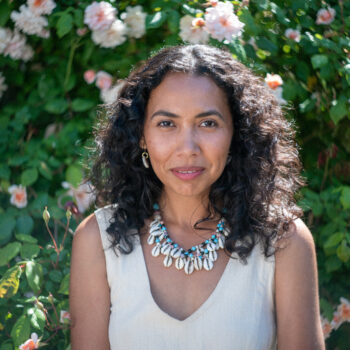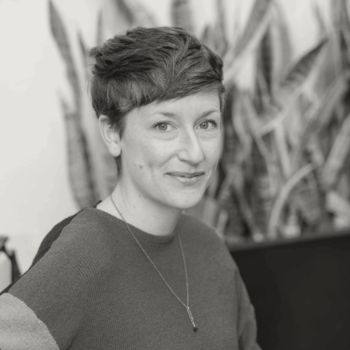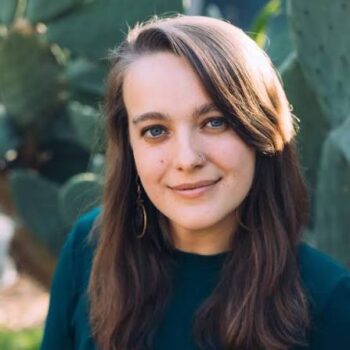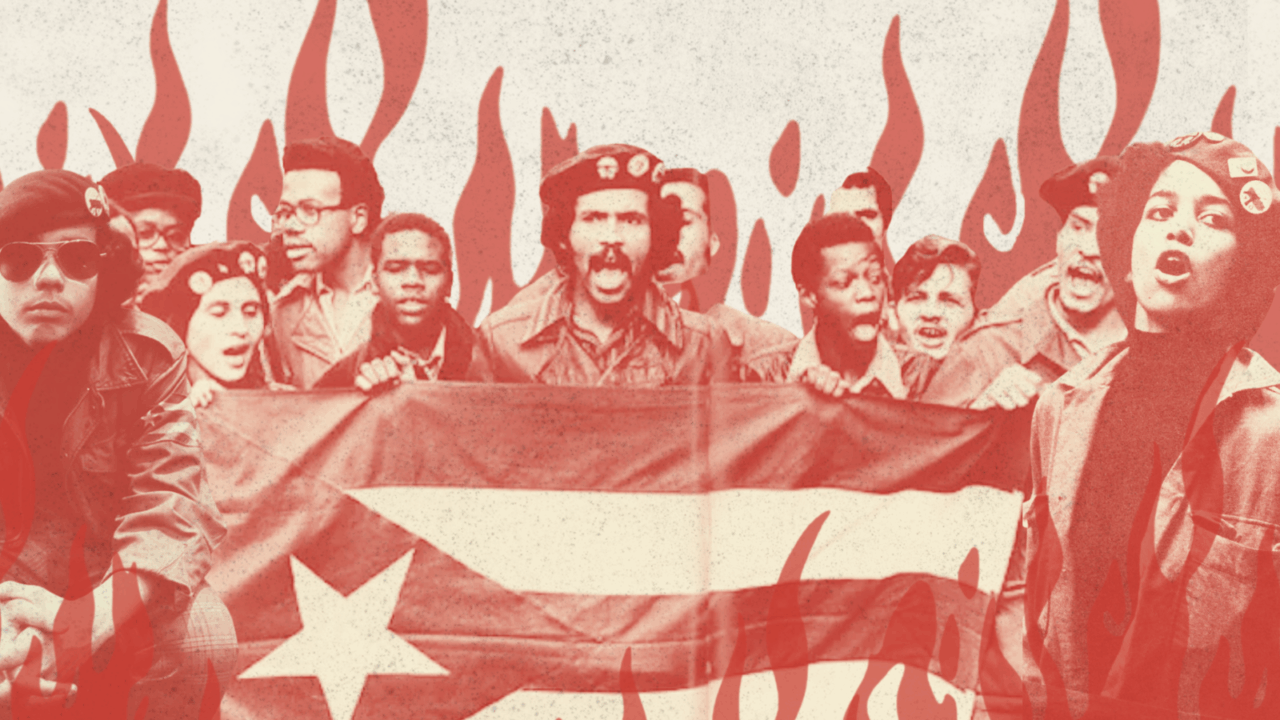
Wealth redistribution, as a relational practice rooted in accountability, has the potential to spiritually transform a person, as shared here by redistribution organizers Brittany Koteles and Morgan Curtis.
Koteles, Executive Director of Land Justice Futures, an organization that supports Catholic nuns in engaging in land return, and Curtis, who offers one-on-one coaching for inheritors of generational wealth, both maintain a committed approach to the “how” of land and resource return. As Curtis speaks to in this conversation with Guest Editor Kailea Loften, “I see money as a bridge linking spiritual reckoning with material change. A way to align our values with our actions, and to participate in repair in a way that is both personal and systemic.”
Koteles offers further thoughts on connecting the personal and the systemic by drawing a clear distinction between charity and solidarity. Charity, as she shares, “assumes neutrality about the conditions that make people poor. And solidarity digs deeper.” And dig we must if we are to remain truthful about why wealth, land, and other resources must be returned to those who have faced generational dispossession.
Kailea Loften
I’ve been looking forward to this conversation! Let’s dive in and start with how you each define wealth redistribution.
Morgan Curtis
I think about wealth redistribution at two interconnected scales.
The first is structural — governmental action that fundamentally reorganizes society toward greater equity, justice, and shared well-being. This can take the form of taxation, reparations, or the redistribution of privately held assets. We’ve seen versions of this throughout history, across different countries and contexts.
Right now, though, we’re living through the opposite: an ongoing concentration of wealth, driven by policies and business practices that extract from those with too little and funnel resources to those with far more than they need.
That’s why a second scale matters just as much: voluntary, personal, and community-based redistribution. For those of us with more than our fair share, this can be a living practice, an ongoing process of asking: “Where do I have enough? Where do I have excess? What do I hold that others need? Where did my wealth come from, and how can I return it? How do I move resources out of accumulation and back into circulation?”
This personal practice isn’t separate from structural change; it’s part of how we get there. When we ask who is working to transform these systems and build more just alternatives, and then direct our resources toward them, voluntary redistribution becomes a way to fuel the movements that can win change at the scale we need.
Brittany Koteles
I’m thinking about Pat McCabe, a Diné elder and advisor of ours, who wrote a poem about a wealth redistribution project she was part of. In the poem, she imagines that in the moment that money is released, life is released from all the different places where it’s been trapped. She writes, “That life is now released, flowing out and flowing out and flowing out. A dam released to the places most critical to the places most generative to the places most restorative.”
When I think about redistribution, I see that watershed that’s been dammed in different places, because we have created a system in which a very few people have been given, by a sort of magical-thinking legal system, the power to enclose wealth.
Wealth, meaning money, meaning land, meaning the things that facilitate our collective thriving on this earth. So wealth redistribution is working to undo the places where a life flow has been dammed up because of the assertion of violence by people in power.
This often looks like, for instance, a deed being transferred, but even that is kind of stuck in a colonial mindset about what wealth is. One way that I have heard rematriation described that I most love is from Louise Herne and Michelle Schenandoah, both members of the Haudenosaunee Confederacy. They describe rematriation as “returning the sacred to the mother.” I think that’s the deeper potential, a return to wholeness for everyone in a redistribution process.
Kailea Loften
I love the metaphor of a watershed. I think it’s helpful in understanding that you’re both tending to an ecosystem. You’re doing some form of a landscape assessment, and part of that is understanding where the waterways are located so that you can reintroduce flow back into the landscape.
And while the two of you don’t work for the same organization, you’ve shared with me that your work is similar: you walk with people through what might be considered deeply painful yet healing work. What are the origin stories of what it is you do now, and what exactly it is that you do?
Morgan Curtis
The work I do grows directly out of my own story.
As a young person, I felt a deep grief about the state of the world, but I didn’t have language for it. That started to change in college, when I got involved in a fossil fuel divestment campaign. Through that work, learning from fellow student organizers, many of them students of color, I began to understand climate change not as an isolated issue, but as a symptom of deeper systems: white supremacy, capitalism, and colonialism.
Hearing those systems named for the first time was disorienting and also clarifying. I started to connect them to my own life: “Hmm, capitalism. Well, both my grandfathers worked on Wall Street. Colonialism? I grew up with centuries-old portraits of my American military ancestors on the wall. And white supremacy? No one in my childhood ever really mentioned race, but there I was, finally realizing that I’m white.” My early 20s became a time of deep reckoning with this country’s history, and my own family’s place in it.
Around that same time, I learned that my father had set aside $500,000 for my education, and it was invested in the very extractive corporations I was organizing against. I began a personal journey to disentangle from those investments and, more broadly, to understand the origins of that wealth. The more I looked, the clearer it became that this money wasn’t simply “mine” — that it represented decades, centuries, generations of extraction.
What emerged from that was a desire to return it — to move resources back toward the communities they had been taken from.
As I stumbled my way through that process, I started speaking more openly about class and wealth in the movement spaces I was part of. And people began quietly approaching me, saying things like, “I’ve never told anyone this, but I have a trust fund, and I feel ashamed, and I don’t know what to do.”
As this kept happening, I started to think, “Maybe this is my role? I think I might be someone who walks with people who have inherited, who have access to material wealth, to extractive investments, and who have been on their own journey of coming to see that something is not right about all of this. And that they are compelled to make different choices than the generations before them.”
So for the past eight years, I’ve been supporting people with wealth — through one-on-one work, group facilitation, and organizing — especially those who feel compelled to move resources through a reparations lens.
I walk with people through all of it, the emotional and spiritual terrain, as well as the practical and logistical. That includes family dynamics, relationships with financial professionals, and building the financial literacy needed to make aligned decisions. I also support people in navigating cross-class relationships and the power dynamics that arise when moving money, while helping them understand where and how reparative social change is already underway.
It’s become my role to be with people with wealth, to love them, to stay with their process long enough so that they can move through some of the overwhelm, guilt, shame, and paralysis that can come up. It’s been an immense privilege to accompany people in this way. I’ve gotten to see both what can happen in the world when people are ready to let go, to invest in very different ways, to let resources move towards community, towards justice, towards healing, towards repair.
And I’ve also been blessed to see what can happen for people personally. How liberating and healing it can be to come into alignment and integrity with one’s values and to take responsibility for one’s history. I feel honored to have been on that personal side of the journey with people as well.
Kailea Loften
What an arc. Reflecting on you as a young person who has questions, is looking for answers, and is looking for others so you don’t feel so alone. I love the story of where your own steady commitment has taken you.
I’d love to turn it over to you, Brittany, and hear a bit about your origin story. What is it that you are doing? I know there’s overlap, as well as variance and distinction.
Brittany Koteles
I came to this work through the Nuns & Nones movement, which was this encounter between Catholic sisters and spiritually diverse activists to explore these themes of community, justice, spirituality, and living in these times.
I was a young twentysomething with a clear conviction that I wanted to live in line with my values. But I understood that the currents of capitalism, consumerism, and individualism are too strong to swim against on your own. Without community, you’ll just get washed away.
And not just “potlucks and friends” kind of community. I was looking for the structures of accountability and shared commitment. There aren’t many examples of real, committed alternative communities that have achieved scale and actual power in the world.
And lo and behold, I find one of the most incredible examples of that in the place I least expect it: Catholic nuns.
I was raised nominally Catholic. In a good year, we’d make it to church on Christmas and Easter. But I had no relationship with the Catholic Church when I met sisters. And I’m meeting these women who wear jeans, not habits; women who protest pipelines, throw good parties, and have excellent book recommendations.
The first people I ever got arrested with were Catholic nuns, protesting the first Trump administration’s detainment and separation of families at the border. I’m learning that these are women who have taken vows to God to live a counter-cultural life, to act in the service of peace and justice, and to support their community members to do the same.
They literally take a vow of poverty. They relinquish all individual wealth and ownership. You’ve got to give it all up before you join the order. On the inside of one of the most famously hierarchical, patriarchal institutions of the world, the largest private landowner in the world, author of the Doctrine of Discovery, you have at its root system a core teaching of the original movement that was all about fighting empire, redistributing wealth, and enacting a spirituality of oneness with all by moving power to the margins. I could see how radical their lifestyle was, and I wanted to learn more about that from them.
Through that, there was a natural kinship to explore and deepen in the work of climate justice. We were taking action for land justice, for climate justice, for a solidarity economy. We were taking Movement Generation classes together. 250 nuns and nones took the course correction course by Movement Generation in summer 2020. It was in that context that the literal places where we were meeting were being sold on the market.
The average age of Catholic sisters in the United States is 82. So orders are aging. They are facing massive amounts of change in letting go. Many of these congregations are figuring out what to do with the places they love that they can no longer steward. They can’t run the retreat center anymore. They have to sell the houses. They have to let go of so much.
So there it was, this opportunity to practice a radical theology: a devotion to action and peace and justice, to ecological healing, to reckoning with the internalized white supremacy within the Catholic Church. The sisters were beginning to make decisions about land that could build community power for those who are trying to access land and infrastructure to enact the kind of alternatives we know are needed.
And so what we do at Land Justice Futures is deepen our work with our community of sisters to say, let’s walk this together and look at the root systems of land injustice, how they’re connected to this same lineage and legacy in different ways. And then we put the question to them: How can the way that you let go actually be one of the most powerful things of all? How can this moment of property divestment actually set the standard for how the Catholic Church — the largest private property owner in the world — should be thinking about land and life and redistribution? And so we walk with communities of sisters to explore that on a spiritual and historic level. We help them find out who in their area is looking for land. We help look for the connections. In that way, we’re really a bridging organization.
Kailea Loften
It sounds as though there’s been a lot of learning and reorientation about who you consider to be teachers.
Could you expand on what it means to be a bridging organization? I’m thinking about the potential in unusual encounters and how important it is that we consider reaching out to people we have considered “the other.”
I’m also curious about the name Land Justice Futures.
Brittany Koteles
I think one of the things that the repair movement is struggling with is that we end up replicating the same kind of binary transactional way of doing things. We slip into thinking that repair means and is as simple as: “your people did bad things in the past. So you need to do or move something physical in order to make it better.” And that is an entirely materialist view of what repair is. That’s not invalid, but I’d say it’s one-dimensional and incomplete.
First of all, it’s a terrible organizing strategy. If we want to undam these rivers, we can’t go attacking the people with the keys and expecting them to want to do anything. I do think there are a few moral people who will join, and that’s who we’ve been recruiting into the party. But we need more people.
I think a stronger message to invite people in has to acknowledge that there can be a different material reality if we do this right, AND that we’re moving toward a future we can all be part of. The roles might be different. The power might be different. But if we can get to the other side, it’ll be rooted in a power that’s actually from a deeper, more authentic place of authority, rather than the power of hierarchy you’re aligning with.
We chose the name Land Justice Futures very purposefully, because the work of repair isn’t only about addressing the past; it’s about opening doors and removing barriers to the futures. A future in which we all belong and in which we can all thrive. I think if we miss that message, our movement won’t grow.
That’s different than centering the comfort of people who hold resources, or centering white comfort. That’s not what I’m talking about. I firmly believe that repair is an act of faith. It is saying, I think, we can transform into something more whole. We can move toward even more wholeness. And if we believe that, then how do we act? And if we believe that, then who do we become?
Western Christian theology has evolved to think of humans as separate and better than nature, and God as separate and better than us or above us. This hierarchy of being separates us. And that is a lonely theology. We have been isolated and removed from the interconnected web of life. The work of repair is about bringing us back together.
In the day-to-day, our work looks like bringing together an Indigenous collective, a Black farming collective, or migrant workers with sisters to talk about and collaborate differently on the topic of land. But when you zoom out, the work is about tending that ecology of relationships. The root word of religion, religio, is bind. It’s about reconnecting with Life, with God. Many modern expressions of religion have forgotten that. Repair is the work of remembering.
Kailea Loften
I love that you brought the root of the word religion in. I was thinking about the root of the word “repair,” which means bringing something back into order. It’s about making preparations for the next action.
Morgan, I think you can move us even further into what comes up when people are working towards repair. There are big feelings, guilt, and fear that arise when people are considering confrontation with family and personal ideals. I can imagine this can even cause identity crises.
Morgan Curtis
I really appreciate what Brittany said about shifting our understanding of reparations — moving away from a transactional frame or a sense of punishment. When reparations are framed in the mainstream as “white Americans having to give something up to pay a debt,” it makes sense that people resist. It doesn’t speak to longing or possibility.
What often gets missed is that this system is harming all of us. Yes, some of us benefit materially, but we’re also living inside a deeply unjust society, and that carries a spiritual cost. We are disconnected from the Earth, our fellow humans, our own families, and even ourselves. This erosion of relationship comes from relying on systems that harm others, whether we’re conscious of it or not.
So part of my work is helping people see that repair isn’t about giving something up. It’s about stepping into a different kind of world. A world of relationships that, in many ways, haven’t existed before. Where people separated by deep historical harm begin to come into real connection, mutuality, and care. That’s something to want — for ourselves, for our children, for the future.
And alongside that vision, real emotions surface — shame, guilt, fear — especially when people first begin to have their eyes opened to these histories and to reckon with the particularities of how they and their families have participated.
Shame and guilt are natural human responses to recognizing that you’ve been a beneficiary of injustice. These are not bad responses. In fact, they’re a sign of your humanity. They’re a sign of your connection to other human beings and to the earth. The fact that it hurts you, that you have hurt others. Good! You are alive, and you are part of this interdependent web. But they’re not a place we can stay.
Guilt and shame are fast-burning fuels: they can spark action or, more often, immobilize us. What sustains people over time is something deeper: a sense of purpose, of responsibility, of wanting to participate in repair. I often come back to a line I wrote in a poem: “what we are most ashamed of is not what our ancestors did, but what we are yet to do.” We can’t choose the history we inherit. But we do have agency in how we respond to it.
As Brittany said, money is just one part of that. But it’s been a powerful area of focus for the people I work with because it’s a bridge between the internal and the external. If we stay only in reflection and feeling, nothing may shift materially. If we focus only on moving money, without inner transformation, the underlying patterns remain.
So I see money as a bridge linking spiritual reckoning with material change. A way to align our values with our actions, and to participate in repair in a way that is both personal and systemic.
Kailea Loften
On the theme of agency, could you expand a little further on what compels some individuals and communities to want to work towards letting go?
Morgan Curtis
I think there are two core forces.
The first is a kind of awakening to impact — not just intellectually, but feeling in the body that what I have in excess could meaningfully transform someone else’s life. It’s the shift from abstraction to reality: from a number in an account that seemingly passively grows, to something that can increase another person’s choices, support their risk-taking, or help bring a community’s vision to life. “Oh wow, this bank account that sends me statements every few months could transform into a tribal community stewarding a new piece of land and having a food sovereignty project that’s actually feeding families.” That transition is fundamentally empowering and opens up a whole world of what’s possible.
The second is more personal. Many people I have worked with have come to recognize that having too much doesn’t actually feel good. That excess can dull creativity, distort relationships, and tie one’s sense of safety or worth too tightly to money. There’s a realization that wealth, beyond a certain point, isn’t liberating — it can be constraining.
And so letting go starts to feel less like a sacrifice and more like a path to freedom. A way of loosening the grip of money as the primary strategy for meeting needs and opening up other ways of living through relationships, community, and one’s own capacity to contribute.
That said, it can be very scary. Especially for people from generational wealth, where those patterns run deep. But even small steps in a different direction can bring a sense of relief, a glimpse of a different way of being that feels more liberating, more alive.
Kailea Loften
What even is liberation? What does that feel like? What is that expression in my own body? I think for many it feels intangible, and every now and then we’re gifted with a felt sense or an intuition, a drawing towards the thought: “I could have the experience of getting free.”
Brittany, I feel there’s a thread here on helping people understand the distinction between solidarity and charity. How is it that we actually can’t get free if we’re using a framework of charity? How do you help the sisters you are working with understand this difference?
Brittany Koteles
I’ll tell a story.
The Franciscan Sisters of Perpetual Adoration of La Crosse, Wisconsin, ran a boarding school for Ojibwe kids on the Bad River Ojibwe Reservation called Saint Mary’s. And when you asked sisters just a few years ago to tell us about the school at Saint Mary’s, they’d be like, “We ran a school. We gave a really good education to poor kids. They were on the Ojibwe reservation.” Generally, they were proud of that work.
The problem here is that Ojibwe kids were forced to go to these schools. It was part of a moment in time when the federal government created a holistic federal agenda of assimilation, which was largely achieved by forcing families to send their children to these Christian boarding schools.
So St. Mary’s was a place that mothers were forced to send their kids, who might return years later, unable to speak the same language anymore, completely cut off from their own cultural traditions. It was absolutely devastating.
Charity assumes neutrality about the conditions that make people poor. And solidarity digs deeper.
The sisters began a reckoning process in 2019 after the LaCrosse Historical Society published a piece that presented a different angle on the story than they had ever heard or inherited. It took years for them to dig in together and reckon with what it means to be a community that’s proud of their work for peace and justice, and that has living members who remember teaching those kids. Reckoning with the fact that the school was a part of an agenda of absolute cultural genocide. They had never processed as a community how Indian boarding schools were a part of this larger agenda.
Sister Eileen McKenzie, the former president of the Franciscan Sisters of Perpetual Adoration, had shared, “We were told that we needed to go to the reservation because God wasn’t there, and we needed to bring God to the reservation.”
So I think charity assumes that the other side, the “recipient,” doesn’t have the same amount of dignity, worth, spiritual knowledge, and spiritual worthiness. Doesn’t stand on the same ground. She goes on to reflect how the charism has evolved, and how the community is evolving to understand that God is everywhere. And when you understand that God is everywhere, you act out of solidarity.
Over the years, the sisters did more work, and they publicly committed to continuing the work of truth-telling and repair. And in October 2025, they returned a lakefront retreat center to the Lac du Flambeau Band of Ojibwe. That was the first Catholic land rematriation in U.S. history.
Kailea Loften
There’s a lot of truth in how those providing charity are unable to see how systems that they’re working in or benefiting from have created the conditions for poverty.
As you were talking about the beginning process of the nuns moving towards reckoning, I was considering the importance of revisionist histories. That there are people who continue to do the digging. In North America, there’s such a desire to want to say, “that was a long time ago,” and here you’ve just shared that there are still members of this society who remember going to collect these children out of their homes and introduce them to their idea of what is God, or love, or rightness.
It’s amazing how people have the opportunity right now to do right in their own lifetimes. That’s tremendous. What an opportunity to reconsider your positionality.
Brittany Koteles
We usually start our teaching with the Doctrine of Discovery, a set of 14th- and 15th-century papal decrees stating that Christians have the right to “vanquish, capture, conquer, and subdue all non-Christians.” And that land unoccupied by a Christian prince is “empty” and therefore available.
That was a long time ago. But what people don’t understand is that the very first title dispute to ever be heard by the US Supreme Court cites these same papal decrees. That case, Johnson v. M’Intosh, is a linchpin in modern property law. And it literally says, “the foundation of title is discovery.”
And that same thing has been cited as recently as 2005 by Ruth Bader Ginsburg. This isn’t 14th-century history! This is active and ongoing.
It was a long time ago. And it’s also right now.
Kailea Loften
I feel so embarrassed for her.
Morgan, considering that you are now a parent, a mother, your lineage continues through your daughter, Sabine. Casting yourself into the future, what is a portion of the story that you would want to be able to share with your grandchildren about what has happened between the present day and then?
Morgan Curtis
Two things come to mind. I was raised with my ancestors all around me: a book about my fifth great-grandfather was always sitting on the living room coffee table. And portraits of my ancestors were on the wall. I knew their names, but not their stories — I had never even opened the book. A friend of mine, Marcus Briggs-Cloud, who is a Maskoke person whose community I have supported through my own journey of redistribution and repair, said to me once, “You better make sure you inherit those portraits.” I feel like the thing I most want to hand my children and grandchildren is a stronger sense of who they are through the whole story. Our ancestors chose to come to this country to create a life for us, their descendants, but they made choices that hurt so many others and the land. I know that my descendants will see my mistakes, as I see those of the generations before me. But I hope that I do right by them, by telling a fuller story than I was told.
One other anecdote that comes to mind. A few years ago, I heard a fellow member leader in Resource Generation (an organization of young people with wealth and class privilege working for the redistribution of money, land, and power) say: “At some point, my kids are going to ask me: Why do our cousins have two houses? Why do our cousins go on fancy vacations?” And she went on to explain, “I’m going to take them to visit the people who live in the houses I funded, and say to them, ‘Mama bought these houses so that people who had never had a home could have a home. We have a house, and they have a house.’”
Brittany Koteles
I love that story. The showing of the houses. There’s a woman, a Methodist minister who gave her farm to a Black farming collective outside of Richmond, and she said, “I’m trading my land for the best neighbors in the world.”
Morgan Curtis
That makes me think of a letter I wrote a few years ago to my descendants. One little piece of it says;
“The money that came down through our family, gathered by generations of bankers, lawyers, captains of ships, and industry, has finally been returned to the people and lands from which it was taken. It is my prayer that you are still connected to the Black and Indigenous villages into which it flowed, that you are shaped by their leadership, and that you still find ways to mutually support one another as the world heats and unravels. These villages are refugia of knowledge and wisdom, places where intergenerational trauma was able to be witnessed and healed, where children grew into elders that guided their people onwards. These are your inheritance, your family’s legacy.”\
Kailea Loften
May it be so. Thank you both for offering a glimpse into the “whole” story.