Introduction: More Than a Vote
In the United States, democracy is often defined by the ballot box. Every two or four years, citizens are asked to cast votes for candidates who make promises to represent them. But what happens in the years between elections? For many, democracy stops after the votes are cast.
This narrow definition leaves communities—especially Black, Brown, and working-class communities—disconnected from the decisions that shape their lives. Schools close, water is poisoned, jobs vanish, and police violence escalates. Too often, those decisions are made by elites and real estate developers with little accountability.
Given the dire implications of the Supreme Court’s ruling in Louisiana v. Callais, a decision that gutted the Voting Rights Act, it is particularly important that we commit to building political power in every arena.
We do not have to accept this limited understanding of democracy. We do not concede our power.
People’s Assemblies (PAs) offer us a powerful alternative. They are vehicles for deep democratic participation where communities can govern themselves. When facilitated well, they allow people to identify needs, make decisions, and hold leaders accountable. They transform democracy from a spectator sport into a practice of self-determination.
The Roots of Assemblies in Black Liberation
Assemblies are not a recent invention. Their roots run deep in Black resistance and self-governance:
- Enslaved Prayer Circles – In Mississippi, enslaved Africans organized clandestine prayer circles to fortify their spirits and secretly plan resistance. These gatherings were about more than faith; they were early forms of assembly.
- Negro People’s Conventions – After emancipation, freed people organized conventions to draft their own plans for freedom and self-determination, rather than waiting for federal authorities or former slaveholders to define their future.
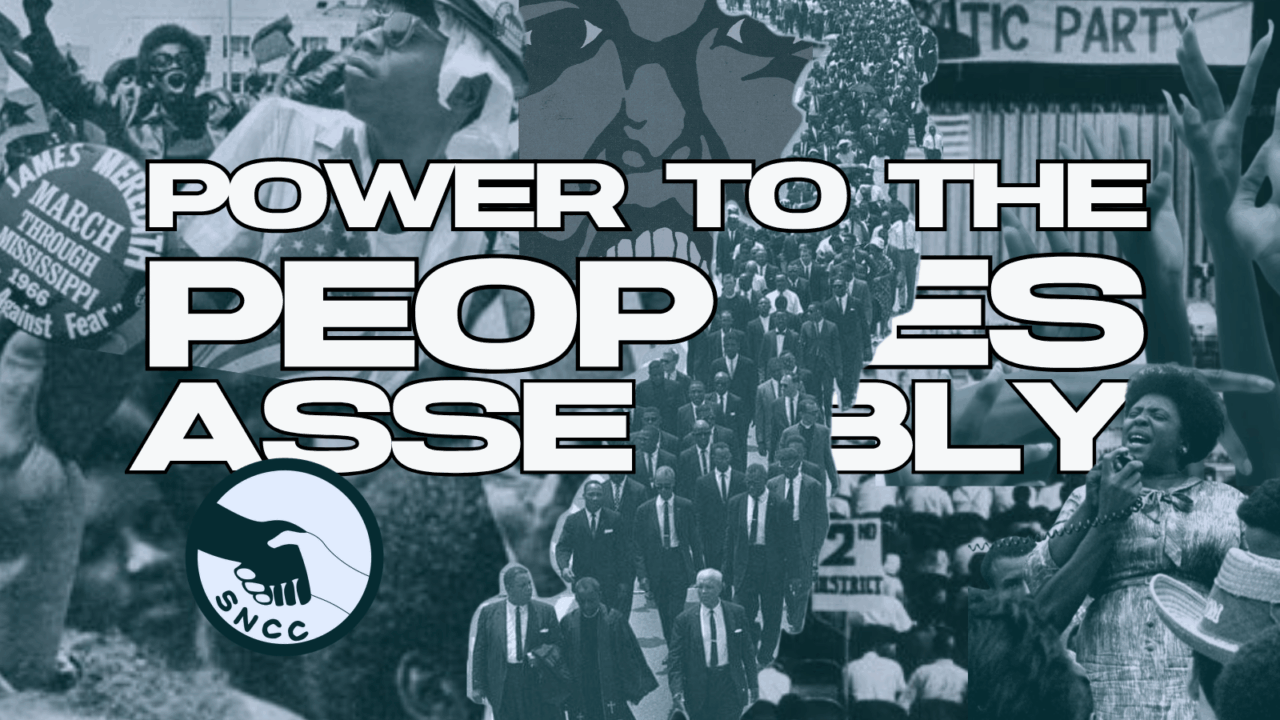
- Civil Rights Era – In the 1960s, assemblies powered the Mississippi Freedom Democratic Party, led by Fannie Lou Hamer, Medgar Evers, and SNCC. These gatherings challenged white political dominance and proved that ordinary people could organize alternative systems of representation.
- Jackson People’s Assembly – In the 1990s and 2000s, the Malcolm X Grassroots Movement launched the Jackson People’s Assembly, which became a permanent vehicle for political education and organizing. It fought the Klan, developed a People’s Platform, and later helped guide policy under Mayor Chokwe Lumumba, Sr. and his son, Mayor Chokwe Antar Lumumba.
Assemblies have always been tools of survival, resistance, and governance for Black communities denied agency by external authority.
The Assembly as a Tool for Deep Democracy
The late Mayor Chokwe Lumumba, Sr., called the assembly “the heart and soul of what we do in Jackson.” For him, it wasn’t just about gathering people—it was about creating a space where they could learn, deliberate, and decide together.
The People’s Assembly has three essential functions:
- Political Education – helping communities understand how systems work and how power can be shifted;
- Collective Decision-Making – creating a space for people to identify priorities and solutions together; and
- Accountability and Co-Governance – establishing mechanisms to hold elected officials accountable and to govern alongside them.
Assemblies expand democracy beyond electoral politics. They build belonging, cultural uplift, and hope. They train leaders and prepare communities to govern themselves.
Assemblies remind us that governance should not be limited to those with the right to vote. True democracy must include formerly incarcerated people, working-class people, the underemployed, people living with disabilities, young people, and others often excluded from decision-making.
From deciding whether a neighborhood needs a new park to determining whether taxes should be raised for infrastructure, communities deserve a direct say. Assemblies create that pathway.
Why Assemblies Matter in the Current Moment
We are living in a time of crisis. Far-right authoritarianism is on the rise. Our voting rights are under attack. Communities are reeling from police violence, housing insecurity, contaminated water, and widening inequality. In this context, traditional politics offers few solutions.
But this month contains Juneteenth. Juneteenth is a celebration and commemoration of the day the last enslaved people in the U.S. learned about the Emancipation Proclamation, which legally ended slavery for people not convicted of a crime. We honor their legacy as we look to the future, and refuse to concede our power and vision for justice.
People’s assemblies matter because they:
- Reclaim people from right-wing narrative capture by grounding politics in lived experience;
- Consolidate organizational power by uniting groups around shared priorities;
- Gather data and stories to shape policy and counter disinformation; and
- Offer communities something more than a vote: the opportunity to govern.
The National People’s Assembly Project
This year, the Movement for Black Lives is advancing this model nationally in partnership with Jackson People’s Assembly, Atlanta People’s Campaign, BLM Grassroots LA, NCBLOC, and the Rising Majority. Together, we’ve organized assemblies in cities like Atlanta, Los Angeles, and Chicago, with hundreds of folks showing up to participate, and we have another one in North Carolina coming up in July.
This project is not just about events—it is about building enduring infrastructure for community-led governance and making sure everyone can participate. That means:
- Participation Infrastructure – hosting hybrid assemblies, using digital platforms, and engaging in deep canvassing to build toward the engagement of at least 10% of local populations;
- Information Access – civic education that helps people understand where government decisions intersect with their lives; and
- Capacity and Power – uniting faith-based organizations, grassroots groups, and everyday people into a durable co-governing force.
Already, twenty faith-based organizations are preparing to carry the model into their communities, and seven more cities are on deck to launch assemblies. We encourage all organizers to consider applying this model in their work to better engage and empower their communities.
The Time Is Always Now
James Baldwin wrote: “There is never time in the future in which we will work out our salvation. The challenge is in the moment, the time is always now.”
The People’s Assembly is about seizing that moment. It moves communities from being governed to governing themselves. It provides pathways for Black, Brown, and working-class people to build governing power inside, outside, and against the state.
As Chokwe Lumumba, Sr. reminded us, history is shaped when the right people are in the right place at the right time. Assemblies make sure that time belongs to the people.
