How a seven-person volunteer crew built a six-campaign direct action engine against ICE.
“A friend in city government told me — the National Guard is coming next week.”
By the fifth time we received this text, we knew something was up. It was June 2025. Our social media feeds were full of standoffs between soldiers and everyday people in the streets of Los Angeles. Temperatures, literal and metaphorical, were running high. The rumor quickly jumped the containment banks of the few professional organizers in Philadelphia and began to spread from Signal thread to Signal thread.
Within a few hours, it was clear that the rumor was exactly that. But the response among Philly progressives and leftists revealed some stark truths. Anonymous digital flyers calling for direct action led to scuffles between a few dozen mostly-white anarchists and bike cops, who are always looking for an excuse to take their gloves off. Assorted communist parties led marches best measured by mileage, not impact. And overworked immigrant justice organizations spent hours supporting scared community members — not to mention their own families — then had to use their dwindling capacity to de-escalate equally-anxious white allies.
There was a gap in our movement ecosystem. It was clear that Philly’s progressive community was activated and looking for a way to take action, and it was equally clear that neither anonymous masked protests nor the existing immigrant-led nonprofits could hold, support, and channel this energy. We needed a new channel to collect this flood and mobilize this energy, without relying on the labor of immigrant organizers. So we got to work.
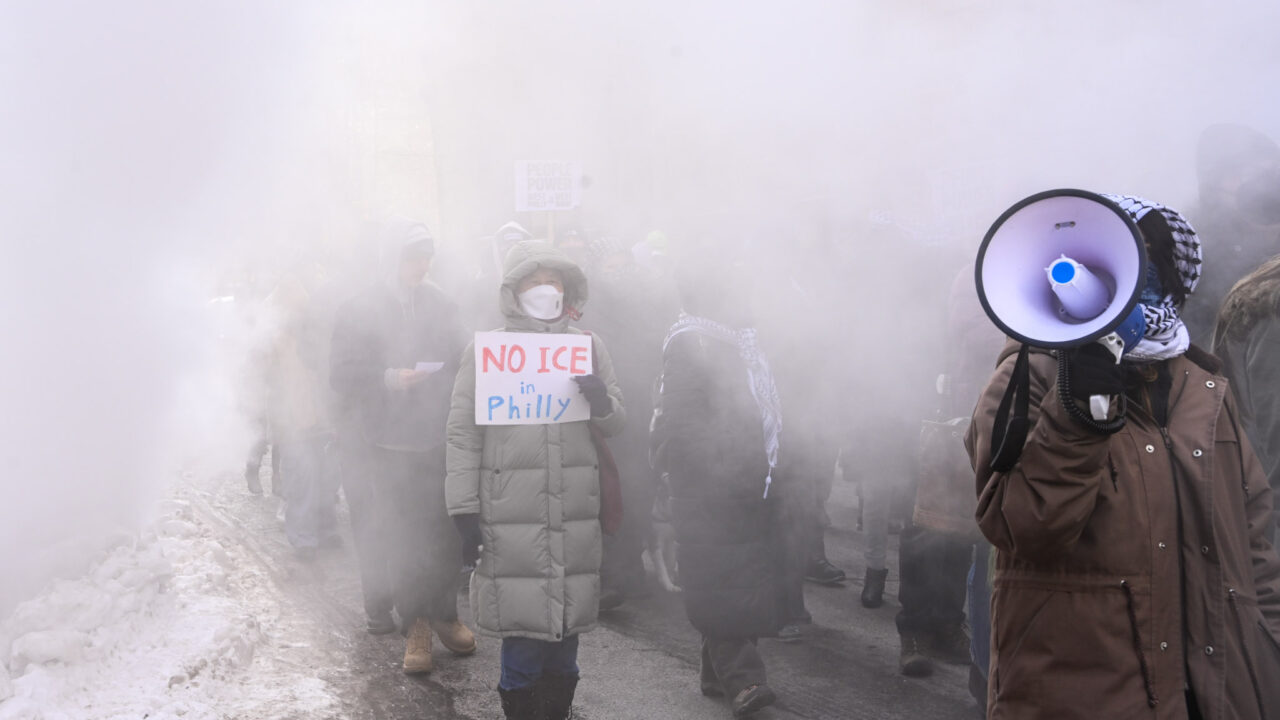
Since our launch last September, No ICE Philly has blossomed. We’ve held more than 25 nonviolent civil disobedience actions across six campaigns, which have resulted in almost 100 arrests. We’ve trained hundreds of people in nonviolent direct action, de-escalation, and campaign strategy. We connected new organizers with ongoing neighborhood ICE Watch groups and advocacy work. No ICE Philly has been in the press nearly every week of our existence. We helped make Philly’s ICE OUT legislation — the strongest in the country — an inevitable City Council victory instead of an exhausting game of compromise. We’ve collaborated with other organizations to provide training on digital security, knowing your rights, and keeping your workplace and neighborhood safe from ICE. We’ve raised thousands of dollars to support families impacted by ICE kidnappings. What began as a 7 person Core Team has blossomed into a 14 person Core Team working across a dozen working groups. We’ve done it all through relentless volunteer passion and creativity driven by a desire for justice and a love for our community.
Philly, like most US cities, has managed to evade the national spotlight but not the reality of daily ICE kidnappings. So we offer these lessons not from a place of uniqueness, but because we believe that anyone can build an all-volunteer direct action movement that bolsters immigrant-led community organizing. As we like to say, we’re bringing together people who want to go on offense against ICE, and unfortunately we’re going to need a lot more offense in the coming years to win a country that is safe for all people.
Lesson 1: Let Theory Emerge From Action
On a hot evening in September 2025, a hundred or so folks gathered in a high-ceiled room at the Quaker meetinghouse downtown for the public launch of No ICE Philly. After a song and an introduction of our core values, we gave the group two ideas for a first protest: A Quit-Your-Job Fair outside the ICE office, or a mock eviction of ICE from the building they rent. The group voted for the second option. As everyone shuffled off to breakout groups to plan logistics, press, safety, jail support, and art, some local tenant organizers came over and expressed concerns about framing eviction as something positive. We saw a chance to model leaderful decision-making, and the art breakout group cleverly came up with a new action “condemning” ICE as an “unsafe structure” and inhumane for our city.
Two weeks later we had beautiful art, designated media spokespeople, a de-escalation team, and a plan to support the people who would be taping giant “Structure Condemned” signs to the ICE office’s garage doors.
As we began marching from a nearby park to the ICE office, Jay (whose day job is pastor of a local church) handed out sheets filled with chants and songs popular with religious immigration-justice actions. The songs were hopeful, the chants were earnest… and they fell hopelessly flat. We realized that one thing we hadn’t figured out was the tone we wanted to strike. Then someone started shouting “Fuck ICE” and the tone was set: No ICE would be snarky, uncouth, direct, and unequivocal — perfect for a city known for throwing snowballs at Santa Claus.
In Let the Record Show, her incredible history of ACT UP New York, Sarah Schulman articulates how the group built a culture of praxis that always began with action, not reflection. If you wanted to see something done, you had to do it. Then and now, we learn what high-minded concepts like solidarity, abolition, and community care actually mean when we live them out in our bodies.
We could have had a long discussion in a pre-action meeting about “tone” or what made for appropriate chants. But when we launched No ICE Philly, we had so many unanswered questions: Who would show up? How would they navigate conflicts? What locations, tactics, and strategies would be most effective? Especially when our open invitation brought together (often older) well-meaning progressives and (often younger) righteous radicals, we knew that endless discussion would not be a substitute for figuring things out in the process of taking action. Solutions to the contradictions of organizing are found by putting the contradictions into practice.
Lesson 2: Lead When It’s Needed, Follow When It Isn’t
Prior to the launch of No ICE Philly, we leaned on the wealth of connections and trust that we each had built across the Left in Philly. We started by talking with immigrant-led organizations, pitching the idea of creating a temporary direct action project to redirect the (mostly white) allies who were knocking down their doors. We promised to exist for six months, and then reassess if there was still a need for an organization like ours. We made it clear that we would be independent in our decision-making (to support our members in developing organizing skills) but also promised to check in with immigrant organizers as we decided on targets and tactics.
Then we checked in with other groups, like the local DSA, and asked for recommendations for folks to join the Core Team of this new experiment. With 7 Core Team members, we set a date for our public launch and started telling people about No ICE Philly via social media, Signal threads, and personal email invitations.
Before our first meeting, we tried to predict and address concerns people would have surrounding this new group: Who are you people? (We posted intro videos to identify ourselves and explain what this work means to us). Who is funding this? (We are volunteers and had received $1,000 from a local community fund). Why aren’t immigrants leading this? (Some of us are immigrants, and more importantly allies must find ways to support overwhelmed immigrant-led groups).
Our first few general meetings ran a lot like that first one: the Core Team brought the bones of a proposal for a single direct action, and meeting attendees put skin and muscle on it. The Core Team meetings themselves also ran this way. Before the group even assembled, Jay developed a draft of shared values and agreements that we used to start every General Meeting. We found that it was far easier to come up with an action plan if there was a draft to edit, reject, or build on.
Then Operation Metro Surge kicked off in Minneapolis. We put together a massive vigil for those killed by ICE alongside the immigrant-led community organizations and, the next day, 600 people showed up to our pre-scheduled general meeting.
By the end of January, none of us could keep up with everything happening within No ICE Philly. People were getting arrested faster than we could update our Instagram. We were averaging two to three direct actions a week. But, thankfully, this velocity could be sustained (temporarily) because of a change in our leadership structure we had made just three months beforehand.
We realized that a single Core Team entrusted with designing actions and planning General Meetings placed too much responsibility on a small group of volunteers and didn’t allow for new leaders to develop. In November, Aniqa came up with a proposal to change No ICE’s structure. We would create campaigns focused on particular targets and reconstitute the Core Team with representatives from each of the new campaigns, as well as our emerging working groups (Art, Safety, Press, and Tabling). The expanded Core Team is now led by a three-person Steering Committee, which sets General Meeting agendas and manages finances.
This structure change shifted the Core Team from leading everything, to leading sometimes and following emerging new leaders at other times. We were able to absorb a lot of that loose and unfocused movement energy, and we made it easier for people to begin campaigns — and they did. People brought forth ideas including targeting local businesses working with ICE, challenging our sheriff’s inaction around ICE kidnappings at the city courthouse, and preparing for the World Cup by providing know-your-rights materials to local bars and restaurants. We saw the fruits of this change in our general meetings, which shifted from training-heavy, leader-focused monthly gatherings to bi-weekly meetings with breakout groups led by grassroots campaign leaders and volunteers.
As we hit the end of our six-month trial period, we knew we needed a way of assessing our work, and we wanted to do it in a way that used our practices of being “action first” and nimble around leading and following. And what better to assess than through action? In February, the Steering Committee proposed a Week of Action to coincide with Holy Week and the start of Passover. It was what union organizers call a structure test — figuring out just what No ICE had become. The Week of Action started with an interfaith civil disobedience at a Target store planned entirely by volunteer organizers in the suburbs. Then we held two separate hours-long blockades of ICE vehicles, a union-led picket against ICE’s presence at the airport, a kid-led teach-in outside a Citizens Bank (who fund private immigration prisons), a sit-in at the sheriff’s Office, college student walkouts, and a music-filled rally and food drive to support folks who missed work out of fear of ICE. Dozens of people stepped up in new ways, and our actions made the news every single day. While the Steering Committee had a hand in every action, none of us went to all of them. Success!
Lesson 3: Embrace the Mess
Fascism both creates and feeds off of instability and fear. Trump’s game plan is simple: Destroy the remnants of our social safety net and democratic institutions, then weaponize our fear and anger to attack immigrants, Muslims, and trans people. Every plank he removes from the floor of collective society means more people fall through, and those who don’t get increasingly anxious. Trust and generosity decrease. When we try to build real power to push back, it gets messy.
We are a volunteer-run, mobilization-based organization. We have no paid staff, and we do not intend to build a permanent membership. We are clear on our lane, but that doesn’t mean the work isn’t messy. Instead, we judge the worthiness of the chaos by the strength of the relationships we build. We measure success by the ties of trust between people who straddle many different identities, but who together represent the sprawling anti-ICE ecosystem in our city. For this to work, we know we need to build real human connections by doing regular human things like having a drink after a meeting or attending and supporting each other’s events and activities.
When we launched our new structure, one of the first ideas we heard from immigrant comrades was to go after the Philadelphia sheriff. While Sheriff Rochelle Bilal has gotten great press for her anti-ICE statements, in practice her office has allowed ICE to follow people around the city courthouse and kidnap them as they leave. In many cases, sheriff deputies have threatened and attacked those who document ICE arrests there. Immigration justice groups didn’t have capacity to launch this sort of long-term campaign, but our group did.
Relationships led us into the campaign, and they guided us through our first messy actions. We invited the sheriff to a press conference outside of the courthouse. Instead, she sent a group of highly-paid consultants to harass and intimidate us. We used every deescalation tool we could think of and eventually we got the sheriff’s supporters to agree that ICE shouldn’t be allowed into the courthouse, regardless of our disagreements on who is to blame. Our preexisting relationships with immigrant organizers, Black abolitionists, and the press allowed us to remain grounded in our purpose and get our message across without getting lost in the identities of the sheriff’s supporter and detractors.
Our relationships also help us say no. We will cosponsor almost anything led by immigrant rights groups, but almost nothing by other movements to keep our focus on ICE. We trust that our comrades in housing justice, prison abolition, Palestine solidarity, and electoral organizing will still respect us even if we don’t add our name to their flyer or turn our people out for their rally.
—
As we pass our one-year mark, we don’t know whether No ICE Philly will still exist next year. The whirlwind of winter 2026 has ended, and it seems like the rumored National Guard may never come. But the conditions that made us take the leap a year ago are still present, so we will continue to organize.
When we do eventually end this project, we hope we will have left the Philly movement ecosystem more relational, leaderful, and action-oriented. And we hope our learnings can help other cities and areas around the country fill the gaps in their ecosystems and escalate the fight against fascism. We have nothing to lose, and a world to win.