5 Lessons Learned for Mamdani From 40 Years of Building Independent Politics in Chicago.
In 1983, Harold Washington was the first Black man to be elected mayor of Chicago. He was elected by a grassroots movement of community organizations, progressive unions, and independent political organizations (IPO’s) who had been organizing for years in many of Chicago’s 50 wards.
40 years later, in April 2023, Brandon Johnson was the second Black man to be elected mayor of Chicago. He was elected by a similar formation of organizations. I am grateful to have worked on his campaign and for Washington’s 1987 re-election campaign.
In November, Zohran Mamdani became the first Muslim man of Indian descent to be elected mayor of New York. Like Washington and Johnson, he was elected by a grassroots movement of the Democratic Socialists of America (DSA), the Working Families Party (WFP), and other community groups, progressive unions, and independent political organizations (IPO’s).
The groups that helped elect these Chicago mayors may look different, but the racism from the Democratic machine and the ruling class both mayors encountered do not.
The same can be said for Mamdani: the racism from the New York Democratic machine and the ruling class has surfaced mightily and will continue.
Here are 5 valuable lessons from the Chicago movements and their victories for the incoming Mamdani administration.
Lesson #1: The Storm is coming, Embrace it!
Both Harold Washington and Brandon Johnson had to deal with a racist press corps, particularly the political columnists and writers, who lapped up stories fed to them by their opponents, riddled with racist characterizations identifying them as incompetent, corrupt managers unable or unwilling to run a city like Chicago, used to authoritarian bosses like the Daley family and Rahm Emanuel.
The same is already happening to Mamdani.
First, get used to him being called “Democratic Socialist Zohran Mamdani,” or worse. Mayor Johnson, who had been an organizer with the Chicago Teachers Union (CTU) before running for office, has been tagged by the press with the CTU name –– it’s a rare news article or political columnist, conservative or liberal, who doesn’t describe the mayor as “Mayor Johnson, who was a paid organizer for the Chicago Teachers Union” or “Johnson, a former paid organizer for the Chicago Teachers Union,” or “Johnson, who is ‘on leave’ as a paid union organizer for the CTU.”
Ordinarily, having the CTU name attached to you would be seen as very positive. Especially after the success of their 2012 strike that catapulted President Karen Lewis and the union into one of the most popular public figures and unions in Chicago history.
But nonstop attacks on CTU and successive leaders, orchestrated by right-wing, pro-business Democrats, funded by the same people and organizations who supported Emanuel and Trump, have taken their toll.
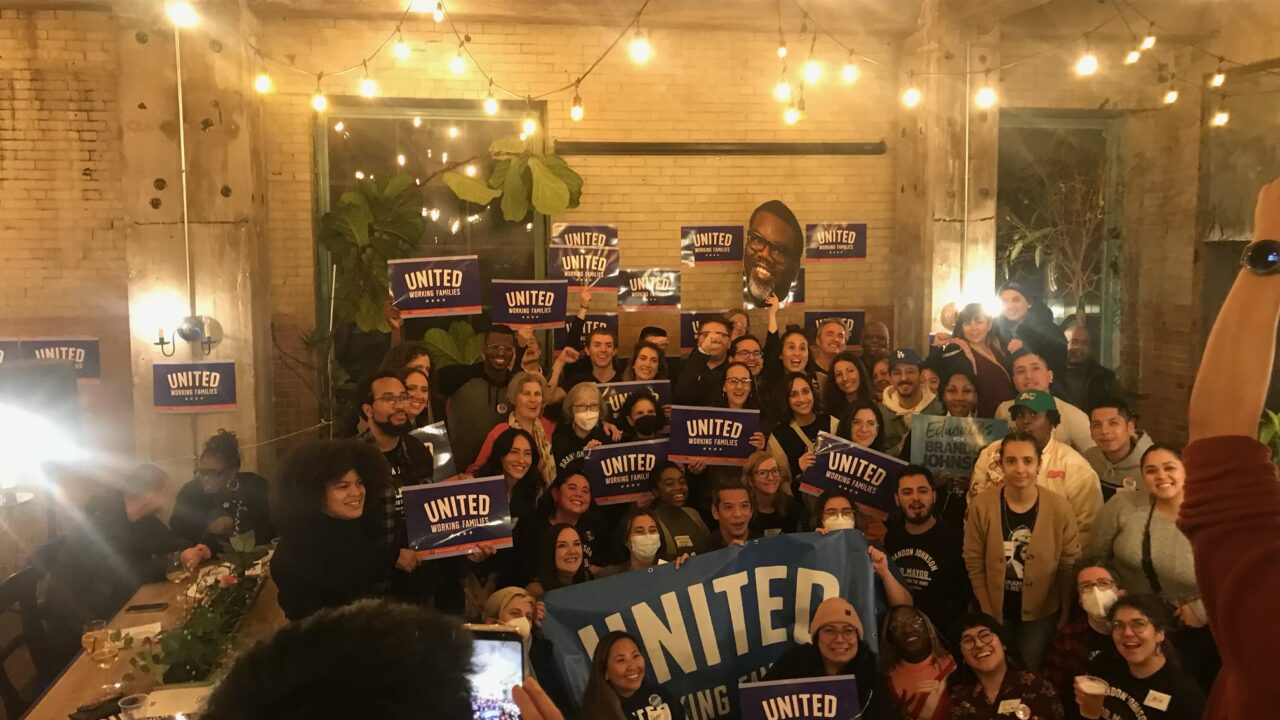
The same with United Working Families, the independent political organization that elected Mayor Johnson. The press has attacked key staff and member organizations, and more will come as the 2027 election nears.
But despite these attempts to demonize the union, CTU is still very popular in Chicago’s neighborhoods and schools and is seen as the force fighting to improve both. The fact remains that people still love fighters and love teachers, unions, and the fact that Mayor Johnson settled the first schools contract in years without a strike.
So be prepared to see “democratic socialist” before or after Mamdani’s name, or in almost every sentence in almost every written or electronic news article, now and for the rest of his hopefully many terms.
There is a way to combat this: embrace it. Mayor Johnson has embraced his connections to the CTU, mentioning how proud he is to have been a teacher and an organizer. While the attacks still come, he keeps fighting for better schools and neighborhoods, defending Chicago’s immigrants and sanctuary city status against the Trump agenda, demanding that the rich and corporations pay their fair share through progressive taxes to solve the city’s budget deficit, and most recently, endorsing a general strike at Chicago’s huge “No Kings” rally, to fight back against Trump’s policies and attacks by ICE.
And it shows in his poll numbers, which are rising despite these attacks. Mamdani should do the same by embracing the democratic socialist tag, defining what it means, and showing that he is a fighter on the issues people care about.
Cuomo as the leader of the Opposition?
In Chicago, the disgraced former head of the Chicago Public Schools, Paul Vallas, who lost to Mayor Johnson by a commanding 52-48%, has now become the legacy and right-wing media’s point man on blowback against any progressive proposal of Mayor Johnson’s.
Lesson #2: Keep Communicating Directly to the Voters
Legacy press will be ruthless, just like in the primary and general. The Chicago Tribune, the conservative reactionary newspaper in town, has given disgraced former head of the Chicago Public Schools and 2023 runner-up, Paul Vallas, as well as other right-wing critics of the mayor regular op-eds and columns criticizing any and everything the mayor has done. Expect the same from Cuomo and other opponents –– unlimited press access and op eds slamming anything Mamdani wants to do and echoing throughout the media.
Instead of chasing legacy media, Facebook, Instagram, Tik-Tok, and other social media should be Mamdani’s go-to to get his message out to his voters and potential future voters. He should institute a series of daily or weekly “fireside chats” to get his message out to his base and always have something for them to do to help him win on his promises, from calling city council people to doorknocking to promote his agenda. Any campaign should be covered on his own social media outlets as well as legacy media. Mayor Johnson is doing that now in Chicago to pass progressive taxation in his current budget and is out doorknocking himself in those neighborhoods with residents and allies through United Working Families.

Mayor Washington did the same. When he was fighting the “Vrdolyak 29,” a solid majority of 29 conservative, racist, Democratic aldermen who formed to thwart his agenda on the 50-person city council, he learned to go directly to the voters. The 29 were mostly located on the far northwest, southwest, and southeast sides of Chicago, and were determined to stop ANY improvements Washington wanted to make to the city’s neighborhoods. Washington went straight to their voters, supporting a bond issue that would bring millions of dollars of much-needed improvements to all of Chicago’s 50 wards, and won the vote in council despite not having a majority of the alderpeople in his corner. The public pressure for critically needed infrastructure improvements to roads, sewers, and other neglected areas was so great that many of the Vrdolyak 29 broke and had to vote yes with the mayor.
Lesson #3: Stay Tight with the Community Groups and Unions
Early in his administration, Mayor Washington appointed former community organizer Joe Gardner to head his newly formed Department of Neighborhoods. Joe became a de facto liaison to community organizations and helped build Washington’s standing across neighborhoods. When Chicago ACORN began a squatting campaign in the early years of his administration, taking over abandoned homes in Chicago’s Black, Brown, and white neglected neighborhoods, Washington did not react as other Democratic mayors had. He was able to respond supportively, unlike his peers in other cities, in part because of his ability to keep in close contact with his constituents.

Mamdani should do the same and appoint a good, trusted liaison to community groups. Mamdani will need some Joe’s.
That liaison could educate and mobilize New Yorkers where they are: meeting renters at their apartments, transit riders on the bus, and childcare workers and parents at schools and care centers.
Prior to 1983, Chicago and Illinois politicians alike forbade and blocked attempts to pass legislation that would allow the hundreds of thousands of public employees in the state the right to organize under the law. The Democratic machine mayors, as well as Republican machine governors, did not want to allow public employees the legal right to organize because they wanted to protect patronage: the mechanism by which both Democratic and Republican machines had mandated fealty to political bosses in exchange for jobs, mandated political donations, and field work during political campaigns.
Public employee unions like AFSCME, SEIU, and others had been organizing for decades but could not break the machine’s hold and pass legislation allowing formal recognition and collective bargaining agreements, having to rely on “handshake agreements” with the politicians which could and had been at the whim of whoever was in power.
Harold Washington, long a supporter of public employee organizing as a state representative, state senator, and congressperson, changed all of that. He campaigned on allowing public employees to organize and vowed to kill machine politics in Chicago once and for all by doing away with the patronage that propped up the machine. And he did. Early in his term, through Executive Order, he allowed public employees in Chicago to organize and set in motion the eventual passage of city and state collective bargaining acts. This not only brought living wages and benefits to the hundreds of thousands of public employees in Chicago and Illinois, it spelled the beginning of the end of political patronage and the iron-fisted rule of machine bosses.
Since the early days of his campaign, Mayor Johnson has been supportive of worker organizing –– be it Starbucks workers or a recent $18 million settlement for DoorDash consumers and workers. Mamdani should also appoint a labor liaison with credibility to produce substantial victories for the unions that supported him in the general, since so few supported him in the primary.
His schedule will pull him in every direction, but he should make sure he prioritizes ANY worker organizing, especially new worker organizing like cab drivers, gig workers, retail workers, and others, that will expand organizing rights for them and other large swaths of workers who were his base and now have no rights to organize. He should do likewise with undocumented immigrants, independent contractors, and the millions of low-wage workers who want and need unions in all of New York’s five boroughs.
And finally, he should introduce, strongly support, campaign for, and sign any legislation through the City Council to dramatically expand workers’ rights to organize in the large low-wage and gig industries in NYC. This concentration on highlighting these pathbreaking organizing campaigns and producing the needed legislation to allow them to organize their unions will show that he wants to produce concrete victories for workers and allies who supported him in his campaign.
Lesson #4: Dealing with the Machine and Democratic “Clubs” in NYC
In Chicago, the machine, although weaker than it has been in the past, is still real. Far northwest side, far southwest side, and downtown machine wards, controlled by mostly Irish or white ethnic alderpeople, as well as some Black and Latino alders, have been steeped in the Democratic machine’s “where’s mine” culture and try to keep a tight grip on the voters in their wards. Although this is changing as newer and younger, more progressive voters inhabit their wards.
In Harold Washington’s day, there was a solid majority of machine ward aldermen blocking his every move from the first day of his term. Johnson has a similar, sometimes majority against him. There is a solid bloc of 20+ anti-Johnson alders in the 50 alderperson city council, who can mount a majority on some issues. Johnson, to his credit, has been very pragmatic and won some very important votes by close margins –– including his historic call for a Gaza ceasefire –– the largest city to do so.
Mamdani will need to do this as well. But on some issues, the tongs of the machine are deep, especially with police and fire unions and some building trades and other unions. In some of these unions, family relations and debts to the old-time machine bosses and organizations go back decades and can influence decisions and are hard to counter. Mamdani, like Johnson, will need to learn how to maneuver in this short term, but will again have to increasingly go directly to the voters in those wards. Mayor Johnson is doing this in his current budget by allying with UWF and other progressive unions and community organizations to pass it through progressive taxation. Mamdani will have to learn to do the same.
Lesson #5: Be Prepared to Take on Trump and his policies because ICE is coming
Even with Mamdani’s temporary truce with Trump, it is likely more ICE raids are coming to New York. Mamdani, like Mayor Johnson, should use his powers to limit ICE’s ability to operate in his city and support local resistance efforts.
Mayor Johnson has issued sweeping Executive Orders establishing ICE FREE ZONES on city owned property and other protections for Chicago residents and undocumented neighbors. Mayor Johnson has actively supported and encouraged Rapid Response groups to defend our communities from ICE thugs patrolling and kidnaping through racial profiling anyone they suspect.
For the past several months, my neighbors and I have attended “Rapid Response” trainings and organized “walking school buses” to escort the children of undocumented immigrants to and from our local schools to protect them and their parents from ICE kidnappings. I write this right after attending a meeting of neighbors, most of them “school walkers” and “patrollers” escorting children of undocumented immigrants to and from school.
The good news is that now we have over 80 children that we are escorting to and from school in the mornings and afternoons. The bad news is that despite our greatest efforts, parents of these same children we escort have been violently kidnapped by ICE. But in response we have organized mutual aid for families with groceries, clothes, toys, and other needed items, raised legal funds to help get some released from ICE custody, and patrolled not only our schools, but our whole neighborhood to make sure our neighbors are safe.
Conclusion
Who knows how long this madness will continue, but what we have learned throughout is that by organizing together, we can fight back even the most authoritarian and brutal leader in our country’s history. And that’s a valuable lesson learned for us in Chicago and supported by Mayor Johnson and one which Mayor Mamdani and our brothers and sisters in New York should do likewise.