Building on our efforts to curb corporate power, Liberation in a Generation recently organized a special edition of The Forge—an online magazine focused on organizing and strategy—centered on reining in the rising influence of Big Business on our lives, communities and economy.
Senior tenants in East San Antonio, Texas, who, after years without adequate heating and air conditioning, resorted to sleeping with the oven on during a cold snap just to make it through the night. Small childcare providers in Wisconsin who, after constant unsolicited outreach, were convinced to sell their businesses, yet were still forced to defend rising prices to the families they served. And working-class families in Altadena, California, and in Asheville, North Carolina, who, after watching their homes go up in flames and be washed away, were targeted during some of their most vulnerable moments for the remnants of their properties.
These stories of tragedy are all too familiar for marginalized communities, who are forced to endure under the Oppression Economy. However, as you’ll explore throughout this edition, at the heart of each of these experiences — and that of so many others throughout our current economy — is runaway corporate power.
Consider those seniors living in San Antonio’s Eastside: they had to brave extreme conditions while their corporate landlords hid behind complex corporate structures to avoid accountability for providing essential services. Similarly, small Wisconsin childcare providers, after selling their businesses to a private equity firm, had to remain subject to a non-disclosure agreement that required them to be the face of higher prices and lower-quality services for a business they no longer controlled. And those families in Altadena and Asheville had to navigate the aftermath of natural disasters while simultaneously confronting manmade corporate exploitation seeking to take over their scorched and flood-ravaged lands, as cheaply as possible.
We Are Facing An Immense & Surging Concentration Of Wealth And Power In The Hands Of A Few Corporations And Wealthy Elites
The presence of corporate power in our lives is not new. However, what is new is the concentration of wealth and power on a scale once unimaginable to many. For example, Elon Musk, the world’s richest person, increased his wealth by $500 billion in just the last year, becoming the first person to be worth more than $800 billion. In the last 10 years, the total net worth of the world’s billionaires increased from $6.48 trillion to $20.1 trillion, a mindboggling figure largely driven by stock ownership, which is concentrated among the top 1% of households, and whose value has exploded over the last few years. And much of that growth is attributable to the non-stop rise of Big Tech in our economy, led in large part by just seven companies — Alphabet (Google), Amazon, Apple, Meta (Facebook), Microsoft, Nvidia, and Tesla — whose market value has ballooned from $911 billion in 2012 to $21.5 trillion in 2025.
Looking around in our economy, many of us know that the issue of unrestrained corporate power isn’t limited to a few very powerful tech companies. Private equity companies and other financial institutions are also deploying a range of extraction strategies to siphon value from our communities — in nearly every aspect of our economy, from consumer goods to healthcare — and funnel it to make the wealthy even wealthier. This has led to some of the largest corporate bankruptcies, mass layoffs, and other cost-cutting strategies that prioritize investor profits over everything else, including, in the case of the rising presence of private equity in nursing homes, tens of thousands of lives that have been lost prematurely.
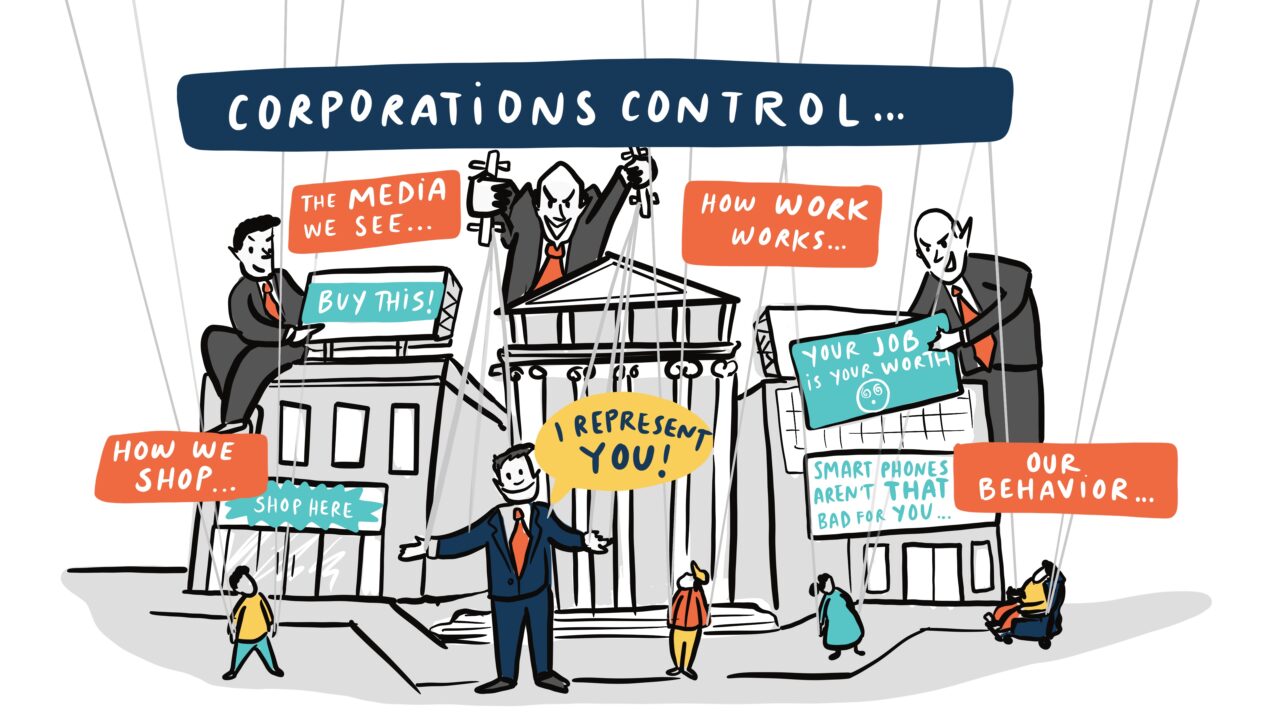
Everywhere we look, we can see and feel the influence of corporate power, which is controlling more of our lives, limiting our choices, and inflicting the worst impacts on the most vulnerable. This is exacerbated by the massive resources corporations and the wealthy elite are pouring into our political system to reinforce and maintain their power. Fueled by the 2010 Supreme Court decision in Citizens United, which ushered in unlimited corporate political spending, independent expenditures for federal elections, which are mostly funded by wealthy individuals, increased from $205 million in 2010 to $4.2 billion in 2024. The largest donors to the most recent presidential election were some of the country’s richest individuals and tech oligarchs, leading to a handful of people having immense control over policymaking to favor their businesses in local, statewide, and federal elections.
Given The Scale Of Concentrated Power & Wealth We Face, Why Should We Even Bother Challenging It?
By now, you may be wondering: if the odds are so stacked against the interests of everyday people, why should we bother thinking about — let alone challenging — entrenched concentrations of wealth and power among big business and the wealthy elites? That defeatism is exactly what they expect of us, making it easier for them to do what they want, when they want, and how they want, with little liability for their actions. Put simply, without challenge, we will continue to die prematurely, see our children robbed of quality care, be forced to work in precarious conditions, face unnecessary housing insecurity, have our needs ignored by a privileged few, and watch our communities’ potential drained. No corporation is worth that.
Fortunately, history has shown us we are capable of reining in outsized corporate power and reclaiming control of our economy and the rules that govern it. But such progress is only possible when we organize ourselves to break the grip of corporate power and wealthy elites over our economy and put power back in the hands of the people.
There are many reasons we, at Liberation in a Generation, organized this edition with the team at The Forge and the contributors who were part of it. Chief among them was our desire to co-create and share something that can serve as a reminder: both that the challenges we face are part of a long and ongoing arc to curb corporate power, and that we all hold power and potential, collectively, to rein it in.
So, What Is In This Edition?
Across all of these conversations, you’ll find stories about how immigrants, farmers, Black, and Brown people have historically led the fight against corporate power. You’ll see connections between strategies and tactics used in previous generations to beat back corporate control, from the early 20th century to the fight for benefits and working conditions for janitors in the 1990s, to today’s growing push back by communities all over against data centers.
You’ll hear how today’s version of corporate power has evolved from historical examples, and how decades of neoliberal racial capitalism have hollowed out labor power, weakened the authority of local governments, and siphoned off public dollars, enabling a small few to amass obscene power. Most importantly, across this issue, you’ll find a constant reminder that to overcome the corporate power challenges we face and sustain those hard-fought victories over the long term, we have to not only have to lean on the core thing that has gotten us so many victories — organizing — but we also must be led by people on the frontlines experiencing the harms of corporate power to do so.
The following conversations in this issue highlight examples of organizing happening in communities across this country to curb corporate power and call on us to empower those closest to the problems, to adapt to how people are connecting today, and to channel widespread frustration with corporations into collective action. They also ask us to rethink, iterate, and evolve our strategies to address the rapid expansion of corporate power today and to better leverage political education, storytelling, and narrative shifts to demystify the role that corporations play in our economy.
- Corrine Hendrickson from Wisconsin Early Childhood Action Needed (WECAN) and Sofia Lopez from Texas Organizing Project (TOP) discuss the visible and invisible ways corporate power harms communities.
- Iris Craige from Strategic Actions for a Just Economy (SAJE), Audrey Aradanas from Miami Homes for All, and Stella Adams from Blueprint North Carolina discuss the role of corporate power in housing and specifically after natural disasters.
- Ron Knox from the Institute for Local Self-Reliance (ILSR) and Candace Milner from Demos discuss the history of reining in corporate power and the people who led those fights.
- Trinity Tran from the California Public Banking Alliance (CPBA) and Sean Gonsalves from ILSR discuss how communities are successfully organizing for public banking and public broadband today.
- Lenore Palladino from the University of Massachusetts Amherst and Sue Holmberg from ILSR discuss Amazon’s growing role in public procurement and how our public and private dollars are enriching the wealthy at the expense of small businesses, workers, and consumers.
- LiJia Gong from Local Progress and Ryan Gerety from Athena Coalition focus on the need for bold, accessible, and relevant policy solutions that center everyday people, name corporate harms, and move beyond the limits of elite-driven anti-monopoly strategies.
- Dania Rajendra, a writer, organizing and founding director of the Athena Coalition, and Andrea Dehlendorf, co-founder of United for Respect, discuss the ways we can meaningfully invite, engage, and empower people to join and lead the fight to curb corporate power.
For any organizer fighting for their community, it’s essential that we identify that corporate power and concentrated wealth are at the heart of so many issues our communities face. Ultimately, whether you’ve been working on curbing corporate power for a long time, are starting to engage in this work, or have yet to jump into the fight, we hope this issue will inspire and invite more people to overcome the defeatism that corporations and the wealthy elite are counting on from all of us and to organize against corporate power. As Dania Rajendra succinctly put it in her conversation, “It’s tremendous what we’re up against, and it is possible that we won’t have the agency to fix it, but it is definitely true that if we do not try, bad things are definitely going to happen, and so we should try.”