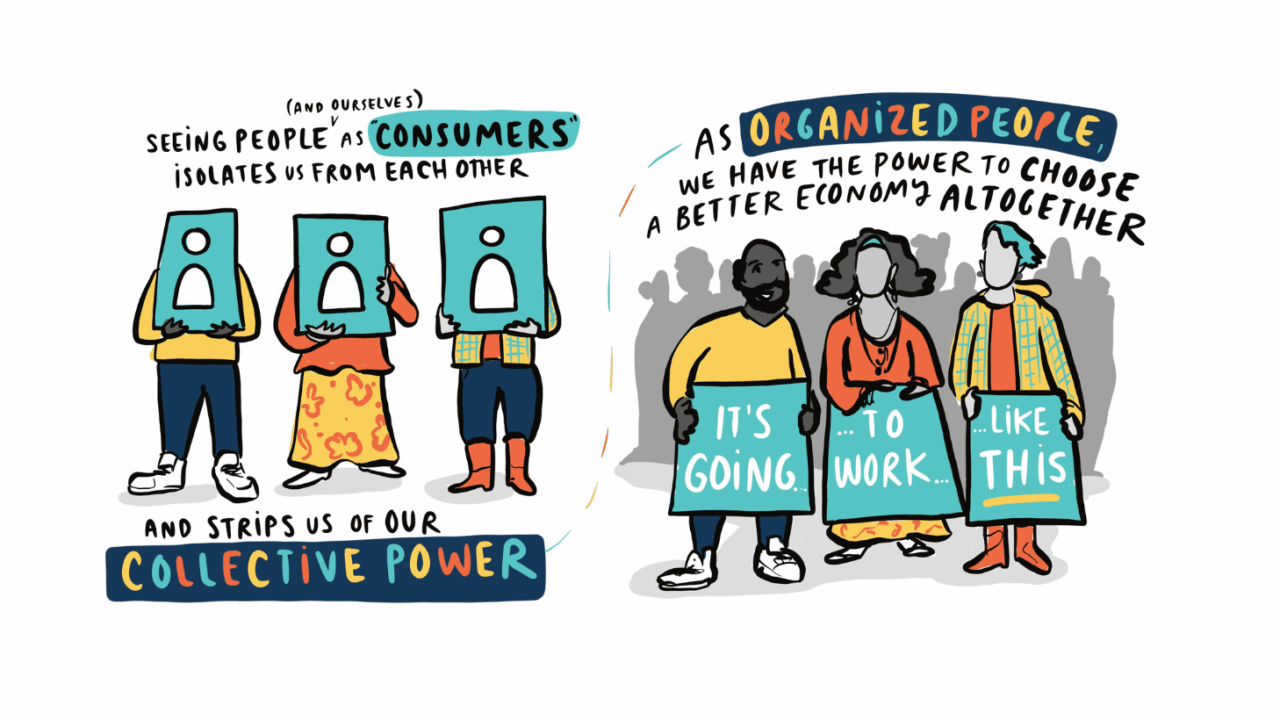
Listen to the interview here.
This interview has been edited for length and clarity.
OPENING
SOLANA RICE
Hello and welcome. I’m Solana Rice, co-founder and co-executive director of Liberation in a Generation, a national movement support organization that builds the power of people of color to transform the economy, who controls it, how it works, and most importantly, for whom.
We are beyond excited to partner once again with the team at The Forge to guest edit this special edition. In this edition, we’ve curated a group of experts to explore and connect on issues that intersect with corporate power, and we’re really going to break it down, folks.
So today we’re going to talk about corporate power and the need for bold, accessible, relevant policy solutions that center everyday people. Joining me for today’s conversation is LiJia Gong and Ryan Gerety.
LiJia is the former managing director of legal and policy at Local Progress. She leads the development of Local Progress’s legal, policy, and research capacity to support members and drives the development and growth of national program areas.
Ryan Gerety also is joining us as the director of the Athena Coalition, a coalition of 50-plus worker, antitrust, racial justice, tech advocacy, economic justice, and environmental justice organizations working together to break Amazon’s dangerous stranglehold over our democracy, economy, and planet.
WHAT IS CORPORATE POWER?
SOLANA RICE
Thanks so much, Ryan and LiJia, for joining me today. I think it’s so important to break down this word of corporate power. I think, in our current day, everyday folks are starting to understand and feel how corporations are showing up, but I really wanted to hear from you two: What is corporate power? From your neck of the woods, what does it mean to you? What does it look like? What animates you about it?
RYAN GERETY
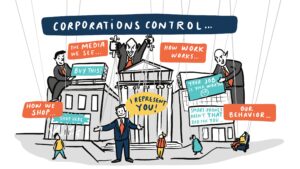
So the thing about corporate power for me is that I really hate two things. One is that I hate being bossed around. So, I hate the idea of a few people in our society getting to make more of the decisions for everybody else because I don’t think those few people should be able to tell us what to do. And when corporations have too much power, that means they control exactly how work happens, they control what media we see, they control how we shop, if we can shop freely, or if our behavior is manipulated, they control whether people can be entrepreneurs or start small businesses. And this idea, I think, is profoundly anti-democratic, that corporations really have too much power.
And then the second thing is the money flowing to a handful of these people as opposed to the rest of us. I studied computer science at the University of New Mexico in the late ’90s. That was when the tech sector boomed. And over that period, the U.S. led this incredible technological revolution. Now it doesn’t look great right now, but back then there was amazing stuff built, but it wasn’t built by just a couple of people. It was built by almost all of us, all the creators, all the programmers, all the public teachers in elementary school, high school, and university. All that wealth was created by all of us. And where’s it gone? It’s gone to the very top while hollowing out the entire middle of our country. It’s like we don’t get to make decisions about the things that impact us, and all the money of all our collective efforts, all our collective potential being humans together, is just flowing toward the top. So for me, that’s what corporate power is. It’s about control.
SOLANA RICE
Yeah. And I imagine many of our listeners and readers also don’t like to be bossed around and told what to do. It’s kind of not in our ethos in the U.S. How about you, LiJia?
LIJIA GONG
When thinking about this question of what is corporate power, I was thinking about what it feels like in my body when I don’t have control, and it’s because of corporate consolidation or power. And one example that was coming up for me: I have a three-year-old daughter and she loves to read. We read a lot to her. And I was noticing as we were buying additional books or going to the library and checking out new books, that a lot of the imprints that we were reading from her children’s books were all part of Penguin or these well-known publishers
I think I looked into that a little bit because I have this kind of suspicion that maybe I don’t have as much control as I would like about what I’m exposing my daughter to. And lo and behold, I do a little bit of research on it, and I learned that actually this is an industry that is highly consolidated. There are only a few large publishers. It’s really hard for smaller authors and illustrators to make it. And I think that’s just one small way that we have ceded and don’t have control in our lives.
I also often think about what the opposite of corporate power is. And it’s people power, it’s worker power. I come to this work having done a lot of work with workers in low wage industries, gig workers, and I think about the stories of Lyft and Uber drivers who are just so worried that they’re going to be deactivated from the app and the precarity and the stress of losing their livelihood and how it must feel in their body to have that kind of stress about their work. And I’m like, that is what corporate power is. It’s that impact on our lives. It’s the stress and the anxiety that it causes people. It’s the lack of freedom.
WAYS CORPORATE POWER MANIFESTS IN OUR DAY-TO-DAY LIVES.
SOLANA RICE
Yeah, yesterday I watched a video from More Perfect Union investigating Instacart, and you’re speaking about the both sides — both as workers, being in a precarious situation, and at the same time, consumers, also being in a precarious situation of not really having much control. So, this investigation of Instacart was showing that they are starting to use technology and have been using technology in ways that change prices of everyday groceries for different folks. And I was shocked because they did test over test to find that it doesn’t matter if you go to one store all at the same time, 40 people, they’re all paying something different, and we have no insight into that. I think that’s a real feeling of insecurity. I felt that immediately.
So I’m curious from you all, when you talk about the role of corporations in our economies and in our governing, I wonder if you could tell me a story about how you talk about corporate concentration and the role of corporations. What comes up for people in your conversations about it?
RYAN GERETY
I mean, talking to people about Amazon just brings up so many different things. People immediately have all this experience about the company. So it could be warehouse workers who understand that Amazon has come to take over online ordering and delivery. I remember one warehouse worker from outside of St. Louis was like, “Oh, there used to be these little craft stores. Now they’re closed. Amazon owns that.” But at work, she feels like they are tracking every minute, every second — leading to questions and comments like “Did you do enough? If you haven’t done enough, you’re going to be warned and then fired.” So there’s a kind of control about every movement that they feel.
If you talk to someone in Virginia who’s been fighting Amazon’s data center growth or other big tech data center growth, what they feel is that they went to their state legislators, they said, “The electricity use is a problem. It’s a problem that coal plants are staying open. The diesel generators are really loud. They create a lot of pollution.” And a lot of these people thought their legislators were going to respond. And it turned out that even very common-sense, very simple demands for transparency were beaten back by industry. And they said, “Once this sector has their claws in your state, you’ll no longer be in control in your state.” So there’s all sorts of ways small businesses feel like, how can we compete with this behemoth that cuts prices, and we can’t afford to do that. It’s all sorts of ways that you feel like, oh, the game’s kind of rigged.
LIJIA GONG
I think that is very resonant. One thing I’ll respond to that you said, Ryan, which I think is so important, is that I think corporate power is typically very divorced from the local, even though it is operating at the local level oftentimes. I mean, when we think about the biggest corporations, sure, they’re headquartered in a place, but they don’t have deep ties to the various communities, whether that’s the workers, the consumers, or the small businesses that they’re displacing. And so that’s just another element in my work, working with a network of local elected officials that I see corporate power operate is that it’s so divorced from the people who are actually living in our communities, our neighbors, our friends, our family. And I think as a result, so much of the humanness of how we engage in the world is just lost.
I think in terms of how I talk about corporate power, I’ll just share a little bit about a campaign that Local Progress has been leading. My colleague, Mia Loseff, has been leading it and has been doing incredible work to pass at the local level bans on algorithmic rental price fixing. Basically, there’s this software — RealPage is one of the major companies that have been selling the software to landlords — that basically allows landlords via AI, via an algorithm, to set prices and coordinate with each other. What we tell our local elected members, it’s actually pretty easy to explain — basically, if all of the landlords in your community and maybe regionally or beyond got together in a room, where they’re smoking cigars or doing whatever, and decided we’re all going to set prices for one bedrooms at this price. And this software basically facilitates that to happen.
At least twelve cities have passed these bans across the country in approximately the past year or so. And I think that it really taps into the sense that I think all of us feel that’s not right. That’s not just. Landlords shouldn’t be able to get together and do that kind of work. So that’s kind of one of the things that I talk about that I think sounds very wonky, algorithmic rental price fixing, and actually, once you engage people on it, it’s highly understandable because I think there is just a deep sense of fairness and sense of like, this is unjust, and this is unfair.
WHAT HAS & IS CHANGING IN THE FIGHT AGAINST CORPORATE POWER.
SOLANA RICE
Yeah, I want to keep pulling on this thread because there are elected officials and advocates that are trying to push back on the many ways that corporate power has surfaced and also put some daylight on what is actually happening. So I’m curious if you could share more about Local Progress’s Affordability for All plans, how it came together, and what parts of it have to do with reigning in corporate power at the local level?
LIJIA GONG
I will just say that I think in order to fight back against corporate power, it’ll require all of us, people power. And I think there’s an incredibly important role that governments at all levels, but especially at the local level, have to play. And that was part of the genesis for this Affordability for All Agenda, which we published with Groundwork Collaborative and the State Innovation Exchange. And our thinking on this agenda was that oftentimes people don’t believe in their elected officials to actually deliver for them. I mean, folks in our network, Local Progress members, they’re definitely there trying to deliver for their constituents.
And it’s hard when there’s been so many decades of ways in which government has harmed our communities, especially communities of color, and frankly, just the media ecosystem we’re all in. And so I think that the genesis behind the agenda was really trying to put together something that would give, especially state and local elected officials, a set of policy tools to take on corporate power. But also to show to their constituents and to voters that we’re willing to fight, we’re willing to take on corporate power, we’re willing to take real action on the issues that matter to you most that are really for folks who are struggling, for working people, for poor people to tackle the issues that are really affecting their lives. So we have this set of policies which address affordability in groceries, healthcare, housing, and utilities.
The folks at Groundwork worked with Data for Progress to do a battery of polling on it, just to also get a sense of what were the most salient things. And it was really interesting that utility costs were the most concerning issue for folks. And it was also interesting to hear that one of the policies that we proposed was that data centers have to, at the very minimum, pay their fair share of how much they’re contributing to the rising costs of utilities. And that polled incredibly well. People were highly supportive of that. And I think one small thing that hopefully local and state elected officials can do is to pass some of these policies to start to reign in Big Tech in particular, but also to really start to actually prove that government can deliver for people on some basic things.
SOLANA RICE
Ryan, I’m curious from your perspective, you’ve been working on reigning in corporate concentration for a long time. What gains have we made? Is it a foregone conclusion that we’re just going to get more concentrated? Where are we in the story of corporate power?
RYAN GERETY
Yeah, one thing that I wanted to respond to, about cities’ power and how they’re showing up right now, is that if we go back in time to where this country made a pivot to deregulate or unleash the wealthy to extract as much money as possible — in the ’90s, which we might call neoliberalism or deregulation or the rich people getting richer — part of that is that cities now have less power. It set up a politics where cities had a hard time getting enough revenue from the businesses and wealthy people to do the basic services they needed. And so they hollowed out, and they had less decision-making power. So when these multinational corporations come in, part of their consolidation of power is that you move from a place where you have local businesses and decisions are made about local economies to most decisions being made on one coast or the other.
And so when you’re looking at Instacart, if you had told me food delivery was going to be controlled by one city from the United States and they were going to take rents off of everything, I would’ve been surprised that is a business model by itself, and here we are. When Amazon was trying to find a second headquarters, they were making cities bid against each other. And it’s not like these electeds meant badly. Most of them just know that they desperately need tax revenue. They’re in a system where they have to compete with each other, and it’s all rigged to benefit the company. So there’s a way in which the consolidation of power largely to the coasts has meant that control locally has disappeared, and the amount that local electeds can control where we have the highest level of democracy has left.
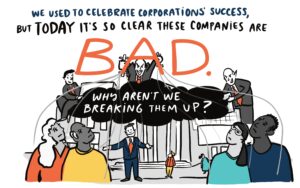
What we’ve seen now is you have Mamdani in New York, but also Katie Wilson in Seattle. Katie Wilson’s been a longtime advocate against monopoly power and for more true democracy. And in cities and states, we do have a lot of levers. And one thing to get to your question about gains is I think over the last few decades, people have seen tech companies change from tiny startup companies to these behemoths. So I feel like I talk to people and they’re like, “Yeah, why don’t we break up those companies?” And that’s a real shift from ten or fifteen years ago, where there was widespread consensus these companies were good and doing a good thing, and why don’t we hand them over more power?
For now, I think every day people are like, “These companies are not good and shouldn’t have this much power, and why aren’t we breaking them up?” So I think if we look at gains, there’s a change in public opinion. People don’t trust Big Business the way that I think they did. Whether or not electives are responding to that is a different question that’s mixed, but I think regular people see it as a problem, and that’s the reason to be hopeful.
IF WE’RE TO BE SUCCESSFUL IN REIGNING IN CORPORATE POWER, WHAT WILL GET US THERE?
SOLANA RICE
Imagine we had headlines two or three generations from now that said, “Company X is not going to merge with Company Y because it creates too much instability for working people.”. If we’re successful in efforts to reign corporate power, what might be different? What will get us there? What is markedly different from what we’re doing now?
LIJIA GONG
I’m happy to start, but what a big question, and I relish it. And also, there’s a lot to do, y’all, let’s buckle up. But I am a true believer that we’re not going to make any sort of large systemic change without mass-scale organizing of people in motion and collective action with one another. I think ultimately, whether it’s policy change or legal change or anything else, that’s a necessary condition for any of those other things to happen at the scale that we need to see it happen. With that said, I do think that frankly, all the other tactics need to be deployed. I think we need to sue the companies. We need to have enforcement at the state, local, and federal levels. We need to do effective boycotts. We need to get labor involved in strategic strikes.
And as it relates to a specific corporate fight and specific entity, you have to think about what are the things that will actually move the needle. But I don’t think any tactics are off the table for me. Overall, if we’re hoping to see this in our generation, it will take organizing. Organizing really starts at the local level and is centralized at the local level because that is the place where people are actually in physical community with each other. I am familiar a lot with a labor context, but it’s like your local — that’s your workplace. That is the person next to you in the Amazon warehouse. And similarly, it’s like your neighbor who’s showing up at the community meeting.
I do think these folks who are showing up to fight against data centers who may not share the same politics on a lot of different issues, I do think that is where it starts, and that’s the genesis of that. But I think the question that’s frankly hard for all of us is how do we move those people into sustained action, over time, outside of just one election or one data center fight? And I know that’s what we’re all trying to do is to continue to educate and move people. But I think that’s the biggest challenge that we face.
SOLANA RICE
Ryan, do we have enough organizing? We made some gains in the last federal administration, be they public or not. And as soon as we got a new administration, all those gains were kind of on the line. Do we have enough organizing? Do we need more? How? Where?
RYAN GERETY
Yeah, I think you really learned that a good administration can move a lot of things, but it’s only as durable as the political will that’s been built over time to fight for and maintain it. And very clearly, we don’t have enough organizing because there’s a lot of dissatisfaction. People know they’re getting screwed. The country’s become very, very rich. I mean, this AI boom is making a couple of people, literally a handful of people, very, very wealthy. People who are white-collar and have stocks are benefiting from that. And everybody else knows, “man, we are really getting screwed here.” But it’s when people are unorganized and then are told, “Well, we can blame immigrants or blame the big cities,” then they’re going to vote in ways that drive towards the opposite thing that they might want.
I’ll just say in two or three generations, I hope that the kids of my nephews or their grandkids are like, “Oh man, there was this blip in U.S. history where the best of us maybe wanted to unleash innovation and creativity. But what happened was that a couple of sectors got really concentrated and controlled everything, and all the innovative juices were poured into really bad technology that wasn’t good for us. And thank God we figured that all out. We stopped letting companies get so big. We broke up some good ones. We put in some guardrails. We made mass public investment in universities and research and science, and we got past that.” It doesn’t feel like that’s where we are, but that’s what I would hope.
SOLANA RICE
I think we’re going to have a whole new line of children’s books, it sounds like.
LIJIA GONG
This is where I pivot to being like, “I’m becoming a children’s book author.” No, I’m just kidding.
RYAN GERETY
Right where we started, actually. I was going to say, I do think for us, it’s like people banding together. These corporations, because they are so big, it feels hard to challenge them locally. And in a way, that’s the system that’s set up that’s reinforcing. But when people band together to say, “This isn’t good for any of us. It’s not good for our community. Let’s band together.” And then if you started to see cities banding together, saying, ”all this money’s getting taken out of our cities, our transportation’s being controlled by Uber and Lyft. Our public sector buses and subways are getting defunded. Our tax base is too low. Let’s band together.” And if you saw regions who’ve been hollowed out start to band together, and then we’re forcing electeds to make choices, you either stand with us or you’re standing against us.
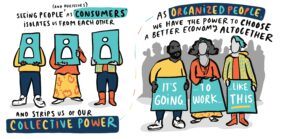
And all of that does take people seeing right now, people are like, “Oh, I can act as a consumer.” You want people to feel like, “Well, we could have a different kind of economy that works much better than this. And so we’re going to start making decisions to change the economy in that direction.” I think that’s kind of how you’d get there over a long time.
LIJIA GONG
Yeah, two things that I would add to that. One, hell yes to the cities banding together, that is literally the work we do. And I’ll just say on Amazon HQ2, we organized progressive city council members in these cities to actually stand up and say together that we’re not competing in this race to the bottom. So I totally agree. And I think the other thing about this vision, where we’re out of this mess, I just want to underscore, and it’s included in our Affordability for All agenda as well, is about public provision. I think currently we do rely on Amazon. I personally do rely on Amazon, but we will need other entities to provide those services.
And I think the question is who? And I think my answer is a democratically controlled public provision for a lot of those things, not everything. But I think a lot of the key things that we’re seeing more and more privatization and takeover of, whether it’s healthcare or housing or even a lot of the tech infrastructure that we rely on, will be critical.
SOLANA RICE
Something that Ryan said really struck me, and it’s something that I’ve known for a while, but maybe hadn’t thought about it in this light. Many of the advocates that are working on the issues of concentration of corporations and anti-monopoly, we, by default, have to focus on people as consumers, because the law is structured that way. What is the impact of this merger going to be on consumers? But what I think is so helpful about the framing of organizing is that we have to encourage us all to recognize ourselves as more than consumers, as more than laborers. And there has to be political will to change those policies so that we are really considering the impacts on much more than just, “Does this limit my choice of how much my cabbage is going to be?”
Because the corporations have taken on a stance of wanting to control so much of our everyday lives, we really do have to live into this idea that we are more than consumers, we are more than just laborers, we are more than tenants. We are residents, we’re caregivers, we’re creatives, all of these things, we’re voters. And we should be able to say, “No, there’s a line here. You can’t … No, that’s too far.” And being clear about what those lines are.
NAVIGATING THE CONTRADICTIONS OF OUR CURRENT ECONOMY WHILE FIGHTING AGAINST CORPORATE POWER.
SOLANA RICE
I think one of our last questions is we often find ourselves interacting with the very corporations that we’re fighting against, whether by accident or by choice, or maybe there’s not a choice. And I think it’s important too, to say that for many people we don’t have a choice. Walmart is the place to shop, and Amazon is the place to shop. Given this, how do you personally reconcile and navigate the contradiction that we’re holding?
LIJIA GONG
So, actually, Solana, what you were talking about about all of us being so many more things than consumers and laborers and how flattening that is, is actually how I think about this question. I’m an activist, I’m a lawyer, I’m a person who works in this field, I’m someone who dedicates a lot of my personal time to these fights. I’m a resident of New York City, and I also am an Amazon Prime user or whatever. And I guess I don’t think “it nets out,” but it’s not clear to me that my identity as a consumer of this feels more important than the ways in which I’m trying to fight corporate power in my work. And it doesn’t mean that there isn’t a contradiction there. I’m not trying to elide that, but I guess I try to focus more of my energy on the proactive fights in my life.
I also think it’s related to this collective action organizing thing, which, if there is a strong organized boycott attached to a power-building exercise, sign me up. But in the absence of that, it’s not clear to me that I’m going to value that over something else.
I’m curious, Ryan, about your thoughts on consumer boycotts and how effective they are. I’ve never had the many organizers I know in my life actually do a one-on-one and tell me, “This is the ask that I want you to do.” I think that is something that is information for me as I’m trying to make these decisions in my daily life.
RYAN GERETY
I think for me, and part of our theory of change is that these wealthy people are just not doing a good job of managing our economy. They’re not. We’re not getting the benefits we should get. Creating an economy that works better than the one we have feels like that’s the level of control that I want to have. I think I certainly make consumer choices, and there’s a role for people to individually choose the kinds of products or companies they want to support, but the kind of choice we’re talking about is so much bigger than that.
It’s really about how we should allow these corporations, who completely depend on the government for infrastructure, trade agreements, and labor, to operate? I feel like the trick is always switching people from consumers, which is how the companies want you to think of yourself, because then you’re one person. Sure, they want to individually negotiate with me as a consumer because that way they can set the price to whatever they want, because what am I going to do about it? I’m not going to spend three days working on it. They don’t want us to have the collective power that we’re entitled to collectively say, “Actually, this is how you’re going to operate. You will negotiate with your workers. You will not expand coal production with your data centers because it’s up to us. We’re the people who live here.” So I just think, of course, there’s a role for personal choice in things, and targeted boycotts in specific moments historically have always played an important role. But the big thing, especially in this country, is like, oh, we have to collectively determine how these companies should operate.
SOLANA RICE
I think this goes back to LiJia’s point of, “We have a lot of tools in our toolbox. We should use them discerningly, and we shouldn’t default to the ones that position us only as consumers.”
CLOSING
We could talk about this for days, I’m sure. Big thank you to Ryan and LiJia for joining me. And please check out the work that Local Progress and the Athena Coalition are doing. Ryan, how do people find you, support, and stay informed about your work?
RYAN GERETY:
You can go to athenaforall.org to learn a little bit more about us. We have great Instagram and Blue Sky, and you should follow us.
SOLANA RICE:
And how about you, LiJia?
LIJIA GONG:
Yeah, localprogress.org. And yes, we’re also on social media, too, just so you can follow our work there.
SOLANA RICE:
Awesome. Thank you for listening. For more conversations like this one, visit forgeorganizing.org. And for more about liberation in a generation, check out liberationinageneration.org or email us at partnerships@liberationinageneration.org.