Elected champions need more than votes, they need organizers at their side, pushing, strategizing, and holding them accountable. That’s how you turn campaign promises into policy.
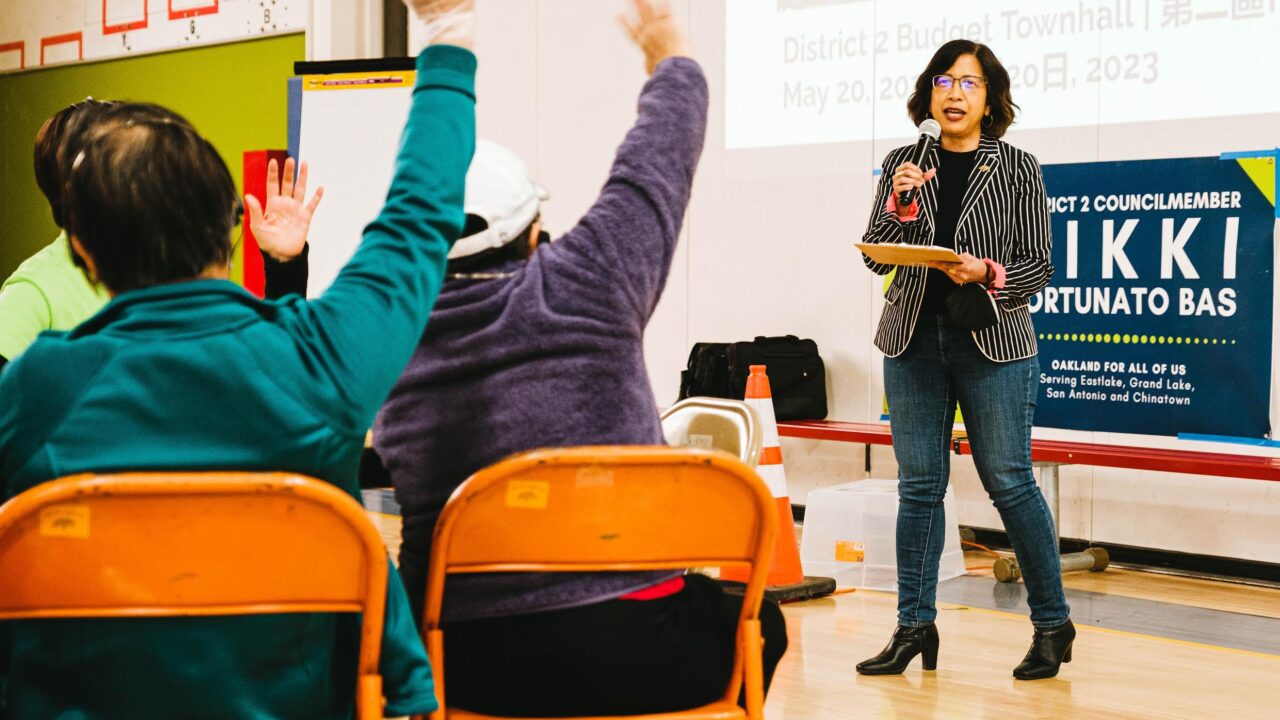
On my first day as a council staffer, I walked into Oakland City Hall –– the place where I’d organized for decades with labor and community groups, mostly to confront elected officials when they made laws and decisions without us. Now, working for our elected champion, I had the chance to govern collaboratively alongside the very organizing groups and movements I’d been a part of.
Initially I was a hard “no” on working in City Hall. Would the bureaucracy be too entrenched against the changes we needed to see? Would I get sucked into constituent requests for filling pot-holes rather than transformative policy-making? As a longtime organizer, Council President and District 2 Councilmember Nikki Fortunato Bas laid out the opportunity to implement a progressive agenda in her second term. I also felt the push from other organizers that electing champions and passing policies wasn’t enough. We needed to exercise governing power –– as council staff, influencing city policies and resources –– to make real the community-driven agenda and wins our communities deserve.
The wave of movements electing progressive champions in cities like Chicago and New York give us hope, but are we ready to govern? Are we on the left prepared to “control and reshape government in order to make our agenda real in the world”?
To leverage those electoral wins into real structural changes, organizers, strategists and elected leaders are practicing “co-governance,” a collaborative approach for using governing power to shift our public institutions toward progressive agendas and win concrete improvements. I spoke with organizers in Oakland, in a governing partnership with then City Council President Nikki Fortunato Bas, to reflect on lessons learned while moving public institutions to better represent and serve our communities.
“If our movements are to succeed beyond winning the intellectual debate, and recenter values of people over profit, we need to efficiently govern and implement our alternatives at scale,” argues Alvina Wong of APEN Action. “Especially in a time when even the baseline of what we want our government and democracy to be is under threat, governing and implementing at scale, over time, is what will shift our culture towards not just believing that another world is possible, but actually living it.”
Trusted Relationships with Organizing Groups
Recruited by community and labor allies to run against a moderate incumbent, Nikki came into office with deep connection to many movement partners. Three of those partners included the Asian Pacific Environmental Network (APEN), Oakland Rising (OR), and East Bay Alliance for a Sustainable Economy (EBASE). Nikki served on the board, as executive staff, and engaged in issue-based campaigns and coalitions with these three organizations, and many other community institutions and nonprofits over the course of a quarter century in Oakland. Coming into office already with a deep level of trust, and continuing to build trust throughout her tenure, was critical for navigating the complex political dynamics and contradictions inherent in governing.
All three organizations have separate 501c4 sister organizations –– APEN Action, OR Action, and East Bay Action –– that endorsed, mobilized, and campaigned for Nikki in one or both of her elections for City Council.
In Nikki’s first term, co-governance partners –– including those named here as well as many others –– worked alongside Nikki to pass a set of groundbreaking policies: the strongest COVID eviction moratorium in the country; a progressive business tax to advance common-sense budget solutions; expanded community safety system with alternative crisis response and investments in violence prevention; creation of a department to enforce fair workplace laws and equitable contracting; and record investments in affordable housing and homelessness solutions including community land trusts and two 100% affordable housing projects on city-owned land.
Nikki and her office also never lost sight of neighborhood-based constituent issues, partnering with groups to bring city services like public bathrooms, park upgrades, speed bumps, and illegal dumping pickups to Oakland’s long disinvested flatland communities.
Here are some key co-governing lessons from the past six years.

Lesson 1: Govern to Change the System and Stretch Institutional Boundaries
In their work with other Chinatown partners to renovate a recreation center and create a hub for climate resilience, APEN Action showed that co-governance means both winning individual campaigns and challenging and changing a status-quo system that wasn’t built for working-class communities of color. Practicing co-governance also means pushing government institutions to be more transparent, participatory, and accessible.
“Being able to apply the organizing approach inside of government allows us to find ready allies in different governing roles, such as city administrators and city staff, that can open the door for outside strategies and demands to take root,” says Alvina Wong of APEN Action. “There’s an invaluable set of tools, relationship building, and political assessment within co-governance that can build wider internal alliances and stretch the boundaries of the governing institution.”
In practice, APEN Action worked with Nikki to untangle the city’s planning and funding processes to move forward the Lincoln Recreation Center Resilience Hub –– a decades-long community-led effort to renovate and retrofit a beloved city-owned facility in Oakland’s Chinatown. “The partnership with Nikki’s office was really helpful in shining a light on the labyrinths of processes in the city –– it would have been so hard to figure out who to talk to, where to go,” shared Shina Robinson of APEN Action. “The consistent and transparent communication was a huge bright spot, which is reflected in one of the city’s first Resilience Hubs being so close to breaking ground.”
“Nikki had a deep desire to tinker with the system toward justice,” reflects Pecolia Manigo of Oakland Rising Action. “She had an understanding, coming in as an organizer, that certain things did not work for the average resident in Oakland, and wanted to make the system more functional. She modeled what transparency and asking good questions in public meetings looked like. She asked why policies weren’t getting implemented, and what it would take to get it resolved.”
Lesson 2: Structure the Governing Partnership for Strong Communication, Mutual Accountability, and Aligning Inside and Outside Strategies
APEN Action and Nikki’s office forged strong internal communication and debriefing along the way, to align inside and outside strategies and messages. APEN Action established regular monthly meetings with Nikki’s office to share priorities and updates and to problem-solve together. “We would do the background work, raise the questions from our members like addressing community safety, and then Nikki’s staff would answer the questions and get out the message,” said Kenneth Tang of APEN Action. “There were a handful of times we asked Nikki’s office to give us hard facts and numbers on crime and community safety, so that we had the information to share with and engage our members.”
In situations of disagreement between outside organizations and inside public officials, co-governance partners are re-examining what organizing looks like when the traditional organizing roles of “ally” and “target” no longer apply. “What does it mean if the elected official needs one thing to benefit the inside strategy, but we feel we need to do extra communication and escalation on the outside?” asks Pecolia Manigo of Oakland Rising Action. “We found we needed moments of shared accountability to move through our disagreement on strategy, and lean into strategizing together through complicated political dynamics.”
The biggest lessons of collaborative governance come from the challenges organizers face, especially aligning inside and outside strategies and holding mutual accountability. To effectively move our governing agendas, elected officials need to preserve their inside relationships and be a credible force with other elected officials and staff. This can conflict with traditional outside pressure and agitation. It takes practice and capacity among organizers and public officials to work through differences in political assessments, and learn ways to together, navigate co-governance effectively.
Lesson 3: Invest in Member, Staff, and Coalition Capacity to Govern
Grassroots members and leaders, supported by staff, should experience for themselves the decision-making power and challenges of getting things done within our halls of government. But co-governance takes deep organizing: our communities are justifiably skeptical of government: that it’s dysfunctional, bureaucratic, and has failed our communities. The larger purpose of co-governance is to transform public institutions to actually work for and improve the lives of people in our communities. Only then can we also win back trust in public institutions –– and government accountability to our communities –– that has been degraded over decades by the conservative right.
“Governing partnerships require trust and understanding among community organizations and elected officials,” says Kate O’Hara of EBASE. “For co-governance to be effective, community organizations need capacity for base building, civic engagement, coalition alliances, policy development, and relationships with city hall; this requires investment and capacity at all levels.”
As a base-building organization, APEN Action grappled with how to deeply engage members in governance, and when to rely on the organization’s staff. “The question we sit with in governing is how much is reliant on staff guided by member vision, goals, and demands, versus on our community members and leaders who are deep in the weeds experiencing and doing the process alongside us.”
Organizationally, APEN Action also stretched to organize around community safety in Chinatown, an issue beyond their core expertise on climate justice and resilience. “For APEN Action, it was important to maintain and contest for our base around community safety. For our progressive movement, it was also important that we keep building trust in progressive elected leadership,” says Alvina Wong of APEN Action. “Community safety wasn’t originally a program of our organization –– but it is something our members were facing, so we knew it was important to take a stance. Knowing Nikki’s leadership role on the Re-imaging Public Safety taskforce, and her facing backlash from the Chinatown community as well as our progressive spaces made it an issue we had to engage in.”
Looking Ahead: We need more of us rooted in organizing, governing, and setting agendas over the long-term
While the historic recall of Oakland’s Mayor dominated headlines last year, organizers on the ground have been doing the quiet but important work of practicing co-governance with Nikki over the past six years –– building off of a rich history of wielding the power of government institutions for community wins. In January 2025, when Nikki was sworn-in on the county Board of Supervisors, the left lost a progressive partner in City Hall. Even with an organized effort among labor and community political organizations to identify, endorse, and campaign for a new champion, our movement was unable to stave off a challenge from more moderate forces. Despite this loss, organizers in Oakland are learning from and recalibrating our work for the long-term, with the opportunity of governing collaboratively with progressive Mayor and former Congresswoman Barbara Lee.
When it comes to building governing power, organizers and strategists in Oakland are balancing short-term opportunities with building for the long-term. “We can create a different way for people to experience government by centering care for our communities and involving people in decision-making,” said Kate O’Hara from EBASE. “To keep building our governing muscle, we can develop partnerships, cultivate leaders, and practice making decisions within coalitions and with existing folks in elected office.”
Keeping our eyes on the long-term agenda pushes beyond the “limitations of what the inside is willing to do, and beyond only focusing on the best possible outcome in the moment,” says Alvina Wong of APEN Action. Co-governance calls for us to stay grounded in base- and power-building campaigns that make concrete improvement in people’s lives. We do this by forging a virtuous cycle of organizing that moves people from engaging in strategic campaigns and policy fights, implementing and enforcing those rules, and coming back to defend and build on our wins. For those ready for more, we build members, leaders, and organization staff as decisionmakers “on the inside” –– serving on commissions, as staff for elected officials, and themselves running for office.
Nikki was always clear that our success on the inside was only as strong and powerful as the organizing on the outside. Local base-building and organizing are still rebuilding after the COVID-19 pandemic, and now responding to attacks under the Trump Administration. But the basics remain the same: base-building and organizing are central, and co-governance is a tool by which we engage and restructure government to make real change for our communities.
Ultimately, effective co-governance is rooted in organizing and power-building. Dozens of organizers and strategists like me who go on the inside are integral to leveraging government institutions for our long-term agenda. By matching strong organizing on the outside with more of us organizing for governing power from the inside, we allow our demands to take root, push the boundaries of government, and create more openings for our movements to build power and win.
Amaya Lin was the Senior Policy Advisor for former Oakland Council President and District 2 Councilmember Nikki Fortunato Bas. She worked with Bay Rising Action to capture organizing lessons with groups working with Bas’ office.