The Jewish community is at a crossroads when it comes to Israel’s genocide. As organizers, it’s our job to bring them along.
As the tenuous ceasefire in Israel and Gaza goes into effect, I am brought back to October 7th, 2023. That morning, I woke up, checked my phone, and my stomach dropped. The moment I saw the news about the Hamas attack, I could already see the horror that was about to unfold before us.
Less than a week later, I found myself sitting on the floor of Senator Elizabeth Warren’s office, as Israel ordered the entire population of northern Gaza –– 1 million people –– to evacuate within 24 hours. In Boston it was almost sundown on the first Shabbat since October 7th. We sat there singing songs about peace we’d learned in Hebrew school, sharing stories of grandparents who had survived the Holocaust, and crying out for our progressive Massachusetts Senator to use her power to push for a ceasefire. As we sat there, I felt my phone vibrate in my pocket. It was my grandpa, calling to wish me a Shabbat Shalom, as he does every Friday. I silenced the call.
There were seven of us in that office. It would be nearly another week before the first member of Congress called for a ceasefire. Day by day, my fear and outrage grew as I watched more members of the Jewish community, including many rabbis and leaders who had recently begun speaking out against the Israeli government, double down in support of Israel’s retaliatory assault on Gaza.
There was no room to question Israel’s increasingly brutal attacks, never mind the long term implications of Israel’s system of occupation, apartheid, and siege. There was no room to grieve the deaths of the 1,200 Israelis killed on October 7th without our communal and political leaders twisting our grief to justify attacks on Gaza. And, certainly, there was no room for the humanity of the millions of Palestinians now facing relentless bombing, displacement, hunger, and disease.
To be Jewish and call for a ceasefire in October 2023 was a profoundly isolating experience that I felt on a deeply personal level. In the weeks and months after October 7th, I could not bear to talk to my grandpa, one of the people I love and respect most in this world. I could not endure hearing Yoav Gallant’s threats to annihilate all of Gaza echoed in my grandpa’s voice, the voice that sang to me as a baby and led Kiddush at Shabbat dinner every week. The voice that cried out to save my brother from walking into a busy street as a small child. I have never been able to square my grandpa’s unconditional love for my brother and me with the violent ideology he supports when it comes to Palestine.
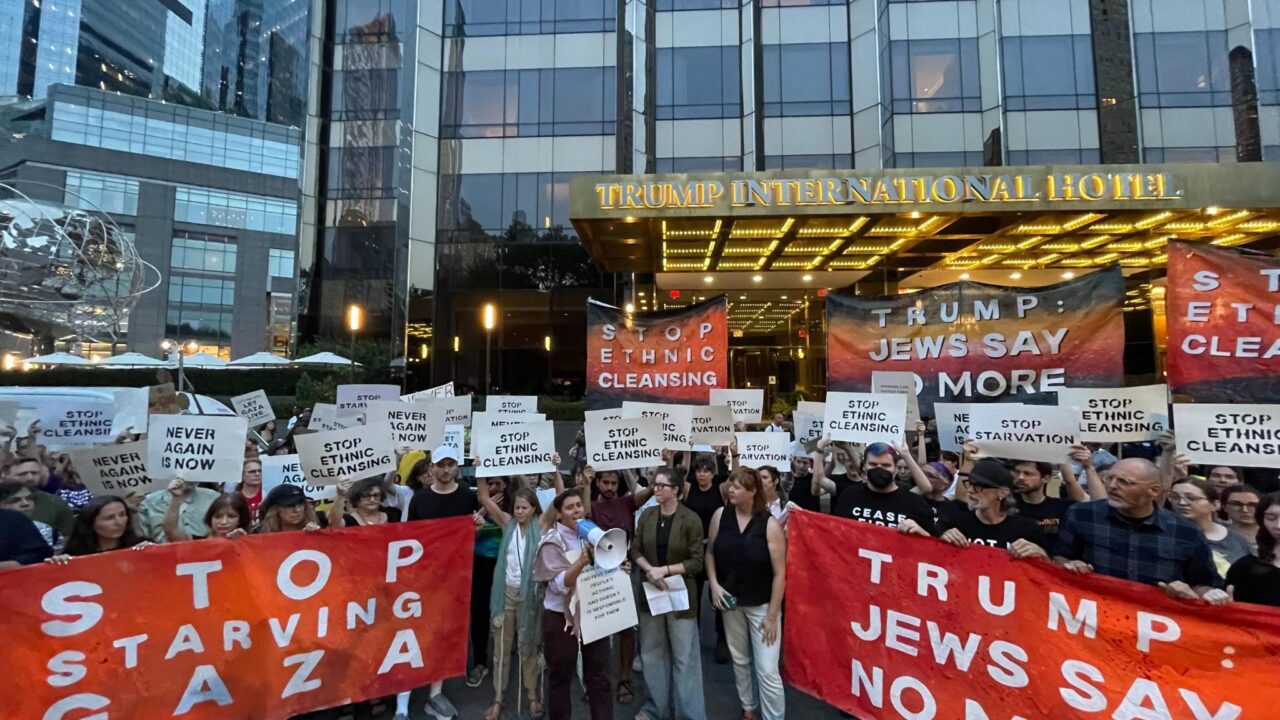
Last month, I opened my phone and this time, I saw my rabbi being arrested in Senator John Thune’s office alongside dozens of other rabbis, calling for food aid to be let into Gaza. I had to check twice to make sure what I was seeing was real. Two years ago, the majority of the coalition of voices speaking out today against the Israeli government’s genocidal actions was defending those very actions. What we are seeing now is an unprecedented communal shift: a new and growing liberal-left alliance united against Israel’s mass starvation and ethnic cleansing of Palestinians in Gaza.
There is no longer any way for right-wing Jewish and non-Jewish institutions to claim that the Jewish community stands unequivocally in support of Israel’s siege of Gaza, or to simply write off dissidents as irreverent and marginal. Every major Jewish movement in the United States, from the Reform movement to over 80 Orthodox clergy, has now publicly criticized Israel’s tactics of mass starvation and indiscriminate killing. Those speaking out are clergy, synagogue members, elected officials, parents, young people, and elders of every race, gender, and denomination. The dam has broken.
I don’t want to gloss over the very real tensions and misalignments that exist within that coalition, or how much work lies ahead of us to make meaningful political change. There is discomfort with using or not using the word genocide, different relationships to Zionism, and disagreement about what it looks like to hold the humanity of both Palestinians and Israelis in our messaging. But the fact these are the conversations we are having reflects an undeniable shift in the center of power in the Jewish community.
This shift didn’t happen because people just woke up one day and decided to act differently. It happened because we, as just one part of the broader movement for Palestinian freedom, have created the conditions for people to move. We have been consistent in our demands from the beginning: since October 8th, 2023, we have demanded a ceasefire, a full hostage exchange, an end to apartheid and occupation, and equality and justice for all Palestinians and Israelis. We brought 2,000 Jews to shut down the White House. We have demanded that our elected officials reject AIPAC money. We knocked doors in Pittsburgh, St. Louis, and Westchester County to defend some of the only members of Congress who were willing to stand up to AIPAC’s genocidal agenda. We showed up by the thousands when Mahmoud Khalil and Rumeyza Ozturk were abducted for their Palestine activism.
Now it seems that we have achieved some of our basic demands as Israel and Hamas enter into a tenuous, fragile ceasefire. The hostages have been released, some aid is entering Gaza, and for now, the daily onslaught of violence has slowed. Despite the fact that this moment is exactly what we have been fighting for, this victory is painful. The journey to get here has been catastrophic and devastating in ways that are difficult to put into words. In the two years it has taken to get here, we have not been able to save the lives of hundreds of thousands of Palestinians in Gaza, and hundreds more in the West Bank, including my friend Awdah, a leader from Umm Al Kheir, a tiny village in Masafer Yatta. And what makes this moment even more fraught is that many of the people who are joining our cries for a ceasefire and end to starvation are some of the very people who defended Israel’s right to drop bombs and murder entire Palestinian families, who saw images of starving children and placed the blame solely on Hamas and preached unconditional support for Israel from the pulpit, who called us self-hating Jews when we dared to call for a ceasefire. They are the communal and political leaders who could have leveraged their power at any point in the last two years to save countless lives.
There have been many calls for the reckoning that these leaders must undergo if they are to be trusted members of our movements. I agree. Our people have serious work to do. And I want to talk about the work that we need to do as organizers if we are serious about achieving our goals, because the stakes are unbelievably high. This victory is a significant one, but we have a long, long fight ahead of us.
Right now, we have a critical window of opportunity to translate this massive wave of energy into real political change –– it’s not a straight shot, and it’s not a guarantee, but we are closer than we have ever been before to winning an arms embargo: the only real, meaningful course of action to end Israel’s system of apartheid and occupation and ensure lasting peace. For the first time, there is a legislative vehicle in Congress, the Block the Bombs Act (HR 3565), with an unprecedented coalition of co-sponsors, including the entire Congressional Progressive Caucus, several Jewish representatives, and some representatives who were once backed by AIPAC. 6 in 10 voters oppose the U.S. sending more arms to Israel, and the Jewish community is openly grappling with existential questions about our community’s historically uncritical support for Israel.
We have between now and the 2028 presidential election to cement support for an arms embargo as the mainstream position in both the Democratic Party and in the U.S. Jewish community. The former is going to take a strong, multi-faceted coalition that can go up against weapons manufacturers, AIPAC, the fossil fuel industry, and the entire military-industrial complex. We have a role to play in that coalition.The latter is our responsibility. We have three years to organize our synagogues, our cultural organizations, our day schools, our JCCs, our summer camps, and our political organizations into a powerful movement that can say, unequivocally and forcefully, that Jewish safety and Palestinian safety are intertwined, and that we refuse to let one more bomb drop in our name. The support of the Jewish community is not “nice-to-have”; it is essential. Without airtight support from the Jewish community, the political right will continue to capitalize on its extremely effective and cynical strategy of using antisemitism to attack, weaken, and criminalize the Palestinian rights movement –– a strategy that has serious ramifications for the very foundations of our democracy.
Our ability to accomplish this feat hinges on whether we are able to hold together this nascent liberal-left coalition, on whether we will have the discipline to stay clear-eyed about our goals, and on whether we have the heart to love our people that are so deeply in need of a different path forward.
In the days following October 7th, 2023, thousands of Jews gathered across the country for public recitations of the Mourners’ Kaddish for Israelis and Palestinians. We mourned the Israelis who were killed or taken hostage by Hamas on October 7th and the Palestinians murdered by indiscriminate Israeli bombs falling on Gaza. We refused to let our grief for Israeli lives be used to justify the murder of Palestinians, and we also refused to let go of the humanity of Israelis and Jews. In the last two years, we have held countless political education events and trainings across the country for Jews who are grappling with their relationships to Israel and Zionism. We have built relationships with members of synagogues and other Jewish institutions who feel disappointed, betrayed, or outraged by their spiritual and communal leaders’ abdication of responsibility in the face of an ongoing genocide. We have supported people to take serious personal, professional, and physical risks to speak out, to demand action from our government, our Jewish institutions, and our elected officials.
This is the work we must recommit to as we face this critical juncture. We must reach the people who aren’t yet with us: people who are confused, who are angry, who are starting to open their eyes to the fact that the story they were told –– that their safety was dependent on the oppression of Palestinians –– was a lie. People just like my grandpa.
In the last two years, I’ve hardly talked to my grandpa about Palestine. At 93 years old, as a child of poor Eastern European immigrants who grew up in the shadow of the Holocaust and the creation of the State of Israel, I thought he was a lost cause. I had given up on him. But this past summer, I visited him at his assisted living facility. At one point, he abruptly interrupted me in the middle of an unrelated conversation and said, “Children don’t look like that after being hungry for a day, or even a week. I remember the photos from the Holocaust. That’s what those children look like.”
Something broke in me then. I never expected him to see what I was seeing. I never expected that his unconditional love would be able to jump the fence of the lie he had been fed about our safety. Through my tears, I told him about my friend Awdah, murdered in cold blood by a settler in the West Bank that very week. I told him about witnessing a home demolition in Masafer Yatta in 2019, about how easily the house collapsed against the bulldozer’s claws, like a house of cards. I told him about the Palestinian kids I met, and their grandmother that reminded me of my grandmother. How they had never seen the sea. I told him how desperately I fight every day for a world where Jewish safety and Palestinian safety are not pitted against each other.
He said, “I’m worried about what this means for the future of Judaism. How do we go on?” I asked him what it was about Judaism that he wanted to protect. His response: “That Jews should care for other human beings as human beings.” I took his hand and committed to him that I would fight every day for a Judaism that embodies this belief.
With tears in his eyes, he said, “The only thing that makes this world good is its people.”
None of us showed up to the movement with perfect politics. We showed up knowing that something was deeply wrong in the world, and desperate for something to do about it. Through that process, we underwent our own transformation. In order to win, we have to believe in people’s capacity for transformation.
I’m not talking about watering down our messaging so that we appear more “palatable” or walking back our commitment to telling the truth about the reality of genocide and of decades of apartheid and occupation. I’m talking about being steadfast: both in our politics, and in how we practice our politics. We have to be committed to meeting people where they’re at, and we have to refuse to leave them there.
This is not going to be easy work. Moving people from an understanding that it is wrong to intentionally starve an entire population to concrete action to end this genocide is not a simple journey. This is work that involves building real relationships, asking questions, digging deeper, and gently but firmly pressing people to entertain the possibility that Jews will only ever achieve true safety if Palestinians are also safe and free. It’s going to involve asking people to face their fears and push through to the other side. It’s going to involve holding people in their shame and despair when they realize the full extent of the catastrophe that our community and our country has enabled for not only the past two years, but the past 77. It’s going to require looking at our own messy politics, the places where we still have more to learn and unlearn as we accompany others on their journeys.
We have the tools to do this work. Over the last decade, community-based Jewish organizing groups, including my organizing home, IfNotNow, have been running training programs that have been transformational for thousands of people. As a participant and facilitator in these programs, I have seen it happen. I have watched as people of all ages have told each other stories of their ancestors’ fights for survival, of their experience of indoctrination in Jewish institutions, of the moments of rupture in their families and communities. I have cried alongside new friends and comrades as we grieve the way that our people’s trauma has been used to justify the oppression, subjugation, and genocide of Palestinians. I have sat with people as they started to see, with fresh eyes, the reality of almost 80 years of apartheid and occupation. And I have asked these people to take action, to do things they’ve never done before: to sign onto a letter, to speak at a rally, to ask others in their community to join them, to risk arrest, to risk getting fired, to risk their status in their community.
Organizing, at its core, is about transformation. It is the job of organizers to help people see the world in a new way and realize their own power. And when that personal transformation happens on a collective level, we unleash the power to transform society. This is as much of a spiritual project as it is a political one.
We are up against forces who are looking to exploit every opportunity they can find to fracture this movement, and we don’t need to give them any more opportunities to do so. We owe it to ourselves and the movement we are building, to the growing movement of Israelis who are taking immense risk to resist their government’s tyrannical policies, to the precious souls who have been murdered by the Israeli apartheid regime, and most importantly, to the Palestinians who continue to resist the daily horrors of genocide, to do everything we possibly can to build the movement we need to win.