Listen to the interview here.
This interview has been edited for length and clarity.
OPENING
ANDREA PORTILLO
Hello and welcome everybody. I’m Andrea Portillo with Liberation in a Generation. LibGen is a national movement support organization that builds the power of people of color to transform the economy, who controls it, how it works, and, more importantly, for whom. We are beyond excited to partner once again with the team at The Forge to guest edit this special edition. For this edition, building on previous efforts to bridge gaps between anti-monopoly researchers, policy advocates, and grassroots leaders of color, we’ve curated a group of experts to explore and connect on issues that intersect with corporate power.
Joining me for conversation today is Iris Craige with Strategic Actions for a Just Economy (SAJE), Stella Adams with Blueprint North Carolina, and Audrey Aradanas with Miami Homes for All. Together, we’ll be discussing how corporate power has shaped and continues to shape housing and the neighborhoods and communities that they serve, and explore how long-term disinvestment and policies continue to prioritize profit over people, have empowered corporate landlords, increased pressures on local communities, and we’ll talk a little bit more about that impact in the aftermath of natural disasters and crises. So thank you all for joining me for this conversation again. I really appreciate you all taking the time, and it’s really nice to see all of you again.
COMING INTO HOUSING JUSTICE & HOW CORPORATE POWER IN HOUSING IS MANIFESTING IN THE AFTERMATH OF DISASTERS
ANDREA PORTILLO
As I was myself preparing for the conversation we’re about to jump into, I began thinking about in what ways have corporate power issues kind of shown up in my own journey as an organizer in this housing space.
And a lot of the early organizing efforts and work that I was engaged in was mainly around tenant protections and demands for building more affordable housing. But one of the main catalysts for us shifting our strategies and our demands locally to prioritize housing preservation was when the city of San Jose voted to approve the construction of a new Google campus in downtown San Jose. And this happened in, I think, 2021. The project has since been on hold, but we knew that the construction of this campus would only further increase these pressures and continue to push folks out of the communities that they have called home for for many years.
And so this completely shifted our strategy locally. We knew that we could no longer just demand tenant protections and the production of more affordable housing. We needed to have a different kind of strategy. That could be tools for land stewardship or for community control outside of the speculative market and the very real corporate pressures that we were feeling. So I’m curious, what brought you to this work? And Iris, I’m curious how corporate power issues are manifesting in places like Southern California, where there are a lot of tenant protections in place, but similarly to most places across the country, very limited housing supply and land.
IRIS CRAIGE
Thank you so much. I started this work in 2015, doing eviction defense in San Francisco, and I was also an intern at Tenants Together. So a lot of my work is initially rooted in tenant protections. I was helping tenants respond to their eviction lawsuits throughout the Bay Area, and it was really hard to see the conditions that tenants were having to live through, the habitability issues that they were dealing with, while also being at such high risk of displacement. And I decided that I really wanted to look at things structurally and to think about who protects tenants; who protects low-income people, people of color, and their housing; and how do we stabilize communities?
I was born in San Francisco, and it was really hard to see certain populations become smaller and smaller every year. In San Francisco, if one were reading the data wrong, there was one year where we said, “Oh, there’s less Black people who have been evicted in San Francisco this year.” But that was not because there were fewer predatory evictions. That was because there were fewer Black people in San Francisco to evict. So I wanted to turn to look structurally to start addressing these issues and these threats of displacement in the community I was from. And I came to SAJE, and it is my dream job to work on stabilizing housing for tenants in South LA. South LA is really unique, and it’s similar to the communities I was working with in San Francisco. They haven’t traditionally had the opportunity to plan their cities and to take part democratically because we’ve been redlined and excluded from the process.
Corporate power is seeing the vulnerability of our communities, and South LA has a really high increase of corporate investment. There’s a really complicated balance that’s happening in LA where we want to encourage building, and we want to encourage development. We are pro-development, but it’s hard when there are no protections for tenants that allow for the demolition of rent-stabilized housing for corporate powers to have an interest in buying what’s traditionally naturally occurring affordable housing. They are buying these units up, evicting tenants, and then selling to a developer or developing themselves. And we’re seeing this turnover, especially in South LA, but it’s not just South LA.
Altadena, unfortunately, as we know, suffered a horrendous fire at the beginning of this year, and thousands of units burned. And still, I checked in on the data just yesterday, and a majority of new purchases in Altadena are from LLCs (Limited Liability Companies) and from corporate investments. And there is an effort to combat that, but it’s really hard for the common person in LA, in Altadena, a historically Black city in Southern California, where they have higher income than people in South LA. And so there are more vulnerabilities, and these are our community members who are being preyed on. Even if you have what you think is slightly higher income and LA –– which is really vulnerable if you don’t have these really, really strong foundations to stabilize people before disaster hits –– corporations still just have more power, and they’re able to come in.
ANDREA PORTILLO
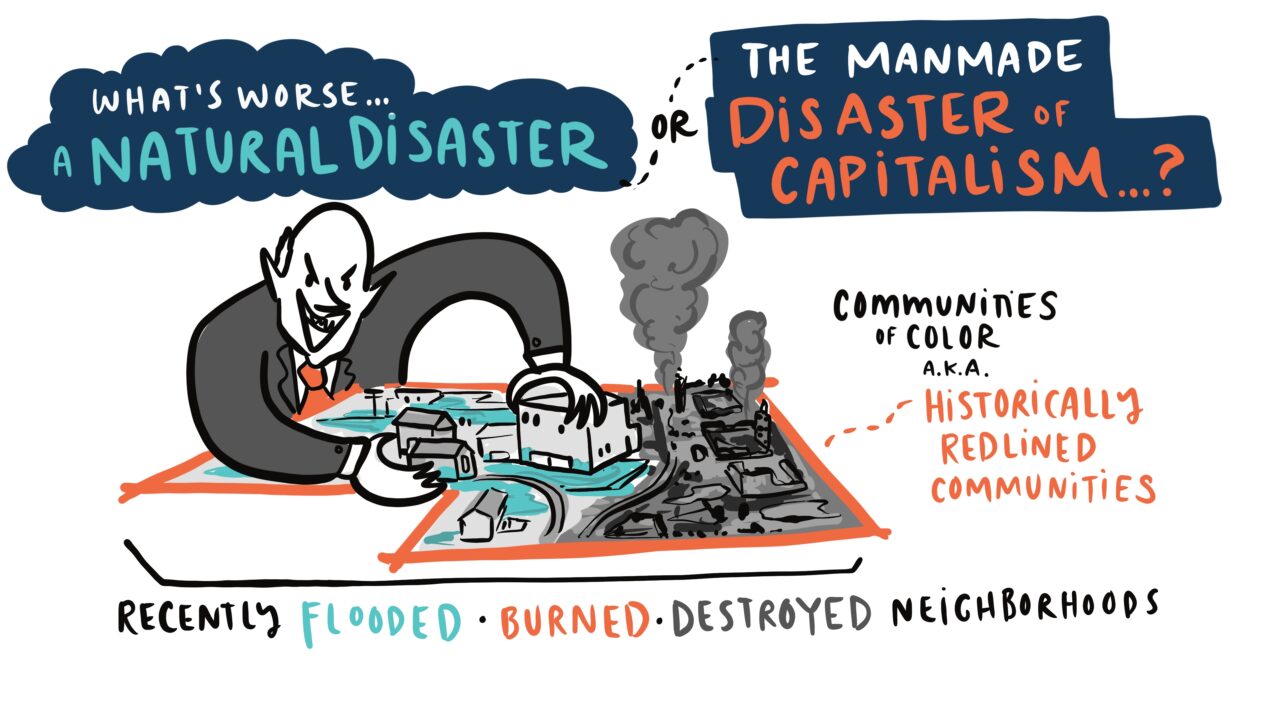
Yeah. Thank you. One of the most disturbing ways –– disgusting ways –– in which corporate power manifests itself in our housing system is in the way that they target and prey on communities during their most vulnerable times of need after a crisis, after a disaster. We can think about the foreclosure crisis of 2008, a lot of the natural disasters that we’re seeing, or the COVID pandemic, which has given rise to this form of capitalism known as disaster capitalism. And I know that this is something that your team at SAJE really looked into closely. You all put out several reports with the research that you found.
I’m just curious, what else did you see from your research, and how are some of the other ways in which you’re seeing the corporate power manifest itself in Altadena?
IRIS CRAIGE
What we’ve seen that’s been interesting is the contrast with the Palisades, which also suffered a devastating fire. I cannot believe these things were happening at the same time, but they also suffered a devastating fire at the beginning of the year. And there’s a stark contrast in who’s able to rebuild and how. We aren’t hearing the same issues coming out of the Palisades because they have so much more access to capital. And we’re also seeing just a handful of corporate investors own a majority of the corporations that are purchasing properties in Altadena after the Eaton Fire. But for folks who want to stay in Altadena, there’s a huge challenge with rebuilding, and the cost to rebuild is astronomical. I think that’s one of the hardest things, which is that there isn’t currently a structure for retention for community members in Altadena who want to rebuild. There are lots of pitfalls to making sure that people can stay in their community, unfortunately.
ANDREA PORTILLO
Yeah. There’s a lot of barriers for those folks, and the process is long and bureaucratic. Stella, if it’s okay, I’d love to hear from you. What brought you into this work, and also how this notion of disaster capitalism is showing up in your work and for the communities that you serve in North Carolina, particularly in the western part of the state that is still recovering from massive flooding and damage brought on by Hurricane Helene? And how has this shaped the housing and the communities that you’re serving in North Carolina?
STELLA ADAMS
Yeah, thank you. I got involved in housing and housing justice from a fair housing lens, which is fighting housing discrimination. And that started in the early ’90s, 1988, back in that timeframe. And I’ve been involved ever since. I got involved in fair lending and the dynamics of the mortgage market. North Carolina, as you may know, was the first state to fight against predatory lending and to pass anti-predatory lending legislation. I was heavily involved in developing that legislation and identifying predatory lending, which at the time was not a crime. It was not unlawful to prey on people in that manner. We were raising the alarm early. It wasn’t being heeded, and it led directly to the 2008 crash.
In the meantime, North Carolina has experienced more than its fair share of devastating hurricanes that hit Eastern North Carolina in the ’90s and the early 21st century, that literally changed the landscape of our state, but also brought with it horrific disaster capitalism exploitation. We still have 256 families, Black families in Eastern North Carolina that are seeking relief from Hurricanes Florence and Matthew, which were over a decade ago. A lot of lessons learned have gone into our efforts around Helene recovery, but I have to tell you that it’s the same. It’s like a rinse and repeat cycle of natural disaster and then manmade exploitation, corporate exploitation of those folks going forward. It’s really been disaster capitalism. It’s just been a year since Helene hit, and 125,000 families lost homes, and those who were landowners are facing buyout offers similar to what’s going on in Altadena, where the property is being undervalued, and the developers and outside investors are coming in trying to grab it at bargain prices. At the same time, renters who make up a significant portion of the population are left without any housing options. And the ones that they’re being offered are at two to three times the rent that they can afford during a period where there is no employment because the jobs were washed away.
And listening to Iris, when she talked about how in San Francisco, they were like, “Oh, there’s been a reduction in evictions,” and it was actually a reduction in the population. The same thing is happening in Asheville. Between the 2000 census and the 2020 census, the Black population of Asheville went from 33% down to 7%. It’s the same story, just a different coast. And what we’re seeing is that this issue of disaster capitalism is magnifying already existing inequalities that low-income households face. Again, our western part of our state, Appalachia, is part of the poorest part of our state. Our Black and Latino residents, our immigrant families, have been pushed out of their neighborhoods under the guise of recovery.
I guess I don’t need to tell you that the debris fields, the trash piles are all being moved into what were historically Black neighborhoods while recovery happens, and the buyout programs are being disproportionately given to those with the greater means, while disaster recovery has become a political football here, and our folks are not benefiting from FEMA. In the past, FEMA covered between 50% to 75% of the costs of natural disasters, and in Helene, they are less than 10% of the recovery funds that have been done so far. Our state resources, our local resources, have been pushed to the edge. But this again then allows for corporate interest to come in and exploit our communities and buy up land. When I was recently in Asheville, just a couple of weeks ago, a mountain that used to be just beautiful greenery as you’re riding up, is now wrapped and stacked with housing all up the mountain. I’ve never seen that before, and I know that’s the future of my mountains, and it’s really troubling.
ANDREA PORTILLO
Thank you for sharing that. I think you’ve started to talk about this not only in the way that corporations are targeting and taking advantage of folks post-disaster, but also in just the recovery efforts that these communities are receiving is racialized. Audrey, I’d love to hand it over to you and, similarly, hear what brought you into this work and what form are these issues showing up in Florida?.
AUDREY ARADANAS
So it’s interesting. Growing up here in Miami, everyone knows about Miami, what they see on the TV, like they see on South Beach and the glitz and glam and the beaches. Yes, that’s very much Miami, but there’s a whole other side of Miami where my colleagues are kind of pointing at redlining and gentrification and all of this. And I’ve lived in the two parts of Miami, so I’ve seen firsthand growing up the differences in our schools, the differences in our housing conditions, and the differences in our community
I joined Miami Homes for All to learn more and do more when it comes to housing justice. So we do a lot in terms of advocating for policies and systemic changes or transformational changes to address affordable housing in Miami-Dade County, as well as addressing homelessness, particularly for youth and families experiencing housing instability. And we found that there were more and more youth and families, and seniors experiencing homelessness after a natural disaster here in South Florida. In 2017 and into 2018, we saw a huge influx of students experiencing homelessness in our public school system because of the hurricanes at the time. We saw many folks moving in from the Keys, from Texas, Puerto Rico, and other communities and areas. And what we also found was that a lot of our housing was not up to par. So now we had hundreds of households being displaced.
Natural disasters led to exposing our system failures. When Miami was developed, all of that development really happened in the 80s, but we didn’t have the best construction practices because we, again, prioritized profit and cost savings rather than making sure that these homes were properly built.
And so we move on to today, and what we’re finding is that we’re seeing this phenomenon called climate gentrification in South Florida, particularly in Miami. When redlining occurred, we forced Black households and Brown households into the inner urban area, and the beaches and more south were primarily for white households and families. Those areas are now flooding tremendously. And so what we’re finding is that corporations are now purchasing homes in the inner areas of Miami-Dade County and pushing Black households out, and Latino households out, and other people of color.
So we’re seeing this push to purchase these homes. And what’s happening now is that we kind of have several issues. We have a lot of people moving inland because there’s nowhere to go. And now we’re seeing not only climate gentrification happening, but we’re also seeing this push to build into the Everglades, to push the urban development boundary line, because we need more homes. Why don’t we just build vertically and make sure they’re safe and good buildings, right?
THE RIPPLE EFFECTS OF PRIVATE AND PUBLIC CHOICES THAT ARE FUELING RISING CORPORATE POWER IN HOUSING & WHAT WE CAN DO TO ADDRESS THOSE EFFECTS
And then also, because of the remnants and what’s still happening with disaster capitalism, we’re seeing this property insurance crisis. A couple of years ago, there was this building that collapsed in Miami Beach, the Surfside building collapse. It showed us that, again, when we are not properly inspecting our properties, when we’re not ensuring that buildings are safe, and we’re not weatherizing our buildings, we’re seeing a lot of unsafe structures. As a response to that, the community panicked and passed a bunch of policies, but who do they really benefit?
At the end of the day, it benefited a lot of lawyers, insurance companies, and not really the tenants and residents that live in these aging buildings. What’s happening is that people are using recertification and property insurance and issues with code as a blanket to then evict tenants, to then push people out because it’s like, “Oh, this building is no longer safe.” Well, is it really true, or are you just trying to push these people out? Because what’s happening is that corporations are buying up these buildings, knocking them down, and then building anew. And now we have more luxury units than ever. I think that at the end of the day, what we’re finding is that again and again, our systems are prioritizing development and profit over people’s lives.
ANDREA PORTILLO
Thank you for that. Stella, did you want to say something?
STELLA ADAMS
I also want us to talk more about insurance, because it is a factor that’s facing all three of our communities, because they are prone. Western North Carolina was devastated because who has flood insurance in a mountain? So nobody had flood insurance coverage, and so then they were denied property insurance. Prior to Helene, property insurance rates in North Carolina increased by 46%, and that was just on GP (general principle). The coastal portions of North Carolina are almost uninsurable. And I know they’ve already pulled out of California and Florida, the big four property insurance folks, but we also have facing us that national flood insurance program expired on September 30th. It hasn’t been renewed.
These rain events are becoming flood events throughout the country, and the flood insurance program is non-existent at this point. And then what is covered under a hundred-year floodplain? 100-year floods are coming every five years in North Carolina. Insurance and the ability to obtain it is going to be, again, pressing on affordability. It’s going to be pressing on recovery because the elderly who own their homes are probably no longer paying for insurance. So when it’s washed away without FEMA, without any other kind of programs, we’re going to again be creating opportunities for corporations to come in, swoop in, take up what available land and housing there is.
ANDREA PORTILLO
Yeah. And I’m curious to hear if Iris or Audrey have anything more to add to this point.
AUDREY ARADANAS
I think, similar to Stella’s experience in North Carolina, in Florida, our property insurance rates went up 60%. And what also happened is that landlords were like, “Hey, my property insurance went up for this building, so now I’m going to charge you, tenant, 60% more.” And so we saw this huge increase, especially during the pandemic, of rent going up because of one, property insurance, and then two, we had a lot of people move into South Florida because it is technically a lot more affordable. And so it was very attractive for other folks to come in here, but they are making wages that are a lot more. The typical wage, our area median income (AMI) pre-pandemic, was about $60,000.
Now our area media income is about $87,000, closer to $90,000, because we saw such a huge migration of folks coming in that make a lot more income, but the typical worker is still making $60,000 or less. And so I think there’s a direct correlation between property insurance and tenant issues. And now here in Florida, it’s interesting that there is now a debate, and there is a push to eliminate property taxes.
STELLA ADAMS
Oh my God. How are you going to fund anything?
AUDREY ARADANAS
So, this will be disastrous for many communities, but there’s misinformation being shared in rural communities and vulnerable communities in general. When you have a senior that’s saying, “My property tax went up, and like, oh, we want to get rid of property taxes. That’s great.” Well, let’s think about what this really means. Is it really your property tax, or is it your property insurance that’s an issue? And is it really the property tax, or is it everything else going on around your community that’s causing your costs of living to go up? We don’t have access to a lot of public benefits as it is. And so I think folks are in pain right now, and the easiest thing to address here in Florida, unfortunately, is property tax rather than property insurance. And so then, what will that mean in our future? Our sales tax is probably going to skyrocket.
STELLA ADAMS
It’s going to go through the roof. In North Carolina, our legislature has gotten rid of corporate taxes, and that’s zero, but the bill has to be paid. And what we are seeing is increases in sales taxes, and somebody’s going to pay, and it’s always going to be the consumer. Property taxes are for homeowners, business owners, or landowners. So if you’re a tenant, you’re not really paying that, but you are paying higher rents to cover that tax. You’re paying higher for consumer goods and food, you’re paying higher taxes for tariffs, you’re paying it in sales tax, and more and more of the costs are being placed on the workers and the poor. And in North Carolina, we’re at $95,000 as a median income, but that’s from the folks coming in bringing their big wages with them. They have pushed it to the point that firemen, policemen, and teachers in North Carolina are below 60% of median income and qualify for very low-income housing.
And while we’re fighting to raise wages, we’re a right-to-work state. So there’s no unions here, and folks are working three and four jobs. When rents for a one-bedroom go from $850 to $1,400 a month between pre- and post-pandemic, how are people supposed to live? Our seniors who are on fixed income, if they own their land, we give them a 50% homestead tax break; if they’re renting, they can’t afford to pay increased rent in rural housing. And for Audrey and me, USDA rural housing programs that provide for homes for the elderly and rural communities, those expire within the next two to three years. And they’re going to kick thousands of elderly people into homelessness before 2030. It’s devastating.
ANDREA PORTILLO
Yeah, and I think to continue on this topic, we know that the corporations they’re not able to amass the scale of land and housing that they are without support. But what role has your political environments had on these issues? How have they made these issues worse? I think y’all have spoken a little bit about this, or are there also examples of ways that local governments are pushing back against these corporate pressures? How are they making things better?
IRIS CRAIGE
It’s just at the top of my mind today because we have a report back from the Housing Department of LA (HDLA) that’s going to be heard at the Housing Homelessness Committee today about corporate transparency. And it’s a concern that’s really big to us when we have these huge actors in LA who can’t be held accountable. And also small landlords who are claiming rent control is damaging them, but we don’t know what their portfolios actually look like. We don’t really know who’s a small landlord because these things don’t have to be disclosed. And so I feel this sense of slight optimism because this motion was introduced by a council member who isn’t historically super pro-tenant, but she is concerned about small mom and pop landlords, about people who can’t get into the first-time home ownership market because they’re competing with corporate landlords.
And so it is important, and I’m glad that it’s being seen that these problems are intertwined. If tenants are suffering because of high rents, it’s also the case that home ownership is almost impossible in LA. It’s extremely, extremely difficult. And yeah, I feel a slight sense of optimism, even though the truth is also that this has failed at our state level, I think three times. And I’m hoping that, as there are smaller instances where locally we can sort of start to peel back the layers of who is behind these giant corporations, this will lead us to a sense of enlightenment, or just at least understanding of who’s who, as they hide behind the opacity of LLCs. So I have some slight optimism. I hope today goes really well.
ANDREA PORTILLO
I think that’s huge, and also wishing luck. I think even in San Jose, that was the first challenge, which I’m sure is in many communities: who actually owns these properties? And then trying to help folks navigate that and looking things up where there’s just a lack of transparency because they don’t need to be disclosed. They’re able to move behind the scenes, and it’s very hard to hold folks accountable when, yeah, you have no idea who this LLC is, how many properties they actually hold, et cetera.
STELLA ADAMS
And we’re experiencing the same kind of optimism. I think as these corporations get more and more greedy in a purple state, with all eyes are centered on it. There’s bipartisan efforts to say, how can we stop these corporate landowners from taking over. In Charlotte, Raleigh, and in other major cities in North Carolina, 20% of single-family rental homes are owned by these corporate landlords. And the conservative folks are like, ”Wait, homeownership and landownership is a critical part of being a Tar Heel.” It’s part of our legacy, generational passing land. So many people in North Carolina are land rich and cash poor, but owning land is critical.
And so this idea that homeownership is not affordable, even with all that North Carolina does and has done to encourage homeownership, has started people having a conversation. And Blueprint NC and our partners across the state have been encouraging and building alliances across racial, geographic, and political divides to really talk about housing justice, resilience, health, and economic stability. And we’ve been working to train local leaders. And our situation is probably different from California and Florida in that we don’t have home rule. Our local governments can’t pass any laws that the state doesn’t give them the authority to do.
And where these corporations have come in is that they have gone to the state legislature to weaken regulation and to take away what little authority we did have to set habitability standards or to do inspections at the state level. But we’re now starting to see a backlash, and we’re able to cross through storytelling, advocacy, and education, and we’re building local-based power to try to change the outcome in our state.
AUDREY ARADANAS
I think in Florida, it’s quite interesting because we’re just full red. And so locally, Miami-Dade, we can be quite progressive. I’m really amazed and love our tenant councils, our tenant unions, and our tenant rights groups. A few years ago, they pushed for a tenant bill of rights that passed locally, and then it got preempted at the state level. And then everyone pretty much agrees, let’s protect our bay, let’s protect our water, let’s protect the Everglades, let’s improve our homes. Our local elected officials are all about it. State came in, kind of swept a lot of that. And so there’s kind of a push and pull right now between our local politics and our state politics.
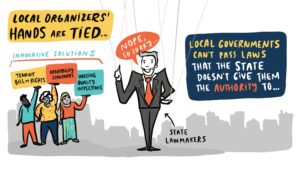
I think right now, whenever we go up to the state, there’s a lot of, “Ugh, here’s Miami again. They have all the stuff, they have all these resources.” And in the ’90s, when Miami-Dade was even more blue, we passed so many resources. We created a food and beverage tax to support domestic violence and homeless services in Miami-Dade County. We also created a surtax program to preserve our local stock of naturally occurring affordable housing, as well as create new housing that’s primarily affordable. Because we created those local tax options and other programs, the state came in and basically made it almost impossible for any other county in Florida to do the same.
Other counties in Florida do not have access to resources the same way we do. A lot of people don’t understand that history. There’s a lot of hate going towards Miami because we have all of these resources. But in reality, these resources are simply not enough when you’re combating corporate power that is trying to build in the Everglades, trying to basically own most of our most vulnerable neighborhoods, and trying to push a lot of our residents out.
A lot of our workforce, our teachers, and everyone, they’re leaving just because they can’t afford to live here. And so I think our local politicians at the county and municipal level are passionate and want to support, but at the same time, we’re thwarted at the state level a lot of the time.
STELLA ADAMS
And I think that’s where we need to start holding our state representatives more accountable. I can’t speak for California and Miami, but in North Carolina, 25% of the Republican representatives ran unopposed. So when you’re looking at switching a legislature from red to blue, if people aren’t even challenging, they’re saying, “Oh, that’s a red county, no need to even run.”
If we concede defeat at the front end –– because he’s Republican or conservative, we don’t approach him about affordable housing, about tenant rights, about home ownership –– we won’t know whether or not he supports it or not. We assume he doesn’t, and he assumes he won’t, and we have to engage. We have to assume that we will win and that we are righteous, that our points are righteous.
Nobody believes in homelessness. Nobody wants to see seniors put out of their housing. We have to break through the stereotype that very low-income housing is whatever their vision is. It’s certainly not a fireman, it’s certainly not a teacher. We have to correct the lens. Be clear and be specific about it. We have to be more aggressive. We have to make these legislatures serve their constituencies and not serve the lobbyists.
NAVIGATING THE CONTRADICTIONS OF OUR POLITICAL & ECONOMIC SYSTEMS
ANDREA PORTILLO
You’re speaking to this complicated balance between pushing against these corporate pressures, trying to hold folks accountable, while also understanding that we do need housing. So I’m curious to hear a little bit from you all, corporate power is just so ingrained both in our politics, but also in our economy and we find ourselves in this kind of contradiction: sometimes we’re interacting with corporations that we’re also trying to hold accountable How are your organizations navigating these contradictions and how are you empowering and enabling your community and your folks to fight back against these pressures, specifically thinking about what are some of the creative strategies and the ways that you all are putting pressure and holding folks accountable?
IRIS CRAIGE
Well, in LA, I think the transparency portion is a really big deal. LA has a ton of tenant protections, and two of these programs that support tenants are the Tenant Anti-Harassment Ordinance (TAHO) and the Rent Escrow Account Program (REAP). So if your unit has multiple code violations and your landlord won’t make the repairs, you can put your rent into an escrow account, and it’s just a portion of your rent, and your landlord doesn’t get the rent until they make the repairs.
There are dozens of units that have been in REAP for two years or more. There are a number that have been in REAP for fifteen years or more. And one thing that LAHD isn’t doing is looking at the tenant anti-harassment ordinance complaints. So if a tenant is being harassed by their landlord, you can make a complaint to LAHD. The complaint will be investigated. What we are not able to see is the overlap of who’s harassing their tenants, who has these open violations, and thus who are the worst actors in LA. So while our tenants have to rent from these corporations, there isn’t a lot that we can do to prevent that. But how do we make the conditions for them to rent in these places better by putting in programs like REAP, putting in programs like TAHO?
Those are excellent, and it has to go further. We have to know who these landlords are to keep our tenants protected and hold these landlords accountable. So I think it sounds so simple, like transparency, it doesn’t sound sexy. Transparency doesn’t sound like taking down the man, but it’s the first step, I think, that we have to do before we can start to truly get creative about how to interact with these corporations so that we know who they are. It’s like the absolute bare minimum and the step in the door to start to get creative, I think.
ANDREA PORTILLO
Yeah, totally. Stella and Audrey, what are some of the ways that y’all are navigating this contradiction?
STELLA ADAMS
One of the ways that we’ve been successful in North Carolina is that we have utilized the Community Reinvestment Act (CRA) and engaged our financial institutions. We are educating people to demand change through existing systems. We in North Carolina have a housing finance agency, most of our major cities have a housing tax that’s set aside for a local housing trust fund. And we have a substantive community development land trust. We’re using mutual aid and trying to come up with different ways of protecting, educating our community, but also getting elected officials who are committed to affordable housing, getting people to understand that just because you approve a dwelling type, that doesn’t mean it’s affordable.
You have a lot of these corporate landlords trying to maximize density with little ADUs (accessory dwelling units) and getting cities to let them infill in this way that they say it’s affordable. But once the dwelling is there, what you charge per square foot is up to the developers. And so they’re encouraging local governments to maximize density, but not guaranteeing affordable units. And so we need to be educating ourselves as advocates that density itself does not guarantee affordability, and don’t buy that hype. We need to be guaranteeing that we have mixed-income buildings and that a percentage is going to be for certain AMIs, and that if you’re going to get any kind of government subsidy, then you have to create some affordability. We have to treat workforce housing, guaranteeing that there’s housing available that’s affordable to the workers at the average wage a company is going to come in at, if you’re giving corporations and corporate investors economic benefits and tax breaks. And also that there’s some benefit to community members. All the folks coming in from San Francisco into Raleigh, Durham, they’re making sky-high money compared to what we make here. So if you’re building housing to meet their expectation, you’re crowding us out, you’re pushing us out. There needs to be some balance in terms of how we think about policy going forward and understanding that housing is a basic right.
AUDREY ARADANAS
Yeah. I mean, I think there’s not much to add from what Iris and Stella have shared, but I think that what’s needed in Greater Miami is supporting our local grassroots organizations more, and partnering with them, and doing a lot more education for our residents and uplifting their experiences. And there’s a lot of fear amongst many of our residents to speak towards government, because based on their experiences in other countries, when you do speak against the government, something bad happens. And I think there is a need to invest further and support and partner with not only grassroots organizations, but community-based organizations that can work more closely with our tenants and homeowners. So that way, collectively, we can be more organized and speak with elected officials to combat corporate interests.
For every corporation, they have ten lobbyists and many more lawyers, whereas mom and pop landlords or tenant union leaders have themselves and that’s it. And so the fight goes on, and it’s a matter of how do we better partner with each other and understand, I think to Stella’s point, we don’t know what we don’t know.
And so it’s a matter of how do we communicate with each other and speak the same language, because I think there’s this confusion that you’re red, so that means you don’t care about my interests. When in reality, our most recent housing bills came from Republicans, right? And so I think it’s a matter of how do we speak to each other so we understand each other and understand our interests, and for supporting the greater good.
ANDREA PORTILLO
It sounds like messaging, demystifying of some of these myths, and controlling the narratives and the ways that we’re talking about these issues and the impact that they’re having on tenants is super key.
LOCAL LESSONS & INSIGHTS IN THE FIGHT TO REIMAGINE HOUSING FREE OF CORPORATE CONTROL
I think there’s a lot of examples of ways that communities have already reimagined housing. So I’m curious if there’s any lessons learned from these efforts or other efforts that are going on locally that can help us continue to kind of reimagine housing free from corporate control, free from these corporate pressures, and if there’s any other models or lessons that folks are pulling insight from as we continue on this fight to ensure that housing actually is a human right.
IRIS CRAIGE
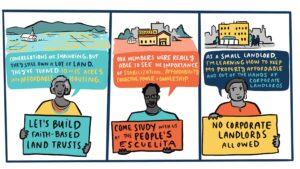
Yeah, I can start. At SAJE, we are a member-based organization, and a lot of the campaigns that we choose come from our members who primarily live in South LA, Southeast LA, and sometimes East LA. But we recently did popular education. So we did a people’s planning school –– we did an escuelita (little school) around disaster capitalism and what would South LA look like if a disaster hit. And it’s a difficult conversation to have with members, and we split up into separate groups, to talk about what would we need to be stabilized if another housing market crashed or if a fire happened in South LA. And I think our members really were able to see the importance of stabilization, monetary stabilization, affordability, the power in community land trust, the power, and collective ownership.
A lot of our members come to the US, and they have a dream of a single-family home. I mean, of course, right? And it’s hard to unlearn certain things, but once you start to hear about the benefits of a CLT, the benefits of a community opportunity to purchase act, or tenant opportunity to purchase act, I think that people see that obviously this would stabilize us. I think that these alternative models give people that chance to become financially stabilized, stabilize in their homes, to band together in an instance of disaster, to see their shared identity as tenants or people who are threatened by disasters or threatened by corporations. It was optimistic for me to see tenants and our members try this perspective on because it was a little different than probably what they came in thinking they wanted to learn about.
ANDREA PORTILLO
Yeah. Just even having conversations or spaces where folks are even open to other models, other ways in which we can think about housing, I think it opens folks’ minds to different possibilities and ways in which we can, as community, take more control, have more autonomy, decision-making power of our housing.
STELLA ADAMS
In North Carolina, we’ve been doing land trusts forever, but we’re also starting to see faith-based models. As congregations are shrinking, but they still own a lot of land, we’ve been seeing churches that have ten or fifteen acres turn that into affordable housing development. There’s a church in Greenville, North Carolina, that has built 150 townhomes, two and three-bedroom townhomes for $200,000 to $250,000. The church, through partnerships with different entities, has $100,000 down payment assistance, which makes the home affordable for folks who can afford a $150,000 home. And so seeing these creative models where churches are stepping in, using land they own to create affordable home ownership, partnering with the city and large employers in the community to create the down payment assistance program. And a couple of the local banks, through their CRA commitment, did a match that created that opportunity to get up to that $100,000 in down payment assistance that made it affordable for teachers and firemen, and in Greenville, where there’s a major hospital for nurses and doctors. And so there are different models there. People are being creative. What we need to do is kind of figure out how we find these creative opportunities and scale them?
AUDREY ARADANAS
Miami Homes for All is working with smaller landlords and developers and providing them with hands-on technical assistance so that way we can prevent corporations and LLCs from coming in and purchasing up their properties. And we’re helping them ensure that they keep their properties at affordable rates when they rent them out. But while we’re doing that, we’re also engaging the greater communities surrounding it. And so what that means is we’re partnering with CBOs, community-based organizations in the area, so that way they understand, development will happen, but how do we make sure that you all have a voice in that development so that way you all could provide feedback and ensure that the communities are preserved, that the culture of each community is preserved.
This is how we want to make sure that as development happens, that you all are inherently involved and authentically involved, not just like, “Here, here’s a community charrette,” which happens a lot of the time. I tend to liken ourselves as behind the scenes, working with different municipalities and government entities, informing how they do their administrative policies. I think Iris and Stella kind of alluded to this, at the end of the day, that’s how a lot of these things are happening. It’s behind closed doors, it’s not really transparent, and we’re trying to flip that. And so it’s a matter of how do we work with all of these folks to kind of shine a light, but also increase transparency and all that.
FINDING HOPE & INSPIRATION IN THE FIGHT FOR HOUSING JUSTICE
ANDREA PORTILLO
Yeah. Thank you for that. I’d love to end on a more uplifting note and hear a little bit from you all about what is bringing you all hope or inspiring you all to keep doing this work and to keep pushing against these pressures and ensuring that housing really is for the folks that we’re engaging with and that need it the most.
AUDREY ARADANAS
I think what’s been giving me hope is these kinds of conversations that are happening, that we are learning from each other and partnering with each other so that way we are learning from past mistakes and kind of pivoting and innovating new solutions and priorities that work better for us. So Iris brought up really cool initiatives to empower tenant rights and all of that, and Stella brought the same of like, how do we create development practices to push things forward. And I think that each of us can learn from each other and try to adapt to each community, and then also figure out what to do next. Because I think as long as we continue having conversations like this things will eventually change. I mean, I think Stella is up in the mountains, right? And so a river doesn’t just flow right through immediately. It starts out as a drop through a mountain.
I think there’s a beauty in that. Nature takes its course. We as mankind can do the same in changing for the better.
STELLA ADAMS
And I get hope from watching communities take stands for themselves. I’ve not seen a community that’s just taken it, just acquiesced to this. People are fighting these corporate entities, they’re fighting against this disaster capitalism. They are trying to keep their communities, keep their culture, keep affordability. Housing is so fundamental because houses become homes, and homes are fundamental to who we are as human beings. It doesn’t matter whether we’re living in a mansion or we’re living ina shotgun shack. It’s our home, and we value it, and we want to preserve and protect it, and we want the opportunity for home ownership. But we also want to have a roof over our head that we can afford, where we can live and thrive. And I see people advocating on a daily basis in their communities for their communities. I see tenants in public housing fighting to get the housing authorities to do right by them. I see teachers and firefighters struggling to protect our communities, protect our health, but they need us. They’re worried about whether they have a roof over their heads at home. And so I have hope that we, as advocates, will be working in tandem with people in the communities to bring this to the attention of those who can make the changes, which are the politicians at the local, state, and federal level. So y’all give me hope.
IRIS CRAIGE
I think, yeah, I’d say the same thing. I think that these conversations are so important. I’m really grateful to hear such different perspectives from people who live in really different places. We share the same hope. Our members fill me with a lot of hope. A lot of them are undocumented or precariously documented, and they still show up as best they can to organize for their rights, for the rights of others, for those who have to stay home, and they can’t show up for it. There’s a lot of power that is rising even out of Altadena. A lot of people have come to take their power. They’re forming tenants unions, they’re forming new community land trusts. There are a lot of new, hopeful, good, powerful things that I think couldn’t happen without these conversations and couldn’t happen without the education and the knowledge of people like Stella who’ve been in the work for a really long time. So yeah, I’m so grateful to have that opportunity to hear from folks and their perspectives and to see our members show up for everything. It’s incredible.
CLOSING
ANDREA PORTILLO
Yeah. I think that’s a great way to end our conversation. I want to extend a big thank you to the three of you all, Audrey, Iris, Stella, for joining me for this conversation today. Thank you for the amazing work that you all do and the communities that you serve. Is there anything that y’all would like to plug or anything that you would like to uplift or highlight? Anything that’s upcoming, or how can folks stay engaged with the work that you’re doing?
STELLA ADAMS
Iris and I will be at the Fair Housing Conference in San Diego, February 12th through the 14th, where we’ll be having this conversation around corporate landlords and disaster capitalism in front of a fair housing audience. And we’re going to be highlighting what’s going on in Altadena and talking with advocates out there about solutions. So I just want to highlight that this conversation continues, and the sisterhood is building.
IRIS CRAIGE
Yeah. Thank you for that opportunity, Stella. I’m really looking forward to it. I guess I’d plug our website, and if you’re a South LA resident, join SAJE, come on down. We’d love to have you on saje.net. We put out a lot of policy analyses. We update on what just happened in the city. Should you want to know on a local LA level, we are always putting our opinion out there.
AUDREY ARADANAS
Check us out online, miamihomesforall.org. And we’re trying to change Miami for the better and ensure that every Miami-Dade resident has a safe, affordable place to call home. And again, thank you so much, LibGen, Stella, and Iris. So appreciate all the work that you guys are doing.
ANDREA PORTILLO
Great. Thank you. And thank you for listening and for more conversations like this one, visit forgeorganizing.org. And for more about Liberation in a Generation, you can check us out at liberationinthegeneration.org, and you can also learn more about the work that we are doing there as well. So thank you so much, y’all.