Section 230 of the Communications Decency Act has drawn the ire of Democrats for years—but without it, decentralized mass protest would be near-impossible.
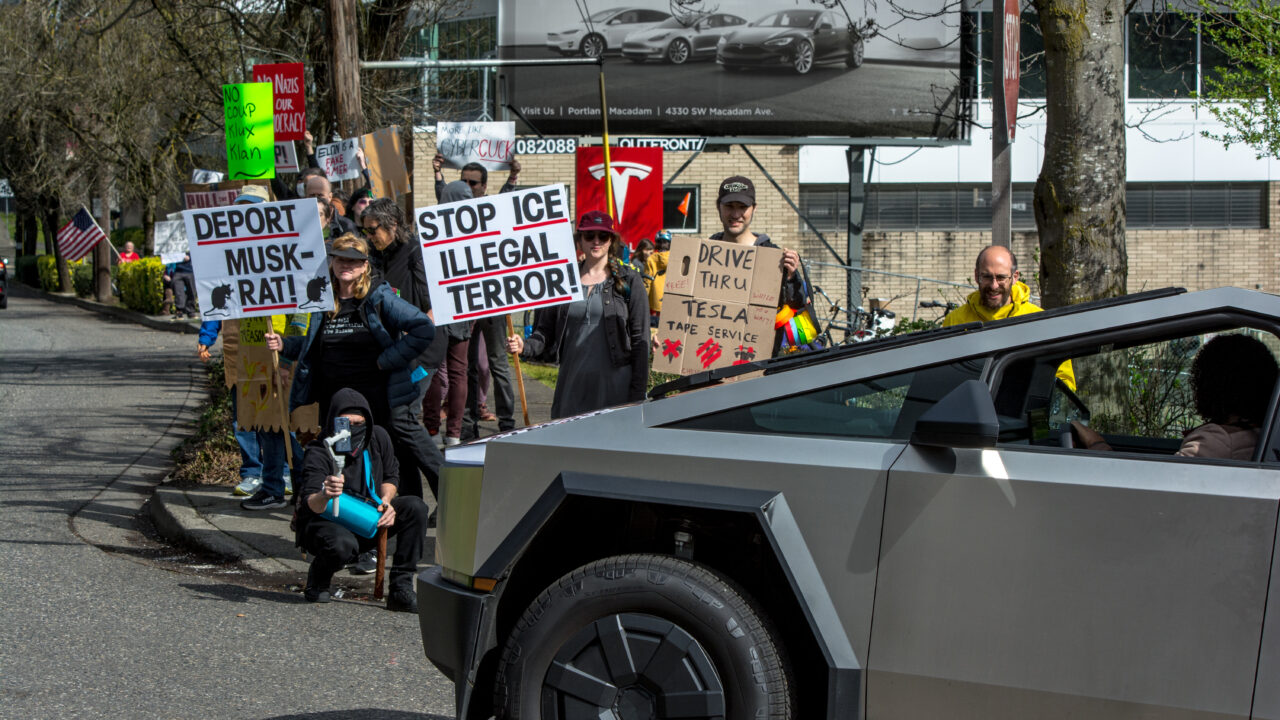
The US protest movements of 2025 will be characterized as broad efforts across cities and states to deliver a coordinated message. Whether the call was for ”No Kings” or to push ICE out of a community, to demand an end to Israel’s genocide in Gaza, to hold Congress to account for broad cuts to social services such as Medicaid, or to drive down the stock prices of Tesla in a rebuke of Elon Musk, these rallies had one thing in common: people organized them on the Internet.
This spring, my organization’s allies at Repairers of the Breach took to the capitol rotunda to begin a series of “Moral Mondays” sermons demanding basic human decency and assistance for poor people across the United States. In a strikingly aggressive response, capitol police arrested religious leaders and forced supporters and press to leave the area.
Such a response made clear the stance of Republican leadership when it comes to activists calling them out: they don’t want to be held to account. Undeterred, Repairers of the Breach have continued to organize their direct actions and promote them with open invitations on social media. A key to organizing direct action of any kind in the 21st Century, these posts and videos of the sermons, in which religious leaders decry elected officials’ abandonment of the poor and vulnerable, have been shared widely.
Meanwhile, an international movement of organizers and activists used the internet to effect a major financial rebuke to Elon Musk, one that clearly motivated his departure from DOGE. Called Tesla Takedown, this group used big tech social media platform Instagram and small tech Bluesky, a competitor to Musk-owned X, to recruit new organizers, coordinate, and share information. By and large, Tesla Takedown’s movement was against tech oligarchy, as personified by Elon Musk.

The way both groups organize online illustrates this crucial point about the state of the internet today: large swaths of our digital lives may have morphed into instruments of surveillance increasingly weaponized by tech oligarchs, but the internet also remains the crucial medium through which we organize resistance loud enough to count.
Online organizing is enabled by the fact that most speech is generally allowed on social media platforms. Instagram doesn’t have to worry that it’s going to be sued by Donald Trump or Elon Musk for Tesla Takedown protesters sharing a flyer or what a Reverend says in a sermon, because Section 230 of the Communications Decency Act shields the Instagram platform from that liability.
Section 230 is ‘90s internet legislation. It was passed after courts ruled that news site comment sections and early social media platforms could be sued for letting people say what they want online. Before Section 230, courts decided that these sites had to either allow any and all speech—including doxxing, spam, hate speech, and threats—or face lawsuits any time someone says something a wealthy person doesn’t like on their website.
Legislators wanted to let these platforms moderate posts and comments without having to be on top of the nuance of literally everything their users post, and so they passed what is often referred to as the “first amendment of the internet.”This law has shaped a lot of how the internet works here in the US, including activists’ expectations that they will be able to use social media to invite their friends and neighbors to picket with them at a Tesla dealership or attend a sermon at the Supreme Court building.
However, even as these movements grew, Democrats were working to end the ability to speak out and organize on social media—by repealing Section 230. Trump and Musk showed everyone their playbook when they arrested religious leaders and characterized the Tesla Takedown movement as “terrorism”—telegraphing that they would be all too eager to sue protest off the internet.
On the heels of a day of action that saw around 300 coordinated, global protests, sixty Tesla Takedown organizers penned a letter to Democratic leaders on forthcoming legislation that would end Section 230—and they asked Democrats to leave it alone. They wrote: “Without this law to protect our online speech and communities from censorship, we would never have been able to coordinate our movement on such a scale. Instead, the social media platforms we used to share information would have deplatformed us, for fear of being sued by Elon Musk or his supporters.”
Tesla Takedown is a movement against the very tech oligarchy and Big Tech monopolies that Democrats are ostensibly targeting with their Section 230 repeal efforts. Such grassroots movements are invaluable in the battle for not only Big Tech accountability, but in the fight for an Internet that does not stand in the way of resilient democracy and community well-being.
But whereas protesters are taking successful strategic action, Democrats’ response to Big Tech appears to be largely rooted in the Politician’s Fallacy.
The Politician’s Fallacy posits that many politicians only want to be seen doing something, regardless of the substance or impact of their action: “Something must be done. This is something. Ergo, we must do it.” In the case at hand, politicians see that beating up on Big Tech is very popular and that the harms of Big Tech are very real—they are right that something should be done. Repealing Section 230 would let a lot of people and institutions sue Big and small Tech platforms alike for speech that they host, and yes—that is something. But they should not do it.
Why? Because they have not thought critically about who in this country decides what speech is criminalized or who has the resources to mount thousands of lawsuits—and they have not looked at the impacts of their last change to Section 230.
The powers that choose what speech is protected in the United States exist on multiple levels. But it is the state level that is most concerning if Section 230 falls: should the legislature of Texas or Florida decide to criminalize all reproductivehealthcare speech or racial justice speech, it is highly possible that such speech won’t just be censored in Texas or Florida—but censored across the board throughout the United States to ensure that residents don’t use a VPN or other tech tools to bypass censorship and create liability for the corporation. We know that platforms will have conservative, risk-averse reactions because of what happened last time Democrats and Republicans united to change Section 230, in a pair of bills known as SESTA/FOSTA.
SESTA/FOSTA were bills that purported to ban human trafficking from the internet. What they resulted in was mass censorship and deplatforming of sex worker communities. This happened because social media platforms cannot differentiate between a consensual sex worker using the internet to vet clients, offer remote options, and keep themselves safe—and a human trafficking victim.
Sex workers are one of the most marginalized communities in the United States. After SESTA/FOSTA forced lifesaving resources and tools for sex workers to be purged by lawsuit-leery social media platforms, sex workers reported increased violence from clients. Moreover, a US Government Accountability Office report revealed that SESTA/FOSTA has never helped government prosecutors pursue criminal restitution for a sex trafficking victim. Sex workers and human rights advocates have repeatedly lobbied for the Safe Sex Workers Study Act, so that Congress would better understand the impacts of modifications to Section 230 and consider repealing a bill that has done great harm and no good. Unfortunately, Congress seems uninterested in learning from its mistakes.
What the arc of these movement stories tell us is that, should Section 230 be wholesale removed, it’s likely many or even most efforts to organize for marginalized communities and take political action will be proactively censored by Big Tech’s AI and content moderation dragnet. Blanket censorship minimizes the number of suits these corporations have to face.
It’s also worth noting that Section 230 further serves as a liability shield against SLAPP suits from public figures with deep pockets. Elon Musk in particular has already shown a propensity for suing away speech he doesn’t like—as with his action against Media Matters. Without the 230 safe harbor, academic organizations and journalists that publish fact- or research- based criticisms of wealthy people may be proactively banned in the same way as activists. What’s more, any news coverage of protests would also be fair game for automated censorship from Facebook, Instagram, TikTok, and X.
As to small tech like Bluesky, moderation demands have already forced them to shut down in Mississippi. Any savvy observer can do the math: a social media startup can’t weather lawsuits or moderate at the scale of one of the biggest tech companies in the world. So, if we lose Section 230, all the Blueskys will either go dark, or likely have to resort to not moderating at all—meaning that their online environment would be so toxic, flooded with hate and bots and disinformation, that no one would want to use it. Mark Zuckerberg has historically supported changes to 230 for reasons that could include his anti-competitive analysis. Meta has the deep pockets to moderate and litigate at scale if they want to take risks, but any up-and-coming Meta competitors would go broke.
The state of the internet today is a big problem that requires big solutions. Repealing one law is not a solution. If anything, it’s a punch that will miss tech oligarchs and land on those who want to hold them to account. For far too long, politicians have pulled the more-censorship-and-surveillance lever at the urging of Big Tech lobbyists, as if greater policing would stop the gaping wound at the heart of our digital lives.
Taking away even more human rights online—this time, the right to protest and critique—is not the solution. Instead, politicians should commit to the hard work of restoring human rights and dignity.
Restoring our right to privacy, so that our digital documents and movements are as private and protected as physical ones, would go far to combat the toxic digital panopticon that forces us into manipulative online echo-chambers. Breaking up tech monopolies would allow small businesses to grow and find their niche serving the rainbow of the Internet. Incentivizing interoperability and robust, fine-tuned user controls would let everyday people decide what they let into their homes and their minds.
And, most importantly, addressing the core social ills that prevent human thriving in every sphere, including healthcare, high quality education, living wages, and stable housing for all would alleviate so much of the suffering and toxic strife that mars our experience of each other and the world. In the face of this higher call, unraveling the Internet’s first amendment is not only wrongheaded, but a cop out at a moment when we need Democrats to finally step up.